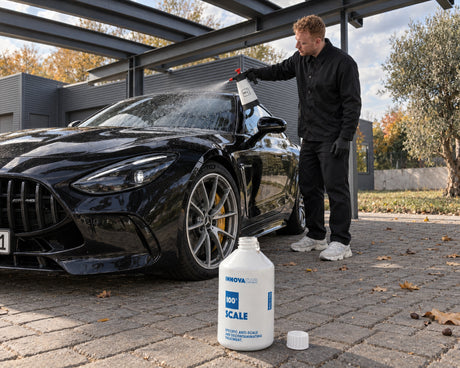
Togliere le macchie di calcare dai vetri dell'auto senza graffiarli
Daniel von Detailing1 |


GYEON
Q²M TireApplicator applicatore per pneumatici per la cura gomme


Soft99
Pitaspo Tire Sponge Spugna pneumatici
Spugna gomme innovativa per una cura ottimale

Meguiars
Tyre Dressing Applicator Pad – tampone applicatore per pneumatici
Pad sagomato per stendere il dressing gomme in modo uniforme
Applicatori per pneumatici: gli applicatori stendono la cura sulle spalle adatte. Forma dell'impugnatura e materiale di contatto ti fanno seguire la curva e stare lontano dalle superfici intorno.
L'applicatore si sceglie sulla geometria dello pneumatico e sul prodotto di cura; battistrada e freni non sono il posto dove stendere.
Troppa scelta in Applicatori per pneumatici? Fatti aiutare a scegliere:
With the applicator, you control the amount and the application area. If sprayed directly, the mist lands on the rim, brake disc, and wheel arch, which is why you hold a cloth between the tire and the rim when doing so. You can also spray a product onto the applicator and then distribute it; this is cleaner and allows you to control the amount.
Apply a small amount of product in a thin layer using an applicator, remove any excess shine with a clean cloth, and let the dressing dry before you drive. Anything just sitting on the surface will be thrown by centrifugal force onto the wheel arches and rocker panels. Silicone- and solvent-based dressings tend to do this more than water-based ones.
That depends on the sidewall height. GYEON recommends the Q²M TireApplicator in Small (40 × 65 mm) for tires with a low profile and Large (60 × 100 mm) for high sidewalls, such as on SUVs. If you maintain tires with both low and high profiles, get both sizes.
Just enough to cover a section of the sidewall. Apply the gel directly onto the foam as GYEON intends, distribute it, and only then add more if needed. A second thin layer is better than a thick first one, because excess shine on the rubber will later end up as splashes on the car.
Yes, as long as the foam remains dimensionally stable. GYEON's advice for the TireApplicator is to rinse it after use or replace it as needed. If the foam becomes hard, sticky, cracked, or frayed at the edges, it will no longer distribute evenly and should be replaced. Always use the same applicator for the same type of dressing.
Not on paint or the interior, because silicone oil from the dressing migrates with the foam and can later interfere with a sealant. If your dressing is also approved by the manufacturer for exterior plastic, use a separate pad for that. For wax and care products, there are foam applicators.
Daniel von Detailing1 |

Daniel von Detailing1 |

Daniel von Detailing1 |

Daniel von Detailing1 |

Jasper von Detailing1 |

Daniel von Detailing1 |

Daniel von Detailing1 |

Daniel von Detailing1 |

Jasper von Detailing1 |

Jasper von Detailing1 |

Daniel von Detailing1 |

Daniel von Detailing1 |