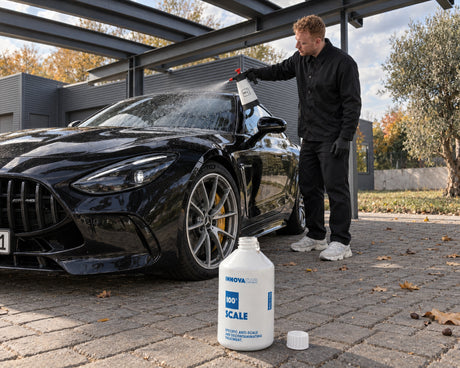
Togliere le macchie di calcare dai vetri dell'auto senza graffiarli
Daniel von Detailing1 |


FLEX
"ORE 3-150 EC 230/CEE" Levigatrice Rotorbitale 3mm Ø150mm
Levigatrice rotorbitale 400W, orbita 3mm, freno platorello, Ø150mm
FLEX
"ORE 5-150 EC 230/CEE" Levigatrice Rotorbitale 5mm Ø150mm
Levigatrice rotorbitale 400W, orbita 5mm, freno platorello, Ø150mm
FLEX
"OSE 2-70x198-EC" Levigatrice Orbitale 70×198mm
Levigatrice orbitale 260W, brushless, 4 velocità, 70×198mm
Levigatrici: le levigatrici muovono gli abrasivi adatti sulla superficie. Orbita, forma della macchina e aspirazione adeguata si scelgono su superficie, materiale e grana che vuoi ottenere.
Macchina e abrasivo sono un sistema; una guida uniforme e il controllo di quanto togli restano decisivi.
Troppa scelta in Levigatrici? Fatti aiutare a scegliere:
For individual paint defects in the clear coat, an eccentric sander with a 3 mm stroke is suitable because it leaves a fine sanding pattern. For filler and primer, a 5 mm eccentric or an orbital sander are appropriate. Tape off edges and beads, and after sanding, always follow up with polishing using a polishing machine.
The eccentric sander rotates a round disc while simultaneously oscillating it on a small circular path, which results in an even sanding pattern on surfaces and paint defects. The orbital sander moves a rectangular plate—70 × 198 mm with a 2 mm stroke for FLEX—and levels filled areas flat right up to the transitions.
For work on the clear coat, use a 3 mm stroke, because the shorter distance per oscillation sands flatter and leaves less work for the polish. The 5 mm stroke removes more material and is suitable for filler, primer, and larger surfaces. FLEX manufactures both with 8,000 to 20,000 strokes per minute and a Ø-150-mm disc.
No, it is not built for that. The stroke, speed, and disc of a sander are tuned to abrasive media; polishing machines work with different values, such as 15 mm free-running for the FLEX "XFE 2 15 18-EC". The sander flattens the defect, and the eccentric polishing machine then restores the shine.
Only if the manufacturer expressly approves the machine for it, as electrical devices and water do not mix. We do not have such an approval for the FLEX sanders in our range. Therefore, you should sand individual paint defects wet by hand, using P2500 sanding discs on the Koch-Chemie hand block for sanding discs.
Tape off edges, beads, and curves, as the paint is thinner there and the disc exerts more pressure. Start with a fine grit—3M recommends P1000 or P1200 for runs—and only sand until the area is uniformly matte. Wipe off and check between stages. Only sand fresh paint once it has cured.
Daniel von Detailing1 |

Daniel von Detailing1 |

Daniel von Detailing1 |

Daniel von Detailing1 |

Jasper von Detailing1 |

Daniel von Detailing1 |

Daniel von Detailing1 |

Daniel von Detailing1 |

Jasper von Detailing1 |

Jasper von Detailing1 |

Daniel von Detailing1 |

Daniel von Detailing1 |