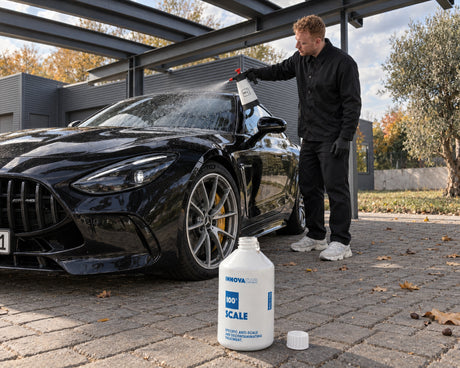
Togliere le macchie di calcare dai vetri dell'auto senza graffiarli
Daniel von Detailing1 |


Koch-Chemie
Masking Tape "50m" (Nastro Senza Residui)
Nastro di mascheratura preciso e senza residui
Nastro carrozziere: il nastro carrozziere copre bordi e pezzi vicini dove serve. Larghezza, tenuta della colla e fondo decidono la scelta; i rivestimenti delicati vogliono un occhio di riguardo.
Il nastro si sceglie per il lavoro che hai davanti, così a fine lavoro viene via come previsto per quel prodotto.
Troppa scelta in Nastro carrozziere? Fatti aiutare a scegliere:
For polishing, use masking tape: a thin adhesive tape that conforms to seals and contours and creates a sharp edge. In our range, we carry the Koch-Chemie Masking Tape "50m" as a 50-meter roll, described by the manufacturer as removable without leaving any residue. To see which width fits which component, check out masking tape by width.
Masking is mandatory wherever polish could cause damage: unpainted plastic, rubber seals, gaps, and thinly painted edges or moldings. Painted emblems and add-on parts do not necessarily require tape if you have steady machine control. As a beginner, it is better to mask too much; with experience, you can stick to just the zones that cannot tolerate polish.
Painter's tape is designed for clean paint edges when painting walls, not for the friction and heat generated by a polishing machine. Forums are full of reports about tape residue left on paint and seals, especially after exposure to heat or if left on for too long. Duct tape and heavy-duty tape are even less suitable because their adhesive softens and transfers onto the paint.
Remove the tape as soon as the component has gone through all polishing stages, not just at the end of the day. Pull it flat, almost parallel to the surface, slowly and in one smooth motion so that the paint edge is not stressed. Afterward, re-mask the adjacent component so that the previously covered edge can also be polished.
As short as possible, ideally only for the polishing process on one component. Heat and sun soften the adhesive, and the longer the tape remains, the more likely it is to leave residue behind. According to Google Trends, interest in car polishing reaches its peak in August. Tape should never be left on a car overnight or outdoors for days.
A masking tape described by the manufacturer as residue-free can be peeled off cleanly after a polishing cycle. Residue primarily occurs due to being left on too long, heat, or unsuitable tapes. If any residue does remain, an adhesive remover like Koch-Chemie Eulex "Eu" will dissolve the remnants. Always test on an inconspicuous area first if working on fresh repair paint.
Daniel von Detailing1 |

Daniel von Detailing1 |

Daniel von Detailing1 |

Daniel von Detailing1 |

Jasper von Detailing1 |

Daniel von Detailing1 |

Daniel von Detailing1 |

Daniel von Detailing1 |

Jasper von Detailing1 |

Jasper von Detailing1 |

Daniel von Detailing1 |

Daniel von Detailing1 |