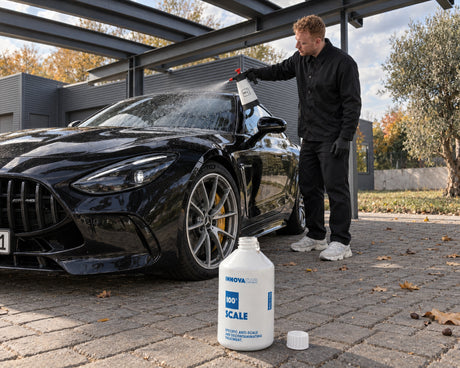
Togliere le macchie di calcare dai vetri dell'auto senza graffiarli
Daniel von Detailing1 |


Dr. Wack "CW1:100"
CW1:100 "Gel rimuovi insetti" rimuovi insetti
Gel rimuovi insetti che aderisce su vetro e frontale, non cola
What is an insect remover? A specialized cleaner that chemically dissolves dried insect remains on the windshield and front end, allowing you to wipe them off instead of scraping them. The Dr. Wack CW1:100 is an adhesive gel available in three sizes from 100 to 750 milliliters, safe for paint and specifically designed for the front of the vehicle.
Insect removers are specialized cleaners that dissolve the proteins in dried insect remains rather than removing them mechanically. A short dwell time softens the crusted layer, after which you can wipe it off with a damp cloth without straining the sensitive clear coat with pressure. These are not all-purpose cleaners and do not replace a full car wash; instead, they serve as a targeted pre-treatment for the critical front section.
Expert tip from Detailing1: We often see the gel sprayed onto a hot windshield in direct sunlight. The gel then dries before it can take effect, forcing you to scrub twice as hard. Park the car in the shade, let the front end cool down a bit, and work area by area so that the gel stays moist and can make use of its 1 to 3-minute dwell time. Never rub over a dry crust; always dissolve it first.
Such a product is a specialized cleaner that specifically solves the problem of the front section: baked-on insect remains that a normal car shampoo can no longer handle.
Chemically speaking, insect remains are protein-based contaminants. As soon as they dry on a warm hood or a sun-drenched windshield, they form a crust and bond with the surface. A classic pH-neutral shampoo is designed for road film and loose dirt, not for these stubborn protein crusts. This is exactly where such a specialized cleaner comes in: its surfactants and alkaline components break down the protein structure and soften the crust enough that it can be removed with a damp cloth.
The crucial point is protecting the clear coat layer. Anyone who scrapes off dried insects with a dry rag or even a fingernail leaves behind fine micro-scratches that appear as dull streaks in raking light. A targeted dissolver replaces mechanical action with chemistry: you dissolve instead of rubbing. On the windshield, this is a matter of comfort; on the painted area, it is a genuine form of paint protection that, over the years, makes the difference between a smooth hood and one covered in holographic scratches.
There is also the safety dimension. A windshield smeared with insects scatters light in low sun and reduces visibility, especially on the highway after long summer stretches. Such a product quickly restores clear visibility without you having to spend minutes scrubbing the windshield with a sponge. It is therefore less of a cosmetic product and more of a functional tool for the hottest time of the year.
When the need arises depends on distance and season. Between May and September, on nocturnal country road trips, and near bodies of water or fields, the thickest insect film accumulates. One or two longer trips are enough to leave the windshield covered. A normal gas station stop with a squeegee usually just smears the remains. This product category is made exactly for this gap between ongoing wiper fluid maintenance and the next thorough wash: fast, targeted, and without the need to handle the entire car.
>>These cleaners come in three forms, which do not differ in their basic effect, but in their adhesion and application.
The thin spray is the classic form. It can be applied quickly and distributed over large areas, but it runs off immediately on vertical surfaces like the bumper. As a result, it loses part of its dwell time exactly where insects are most concentrated. It is usable for horizontal hoods, but less so for the vertical front end.
Gel is the answer to this problem. A thickened consistency, such as the one found in the CW1:100 Insect Remover Gel, remains adhered to the surface after spraying instead of running off. This gives the product time to take effect, even on the bumper, radiator grille, and headlights. You need less product per spot because almost nothing runs down the paint unused. The gel is the most precise of the three forms when it comes to targeted front-end treatment.
The third form is the concentrate for the wiper fluid. It removes fresh insect film continuously while driving as soon as the wipers are running, but reaches its limits with already baked-on crusts. Concentrates like the other CW1:100 windshield cleaners are for long-term maintenance, while the gel is the targeted spot cleaner. Those who combine both cover everyday film and stubborn individual cases without trying to force one product to perform two different tasks.
A fourth form you will see in stores is the soaked non-woven or sponge cloth with an integrated layer of cleaner. It is practical for on-the-go use at the gas station, but it is only suitable for fresh, light deposits. It lacks the necessary dwell time to tackle baked-on crusts because you are rubbing immediately instead of dissolving, and it is precisely this rubbing that you want to avoid on the paint. It is an emergency solution for your pocket or center console, but for thorough front-end cleaning at home, the adhesive gel remains the superior form.
>>When choosing the right product, three criteria count for more than the packaging: adhesion, paint compatibility, and the appropriate container size.
Adhesion determines how much of the dwell time actually lands on the insect crust. A product that runs off the bumper in seconds cannot let its surfactants work. An adhesive gel keeps the active ingredients on the dirt until it is soft. Therefore, the consistency is not a minor aspect, but the core of the performance on the vertical front end. Anyone who mainly treats the windshield and bumpers is clearly better off with a gel than with a thin spray.
Paint compatibility is the second criterion and is non-negotiable, especially on the painted front end. Such a cleaner inevitably comes into contact with clear coat, plastic, and headlight lenses. The CW1:100 Insect Remover Gel is guaranteed to be paint-safe according to the manufacturer, so you can use it on the hood, bumper, and plastic parts without worry. For every product in this category, ensure it is explicitly approved for painted surfaces, not just for glass.
The third criterion is the container size, tailored to your driving frequency. For the occasional driver, the small 100 ml bottle for the glove compartment is sufficient for a quick on-the-go solution. Those who regularly drive longer distances are well-served with 500 ml for a whole season. Frequent drivers or multi-vehicle households should opt for the 750 ml container, which offers the most front-end treatments per milliliter. Three sizes, three driver types, one and the same proven gel.
A fourth, often overlooked criterion is the nozzle design. A spray head that delivers a fine, directed stream applies the product to the dirty area precisely, rather than distributing it as a mist over the entire front. Especially on the vertical bumper, this determines whether the product lands where the insects are or disappears into the gap under the license plate. When buying, therefore, do not just look at the formula, but also ensure that the sprayer doses the product rather than atomizing it over a wide area.
>>The correct application determines the result. The most common mistake is haste; the second most common is the wrong time of day.
First, park the car in the shade and let the front end cool down a bit. On a hot, sun-exposed surface, the gel dries before it can act. Then spray the product directly onto the insect-infested areas and let it sit for 1 to 3 minutes. During this time, the surfactant effect softens the crust. Afterward, remove the gel with a damp microfiber cloth or a soft sponge and rinse with clean water. A single wipe is usually enough if the dwell time has been observed.
Work through the front systematically: windshield, hood, bumper, radiator grille, and the headlights with their plastic lenses. Because the gel does not run off, you can treat vertical surfaces just as effectively as horizontal ones without the product disappearing immediately. Treat area by area instead of spraying the whole car at once so that nothing dries before you get to wipe it off.
For light contamination, one pass is sufficient. If the remains are heavily baked on and set by the sun multiple times, apply the gel a second time and give it more time instead of rubbing over the paint with pressure. Two patient passes are gentler on the clear coat than one forceful one. Before going to the car wash, the gel serves as a pre-cleaner for the front end: you dissolve the crusts, and the car wash then removes the rest. This is how you get the best out of both methods.
A final step determines the finish. After wiping, check the windshield in raking light and go over it again with a dry microfiber cloth so that no cleaner residue remains. On the painted front, ideally apply a spray sealant or quick detailer after the insect treatment, as cleaned paint is particularly receptive to protection. Anyone who incorporates this intermediate step keeps the front clean for longer because the next generation of insects will adhere less effectively and be even easier to remove the next time.
>>Our choice in this category is the CW1:100 Insect Remover Gel from Dr. Wack, based in Ingolstadt. A product that consistently capitalizes on the gel form.
The CW1:100 Insect Remover Gel is a targeted dissolver with a gel consistency for heavily stressed front surfaces. Instead of running off immediately like a thin spray, the super-gel formula adheres to the windshield, hood, and bumper, dissolving the baked-on insect remains until you can remove them without effort. According to the manufacturer, the product is guaranteed to be paint-safe, and thanks to its adhesive consistency, it is economical because less is lost per spot compared to a running spray. It is available in three sizes: 100 milliliters for the glove compartment, 500 milliliters for the season, and 750 milliliters for frequent drivers.
Positioned within the brand: With the CW1:100 line, Dr. Wack considers the windshield and front end as a distinct discipline alongside cars, motorcycles, and rims, rather than treating them as a side product. Those who use the brand holistically combine the gel with the wiper fluid concentrates of the same line and complement it with the P21S cleaners for rims and paint, or stick with the A1 car care line for all-around needs. The formulas are stable over years and are Made in Germany, which makes the brand predictable: what worked last year works just as well this year.
An honest limitation belongs in this assessment. The gel is a specialist for insect remains, not an all-purpose or wheel cleaner. It is not designed to handle tar, tree resin, bird droppings, or baked-on mineral stains, and it does not replace a complete car wash either. It works specifically on the front end and solves exactly the one problem it was built for, but it does so reliably. Anyone expecting more is choosing the wrong product; those who have exactly this problem get a perfectly fitting tool.
>>The purchasing decision depends less on the brand and more on your driving profile and your expectations regarding paint protection.
If you drive a lot on highways and country roads in the summer and are familiar with the sight of a heavily smeared windshield, an adhesive gel is the right choice. It treats the windshield and painted front in one step, protects the clear coat from scrubbing, and manages the vertical surfaces where a spray fails. Grab the 500 ml bottle for the season or the 750 ml container if you maintain multiple vehicles or are on the road a lot for professional reasons.
Are you an occasional driver who only occasionally needs a quick solution for a few insects on the windshield? The small 100 ml bottle in the glove compartment is enough. It costs little, takes up no space, and is ready for use on the road. For ongoing maintenance while driving, supplement it with a wiper fluid concentrate that removes fresh film before it dries.
If you place special importance on the paint of your well-maintained vehicle, paint compatibility is the deciding criterion. In that case, a gel explicitly approved for painted surfaces, such as the CW1:100 Insect Remover Gel, is the safe choice because you can work on the hood and bumper without worry. Our practical recommendation: Keep a 500 ml bottle of gel in stock for the season and a small 100 ml bottle in the glove compartment. This way, you are thorough at home and fast on the road, and with the reliable Made-in-Germany formula from Ingolstadt, you know the result will be the same summer after summer.
Troppa scelta in Elimina Insetti di Dr. Wack "CW1:100"? Fatti aiutare a scegliere:
Daniel von Detailing1 |

Daniel von Detailing1 |

Daniel von Detailing1 |

Daniel von Detailing1 |

Jasper von Detailing1 |

Daniel von Detailing1 |

Daniel von Detailing1 |

Daniel von Detailing1 |

Jasper von Detailing1 |

Jasper von Detailing1 |

Daniel von Detailing1 |

Daniel von Detailing1 |