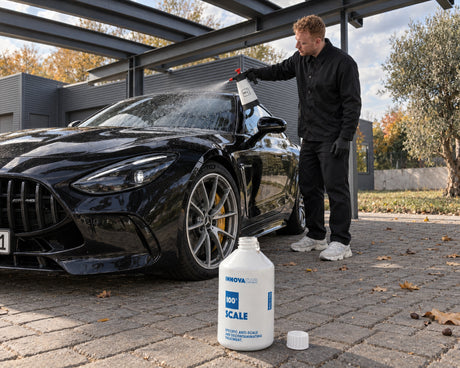
Togliere le macchie di calcare dai vetri dell'auto senza graffiarli
Daniel von Detailing1 |


Koch-Chemie × COLOURLOCK
Pulizia delicata e cura profonda sicura per anilina e nabuk
What is the COLOURLOCK Aniline & Nubuck Cleaner? A mild leather cleaner for open-pored leather without a protective top coat: aniline, semi-aniline, and nubuck. Fiber-friendly surfactants dissolve dirt and handling marks using as little moisture as possible, preventing dark rings from forming during the drying process — on car seats just as on sofas, bags, and shoes.
The COLOURLOCK Aniline & Nubuck Cleaner handles the most delicate task in leather cleaning: leather that lacks a protective pigment layer. COLOURLOCK "Aniline & Nubuck Cleaner" dissolves dirt, body oils, and handling marks from aniline, semi-aniline, and nubuck leather without soaking the absorbent fiber structure. The formula is backed by the repair expertise of leather specialists since 1995, now under the Koch-Chemie umbrella — and the method is the same for car seats as it is for sofas, bags, or saddles.
Expert tip from Detailing1: The most common mistake on open-pored leather is focusing only on the stain. We often receive inquiries about dark rings that are more noticeable after stain removal than the stain itself — almost always because the user rubbed locally and used too much moisture. Therefore: apply the cleaner sparingly to a soft cloth or sponge, never directly onto the leather, and always work the entire area from seam to seam instead of just the soiled spot. Then, let it dry slowly, without a hairdryer or direct sunlight. This allows the surface to dry evenly — which is exactly what prevents the ring.
Aniline leather is only dyed through, not coated: the pore remains open, the leather feels warm and natural, and it is noticeably breathable. This very openness makes it sensitive — a single drop of water soaks in within minutes and leaves behind a dark spot. Semi-aniline leather has a wafer-thin pigmentation and sits between these worlds, while nubuck is additionally sanded and has a velvety nap.
For cleaning, this changes everything. On pigmented smooth leather, a cleaner works on a closed color layer — whatever is too much stays on top and can be wiped away. Open-pored leather absorbs the same liquid like blotting paper: it travels into the fiber, carries dissolved dirt with it, and deposits it at the edge of the damp zone when drying. Anyone who has ever tried to quickly treat a stain with water knows the result: the stain is gone, but a new ring has appeared.
A drop of water in an inconspicuous area will tell you whether your leather is open-pored: if it beads up or stays on the surface, the leather is coated. If it soaks in and darkens the spot, you are dealing with open-pored leather. With nubuck, it’s even faster — run your finger over the surface: if the color changes like brushed velvet, the leather "writes." Only open suede shows this writing effect.
You will encounter this family of leathers wherever naturalness is the selling point: in furniture classics and vintage armchairs, in high-quality bags and jackets, in equestrian sports — and in cars, primarily in older premium interiors and special equipment. For semi-aniline, the simple safety rule applies: it reacts closer to aniline than to coated smooth leather. When in doubt, treat it as open-pored leather — the gentler method never does any harm, while the harsher one might.
COLOURLOCK "Aniline & Nubuck Cleaner" works with mild, fiber-friendly surfactants — detergent molecules that bind to dirt at one end and moisture at the other, lifting particles out of the fiber rather than rubbing them in. In other words: the dirt is lifted and transferred to the cloth before it can be pushed deeper into the open pore by pressure.
The second component is metered moisture. The formula works via capillary action — it uses the leather's fine absorption channels to mobilize dirt on the surface without flooding the fiber. You can tell by the result: the leather only becomes superficially damp during cleaning, dries back evenly, and subsequently shows neither dense, shiny spots nor hardened areas that would visually stand out later.
It should therefore never be applied directly to the leather, but sparingly to a soft cloth or sponge. For the first go at a bag or a single armchair, the 250 ml bottle is sufficient; anyone with a complete interior or a sofa set should reach for the 1000 ml / 1 liter size. If, on the other hand, your leather has a closed pigment layer — the standard in modern cars — then COLOURLOCK Leather Cleaners in Mild and Strong are the right choice; the Aniline & Nubuck Cleaner is the gentle specialty product alongside them.
For high-traffic zones — armrests, handling areas on bags, the seat of your favorite armchair — a two-step approach has proven successful: first clean the entire area mildly, let it dry completely, then work specifically on remaining spots. This way, the application remains uniform everywhere, and with aniline, you create the soft transitions that make the difference between "cleaned" and "stained." Two gentle passes beat one thorough one, without exception on open leather.
The dark ring is pure physics. As long as the leather is damp, liquid migrates through the fiber to the drying edge — and takes dissolved dirt and tannins with it. Where the moisture evaporates last, everything it carried remains behind. It is the same effect that leaves a ring in an empty coffee cup, only in the middle of your seat.
The counter-strategy is "area instead of spot." Clean from seam to seam — the entire panel, the entire seat element, the entire side of a cushion. This prevents a border between damp and dry from forming in the middle of the surface, and the drying line coincides with the seam, where it remains invisible. Working evenly and thinly beats thorough soaking, in any case.
From the daily experience at Detailing1, we can clearly name the second ingredient: patience while drying. Freshly cleaned open-pored leather will look darker and patchier when damp than it did before — this is normal and part of the process. Anyone who tries to speed this up with a hairdryer or direct, intense sun is accelerating the exact moisture migration they wanted to avoid. At room temperature, the surface will balance itself out as it dries.
Before the first use, a minute of caution is worthwhile: test the cleaner in an inconspicuous spot — under the edge of the seat, on the back, or in an inner fold. Open-pored leathers are dyed through, and older pieces in particular may release some color onto the cloth during cleaning. With this family of leather, this is not a product defect, but a material property; you just want to know about it before you work on the visible surface. If the cloth remains largely clean, work through the large areas panel by panel, without letting one panel dry before the next one is connected.
Before cleaning, nubuck should be dry-brushed or vacuumed. The reason is simple: loose dust lies on the velvety nap, and every damp cloth that passes over it massages it into the fiber. A soft leather brush or the upholstery nozzle will remove the loose layer in two minutes — only then is the cleaner worth it.
After drying, use the brush a second time. During cleaning, the fiber nap flattens; once brushed up, it stands upright again, and the velvety, matte look returns. This step determines whether cleaned nubuck looks like nubuck again or like dull, smooth leather.
The brush is also the best prevention against the typical nubuck decay: greasy, shiny seats and armrests. Grease shine occurs when skin oils and pressure flatten the nap — weekly dry brushing keeps it upright long before a cleaner is necessary. We clearly advise against household remedies like soapy water or steam for suede: too much moisture, no controlled drying, and ring formation occurs unchecked.
We regularly clear up one confusion: Alcantara looks like nubuck and feels similar, but it is a microfiber fabric, not leather. For steering wheel covers, headliners, and microfiber seat center panels, you should reach for COLOURLOCK "Pol Star", the cleaner concentrate for textile, leather, and Alcantara. The Aniline & Nubuck Cleaner remains the specialist for genuine, open-pored suede — both surfaces share the brushing routine.
To be honest: deeply absorbed grease is a job for absorption, not cleaning. An oil stain that has sat in an open pore for days can be loosened with surfactants but will then migrate back to the surface. For this, there is COLOURLOCK "Grease Absorber Paste": the paste draws the grease out of the fiber into itself over several hours, instead of spreading it over a large area.
Second limit: color. Cleaning does not bring back a faded area — the color depth that UV light has taken from an aniline or nubuck leather has been chemically altered, not soiled. This is where color refreshing with Nubuck Fresh comes in: it refreshes the tone of open-pored leathers once the surface is clean. The order is fixed — first clean, then refresh.
And the third limit must be stated: even the right cleaner often only fades old, deeply absorbed stains in light-colored aniline, without removing them completely. We have learned in our consulting to say this early on — some marks in open-pored leather are patina and remain. Anyone who wants a perfectly uniform surface is better off with pigmented smooth leather; open-pored leather pays for its naturalness with sensitivity.
Freshly cleaned open-pored leather is clean and unprotected at the same time. The pores from which dirt was just lifted are just as open to the next splash. Therefore, cleaning is followed by film-free care: COLOURLOCK Aniline Leather Care penetrates via capillary action with COLOURLOCK "Aniline Cream," stabilizes the fiber from within, and leaves the matte finish untouched.
We often hear the question about waterproofing, and the answer has two halves: protection yes, sealing no. Protection for open-pored leather must remain breathable and acts as a time buffer, not a suit of armor — spilled liquids stay on the surface longer and can be dabbed away before soaking in. A dense layer, on the other hand, would close the very openness that defines the character of this leather.
As for the interval, the most relaxed rule in the entire leather program applies to open-pored leather: clean when soiled, not according to a calendar. Over-conditioning makes the sensitive surface duller instead of more beautiful. What remains is the routine with the dry brush on nubuck — and a scrutinizing look at the contact areas where skin oils work: armrests, side bolsters, steering wheel rims, sofa edges.
In the end, the sentence that saves you the most stains on open-pored leather is not about chemistry: never clean the stain, clean the area. Anyone who works from seam to seam, doses sparingly, and gives the leather time to dry achieves with a single mild cleaner what most household remedies fail at — clean aniline and nubuck without a single new ring.
Troppa scelta in Detergente per anilina e nabuk di COLOURLOCK? Fatti aiutare a scegliere:
Daniel von Detailing1 |

Daniel von Detailing1 |

Daniel von Detailing1 |

Daniel von Detailing1 |

Jasper von Detailing1 |

Daniel von Detailing1 |

Daniel von Detailing1 |

Daniel von Detailing1 |

Jasper von Detailing1 |

Jasper von Detailing1 |

Daniel von Detailing1 |

Daniel von Detailing1 |