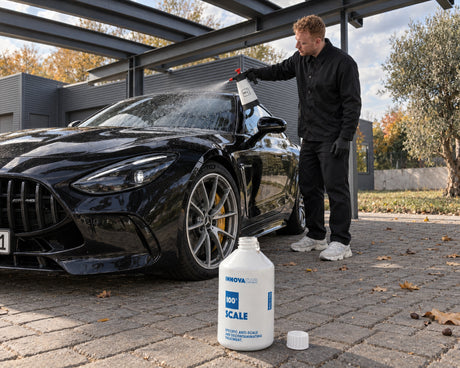
Togliere le macchie di calcare dai vetri dell'auto senza graffiarli
Daniel von Detailing1 |


Koch-Chemie × COLOURLOCK
COLOURLOCK "Leather Fixative" fissatore di colore contro lo sbiadimento dei colori al lavaggio
Fissativo colore per pelle lavabile: colore stabile e sicuro
Koch-Chemie × COLOURLOCK
COLOURLOCK "Leather & Fur Wash Concentrate" concentrato di lavaggio per pelle e pelliccia
Detergente concentrato pro per lavaggio delicato di pelle e pelliccia
What are COLOURLOCK leather detergents & color fixatives? A two-component system for washing leather jackets, motorcycle suits, and lambskins: a replenishing wash concentrate with mild surfactants for hand washing and delicate cycles up to 35°C, plus a color fixative that binds loose dyes before the wash cycle and prevents bleeding.
Leather detergents from COLOURLOCK answer a question that every washing machine manual leaves open: how do you wash leather and fur without ruining them both? This category consists of two products with clearly defined roles. The wash concentrate cleans washable leather and fur items while replenishing oils in the fibers instead of stripping them. The color fixative anchors loose dyes in the leather before the first drop of water can mobilize them. Both products originate from COLOURLOCK’s practical experience in leather repair, now under the umbrella of Koch-Chemie.
Practical tip from Detailing1: The most expensive mistake in leather washing happens before the wash—the missing color test. Rub a damp white cloth with some pressure over a hidden area, such as the inside of the collar or the hem. If the cloth picks up color, the leather is not colorfast, and the fixative bath is mandatory, not optional. We regularly receive inquiries about two-tone jackets and suits where black has bled into white—afterward, only re-dyeing helps, but a thirty-second color test beforehand would have been enough.
Leather handles water much better than its reputation suggests—what it cannot handle is the chemistry of regular laundry detergents. Full-duty detergents are alkaline and their surfactants break down fats, which is their job. However, in leather fibers, fats are not dirt; they are the lubricant between the collagen fibers—and that is exactly what they wash out. What remains is a piece that feels like cardboard and crinkles when bent.
COLOURLOCK's wash concentrate reverses this logic. It works with mild, leather-compatible surfactants and lanolin—the wool wax from sheep shearing, the same fat that keeps raw wool water-repellent and supple. During the wash, sweat, sebum, and road grime are dissolved, while at the same time, the fats are returned to the open pores. For you, this means: the jacket comes out of the drum soft and does not require days of post-treatment before it is wearable again.
Washing is for things that a surface cleaner cannot reach. A leather cleaner works on the surface—it is the right tool for installed car seats, steering wheels, and furniture. Sweat in the lining of a motorcycle suit, odors in a vintage leather jacket, or a heavily soiled lambskin go deeper: only washing through the entire material works here. This category exists precisely for these cases.
It is no coincidence that a repair specialist developed this detergent. Since 1995, COLOURLOCK has supplied detailers and saddlers who restore hardened, faded leather—and therefore knows both ends of the story: the incorrectly washed leather on the workbench and the formula that would have prevented exactly that.
The division of labor is strict: the leather wash concentrate cleans, while the color fixative secures the color. COLOURLOCK "Leather & Fur Wash Concentrate" takes on the role one expects from a detergent—just with a formula for skin rather than textiles.
The concentrate is explicitly formulated for both leather and fur. This sounds like a detail, but with lambskin, it determines the result: the hair side needs mild cleaning without matting, while the leather backing needs replenishment—a product that can only do one of the two will leave you with either dull fur or hard skin. Wash on a delicate cycle at a maximum of 35°C or by hand in lukewarm water, using a sparing dose.
COLOURLOCK "Leather Fixative" is used beforehand. The slightly acidic fixative attaches to loose, incompletely bound dye particles and anchors them in the top layer of the leather—without leaving a film or noticeably changing the feel. It is prepared as a bath before the wash cycle and is suitable for aniline, nubuck, and pigmented leathers; it can also be used as a standalone fixative for leather that bleeds dye even outside of the washing process.
The container sizes follow usage patterns. A single machine cycle requires about one-third to one-half of a small bottle of concentrate—so the 250 ml covers the jacket and lambskin you wash once a year. If you wash motorcycle gear for the whole family or take in washable leather items as a professional detailer, the 1000 ml / 1 liter size is much more economical. The same applies to the fixative: 100 ml for individual cases, the liter for regular use.
If you need both components for the first time, you don't have to put them together individually: the COLOURLOCK "Leather Wash Set" combines the wash concentrate and fixative in one package—the easiest introduction to your first machine wash.
To be honest: you can wash a single-colored, colorfast, pigmented leather with the concentrate alone—the color test from the practical tip is the deciding factor. The fixative bath becomes mandatory whenever colors are adjacent: dark seams on a light background, two-tone suits, or color-intensive inlays. And for open-pored leathers like aniline and nubuck, whose dyes are fundamentally weaker than in coated goods.
The mechanism behind it is simpler than it sounds. In every dyed leather, some of the dyes are loose—not fully bound into the fiber, and mobile as soon as water and surfactants are introduced. The fixative binds these exact particles before the wash sets them in motion. You can tell it worked if the wash water remains clear instead of taking on the color of the jacket.
The limits are just as clear. The fixative stabilizes existing pigments—it does not refresh faded areas or cover worn spots. That is the job of the COLOURLOCK dye line, not the laundry shelf. What we at Detailing1 see again and again: those who expect both in one step are better advised to re-dye after the wash than to hope that the bath will bring color back on its own.
The procedure in summary: First, check washability—label, manufacturer instructions, or the manufacturer themselves in case of doubt. Then the color test, the fixative bath if necessary, followed by the wash on a wool or delicate cycle at a maximum of 35°C, without a high spin speed. Hand washing in a tub works the same way, just with more patience for rinsing.
High-stress areas benefit from a pre-wash. Collars, cuffs, and lining edges collect sweat and sebum over the years—in a normal wash cycle, this ingrained dirt simply stays put. Before machine washing, these areas should therefore be specifically pre-treated with the concentrate and a soft brush. Two minutes of manual labor that determine whether the collar is clean after washing or was merely wet.
The 35°C is not a recommendation, but a limit. Leather is protein: above this temperature, protein structures begin to coagulate—the same process that makes an egg solid in boiling water, and just as irreversible. Leather washed too hot shrinks, warps, and remains hard, no matter how good the detergent was. In other words: the temperature button on the machine is the most important control in the entire leather washing process.
We often see that the washing is successful and only the drying ruins the result. Leather and fur should be dried lying flat, pulled into shape, at room temperature—never on a heater, never in the sun. While drying, move and knead it occasionally so the fibers learn to slide against each other instead of hardening while stuck together; gently brush out furs after drying. The first time, the leather may feel stiffer than expected when semi-dry—that is normal and disappears with kneading.
After the wash is before the care: freshly washed smooth leather is particularly grateful for a thin layer of COLOURLOCK leather care—it replaces the surface fats that even the gentlest wash removes from the exterior.
The classic advice for lambskins is to use wool detergent with lanolin—it is not wrong, it is just half-right. The lanolin in the wool detergent cares for the hair side; however, the leather backing still loses its fats in the alkaline wash and dries out stiff like a board. That is precisely why the wash concentrate is formulated for both leather and fur: it treats fur as what it is—skin with hair.
Online forums are full of the results of half-advice: lambskins that are as hard as a doormat after washing, and the rescue is days of manual labor—re-moistening, pulling over a blunt edge, kneading, re-moistening. Prevention, on the other hand, is just a change in detergent and the right temperature. From the Detailing1 daily routine: the lambskin question reaches us every autumn when baby skins and seat pads are to be freshened up before winter—almost always after the first failed wash, rarely before.
In the motorcycle community, many have washed their suits with liquid detergent in the machine for years—with the well-known aftermath that the suit comes out of the drum stiff and only becomes supple again after several evenings of working in leather oil. The replenishing concentrate saves exactly this post-processing step because the fats return during the wash cycle.
For very old suits, heirlooms, and jackets with unknown tanning processes, professional cleaning at a leather specialist remains the honest alternative—there, they check what the material can handle before washing. For everything else that the manufacturer declares as washable, home washing with the right detergent is the cheaper and faster way.
The decision depends on the application. Removable and washable plus odor, sweat, or surface dirt: wash. Fixed or only superficially dirty: wipe—car seats and steering wheels are never washed; that is what cleaners are for. Not declared as washable, exotic tanning, or irreplaceable: go to a professional.
Within the washing process, the allocation is just as brief. Single-colored and colorfast: the wash concentrate alone. Multicolored, aniline, nubuck, or a positive color test: fixative bath first, then wash. If you are starting from zero, take the Leather Wash Set with both components—further combinations for cleaning and care are bundled in the cleaning & care sets. You can find all other cleaning products from the brand one level up: Back to COLOURLOCK cleaning.
And count on the right rhythm: leather washing is the exception, not the routine. A motorcycle suit is due after a season, a lambskin as needed, a leather jacket often only after years—in between, a brush and cleaner are sufficient. Precisely because washing is so rare, it is worth doing it right the first time.
The thought that stands over this entire category: no care product in the world can bring back incorrectly washed leather—the decision between soft or board-stiff is made before the drum starts spinning. Color test, 35 degrees, replenishing detergent: these three points separate the jacket that looks like it was just bought from the one that ends up as illustrative material for the repair department.
Troppa scelta in Detergente pelle e fissatore colore di COLOURLOCK? Fatti aiutare a scegliere:
Daniel von Detailing1 |

Daniel von Detailing1 |

Daniel von Detailing1 |

Daniel von Detailing1 |

Jasper von Detailing1 |

Daniel von Detailing1 |

Daniel von Detailing1 |

Daniel von Detailing1 |

Jasper von Detailing1 |

Jasper von Detailing1 |

Daniel von Detailing1 |

Daniel von Detailing1 |