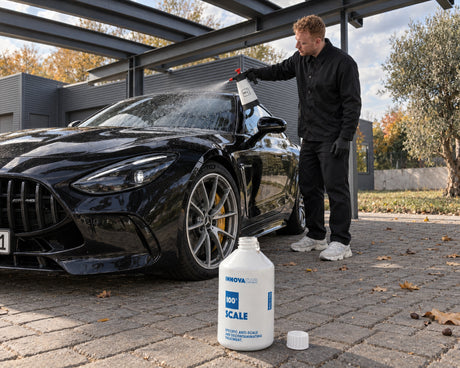
Togliere le macchie di calcare dai vetri dell'auto senza graffiarli
Daniel von Detailing1 |


Koch-Chemie × COLOURLOCK
Sgrassante senza solventi per preparare la pelle alla riparazione
Koch-Chemie × COLOURLOCK
COLOURLOCK "Sek-Off" rimuovi-residui di colla cianoacrilica
Rimuovi supercolla da pelle e plastica
Koch-Chemie × COLOURLOCK
COLOURLOCK "Grease Absorber Paste" — assorbente per trattare le zone grasse della pelle
Rimuovere le macchie di grasso dalla pelle
What are COLOURLOCK's stain & specialized removers? Problem solvers from leather repair for cases where a standard leather cleaner fails: wax and care product films, absorbed grease stains, jean abrasion, superglue, and grease films prior to repair work. Dosed for spot application, developed at the Lederzentrum since 1995, and now part of the Koch-Chemie portfolio.
Stain & Specialized Removers by COLOURLOCK are the problem solvers of leather cleaning — for everything that will not budge with water and cleaner. Each product addresses a specific type of damage: wax and care product films, deeply absorbed grease, color transfer like jean abrasion, superglue residues, and grease films that must be removed before coloring or repair. They were developed by the leather specialist that has been supplying repair professionals since 1995 as Lederzentrum GmbH and is now part of Koch-Chemie.
Pro-tip from Detailing1: The most common mistake with stains on leather is reaching for the strongest product first. We regularly receive inquiries about leather damage that didn't come from the stain, but from the attempt to remove it — acetone, nail polish remover, or a razor blade took the color layer off with it. Therefore: always work from mild to strong. Start with a leather cleaner, then use the appropriate specialized remover, and always test every product on an inconspicuous area first, such as the underside of the seat. The stain isn't going anywhere — but a dissolved color layer will.
A stain on leather is rarely dirt in the classic sense. Wax from care products polymerizes into a film, skin grease absorbs into the coating over months, jean dye bonds with the pigment layer, and superglue hardens into a glass-hard structure. A leather cleaner works with surfactants on the surface — it cannot do anything against these bonds, no matter how long you scrub.
COLOURLOCK knows these cases from the repair table. The brand was created in 1995 at the Lederzentrum, a specialist in leather repair and leather dyes, and has been supplying saddlers and detailers for three decades. Anyone who recolors discolored seat bolsters daily and saves glued furniture edges knows exactly which residues require which chemistry — and where the wrong product causes more damage than the stain itself.
This leads to the logic of this category: no universal remover, but tuned specialists. One dissolves wax and care product films, one sucks grease out of the fiber structure, one removes color transfer, one softens superglue, and one degreases before repairs. Since the acquisition by Koch-Chemie, the line is managed under Koch-Chemie × COLOURLOCK — nothing has changed regarding the formulas or this classification as a result.
The classification is not product marketing, but chemistry: A product strong enough to solve all these problems at once would dissolve the leather coating as well. Specialization is the reason why these products can be used in a controlled manner — each only acts on the bond it was built for.
The range extends from wax films to superglue. Against wax, grease, and care product films, there is the Stain and Wax Remover COLOURLOCK "Stain Remover": It dissolves old sealing layers, polish residues, and built-up care films that mild cleaners slip off of, leaving behind a uniform, receptive surface. Available as 1000 ml / 1 liter; for detailing shops, also as 10 liters. Together with the next two products, it forms the brand's stain remover group.
Absorbed grease stains are a different caliber. Dark zones on headrests, armrests, and seats do not sit on the leather, but inside it — that is where the Absorber Paste COLOURLOCK "Grease Absorber Paste" works: It is applied to cover the area, pulls the grease out of the leather structure as it dries, and is then brushed off. It visibly lightens dark grease zones, especially on light-colored smooth leather.
For color transfer — especially jean abrasion on light-colored seats — there is the Discoloration Remover COLOURLOCK "GLD Solvent". It softens color transfer and old coating residues in the top leather layer and opens the surface in a controlled way for the next step. For spot applications, it is available in the 40 ml (pen) variant, and for larger areas as 250 ml or 1000 ml / 1 liter.
The special case of superglue has its own adhesive remover: COLOURLOCK "Sek-Off" swells the glass-hard glue structure and makes it soft enough to carefully lift it off — in places where mechanical scraping would leave behind shiny spots and abrasion marks. The 20 ml bottle lasts a long time because it is applied drop by drop.
The most inconspicuous tool works in preparation: the solvent-free Degreaser COLOURLOCK "Degreaser" removes skin oils, dirt films, and product residues from heavily used areas like seat bolsters and steering wheels — everywhere that fillers, color, or sealant need to adhere afterwards. Available as 100 ml, 250 ml, and 1000 ml / 1 liter; in the range, it has its own subcategory: Degreaser by COLOURLOCK.
The first active principle is dissolving. COLOURLOCK "Stain Remover," COLOURLOCK "GLD Solvent," and COLOURLOCK "Sek-Off" work with solvent formulas of varying strengths: They swell the target bond — wax film, color transfer, or glue — and separate it from the coating, similar to how warm water loosens a label from glass. For you, this means: the residue comes off without you having to scrub mechanically and roughen the surface in the process.
The second principle is absorbing. The COLOURLOCK "Grease Absorber Paste" is based on highly absorbent mineral components that pull grease out of the leather structure via capillary action — like blotting paper absorbing ink. The paste binds the residues while drying and transports them to the surface. You can tell it's working because the paste changes color while the stain lightens — the grease is then in the paste, no longer in the leather.
The third principle is solvent-free degreasing. COLOURLOCK "Degreaser" uses surfactants that encapsulate grease molecules and lift them from the surface without attacking the coating. In other words: It removes the invisible grease film that causes every repair to fail — because fillers, color, and top coat only hold on a grease-free, matte surface.
Each principle has its limits, and those belong on the table. COLOURLOCK "GLD Solvent" opens the color layer in a controlled way — after application, the area needs to be treated or rebuilt with the coloring and finishing line; this is not a defect, but the point of a repair preparer. The Grease Absorber Paste belongs on pigmented smooth leather, not on aniline, nubuck, or suede. And the Degreaser removes surface fats, not deeply absorbed oil stains — those are a job for the paste. We can confirm this from daily Detailing1 life: Most inquiries about GLD Solvent end with the question about the appropriate color to follow — anyone who plans for that beforehand won't experience any surprises.
Before every specialized remover comes standard cleaning. A leather cleaner removes everyday dirt and only then shows what is truly a case for the specialists — surprisingly often, the supposedly absorbed stain is simply gone after the basic cleaning. What remains is treated in a targeted manner: Apply the product sparingly to a cloth or pad, never directly onto the surface, and work on the spot in a controlled manner rather than rubbing over a large area.
Testing on an inconspicuous area is not just a precautionary cliché, but part of the application. Every leather is coated differently, every color is differently stable — a minute on the underside of the seat or behind the seat rail tells you how your surface reacts before you work in the visible area. Professionals perform this test on every vehicle, precisely because they know the products.
The Grease Absorber Paste requires a different rhythm: apply it to cover the dry grease spot, let it dry completely, brush off or vacuum — and repeat for older stains. Expect several passes for a grease stain that has been absorbed over years; that is normal and part of the process. Each pass pulls out another layer of grease, and the stain becomes visibly lighter instead of disappearing in one step.
After removal comes reconstruction. An area that has been degreased or softened needs care — and where the color layer has suffered or the GLD Solvent has been used, the coloring line takes over. We recommend thinking about the finish right away: Anyone who removes the stain and leaves the area exposed will have the next stain in the same spot in a few weeks, because open surfaces absorb dirt faster.
The list of home remedies for leather stains is long: acetone and nail polish remover for glue, razor blades for thick crusts, vegetable oil for softening, miracle cleaners from the drugstore for jean abrasion. The results are right there in the forums — we read the same histories there that also reach us as inquiries: The glue is gone, and the color layer is too. The spot is shiny, has become hard, or is lighter than the rest of the seat.
The reason is always the same: home remedies act uncontrollably. Acetone does not distinguish between superglue and pigment layer — it dissolves both. Oil absorbs uncontrollably into the leather and becomes a stain of its own. A razor blade works mechanically against a crust that is harder than the coating underneath; if it tilts, the cut is deeper than the glue ever sat. The specialized removers, on the other hand, are tuned to exactly one bond and can be dosed, stopped, and repeated.
Honest classification also includes the other direction: Not every stain needs a specialized remover. Fresh dirt, drink splashes, and normal gray haze are a case for a mild leather cleaner; fresh grease splashes are often removed by the strong one — you can find both among the leather cleaners by COLOURLOCK. The specialists begin where the stain has been absorbed, hardened, or chemically bonded. If you are unsure, start with the cleaner — this path is always reversible.
And sometimes the right answer is none from this category: A seat that is worn and frayed over a large area can no longer be saved by any remover — that is a case for coloring and repair. We would rather say that before the purchase than afterwards.
The assignment is easier than the range looks. If a wax or care product film makes the surface dull and sticky: COLOURLOCK "Stain Remover." If there is a dark grease zone on the headrest or seat that no cleaner moves: COLOURLOCK "Grease Absorber Paste." If light-colored seats show jean abrasion or color transfer: COLOURLOCK "GLD Solvent" — as a spot application (40 ml pen) or for larger areas (250 ml). These cases are gathered in the subcategory Stain Removers by COLOURLOCK.
If superglue has landed on leather, faux leather, or plastic: COLOURLOCK "Sek-Off" from the subcategory Adhesive Removers. And if you are preparing for coloring, repair, or sealing: the solvent-free COLOURLOCK "Degreaser" from the subcategory Degreaser — it is the least spectacular of these cases and yet most often determines the final result, because color simply does not hold on grease.
All other cleaning products of the brand — from leather cleaner to odor neutralizer — can be found one level up: Back to Cleaning by COLOURLOCK. And where color correction is pending after removal, Coloring & Finish by COLOURLOCK follows directly.
The thought that stands above the entire category: with stains on leather, time decides more than chemistry. What a mild cleaner can still manage today will need a specialized remover in a month — and what has absorbed for a year ends up needing recoloring. The best time for the right remover is therefore always: as soon as you notice the stain.
Troppa scelta in Smacchiatori e prodotti specifici di COLOURLOCK? Fatti aiutare a scegliere:
Daniel von Detailing1 |

Daniel von Detailing1 |

Daniel von Detailing1 |

Daniel von Detailing1 |

Jasper von Detailing1 |

Daniel von Detailing1 |

Daniel von Detailing1 |

Daniel von Detailing1 |

Jasper von Detailing1 |

Jasper von Detailing1 |

Daniel von Detailing1 |

Daniel von Detailing1 |