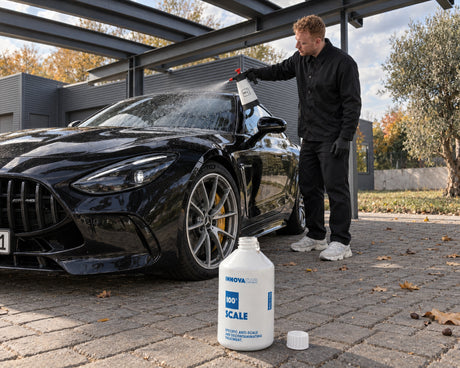
Togliere le macchie di calcare dai vetri dell'auto senza graffiarli
Daniel von Detailing1 |


Koch-Chemie × COLOURLOCK
COLOURLOCK "Elephant Leather Oil" Prodotto naturale per la cura della pelle leggermente indurita
Olio di cura intensivo per pelle secca e indurita
How do you make hard leather soft again? Through re-greasing: COLOURLOCK "Elephant Leather Oil" deposits lost fats deep into the dried-out fibers and makes stiff leather pliable again over several thin applications — on classic car seats, motorcycle saddles, belts, bags, and old furniture leather. Heavily hardened leather should be loosened beforehand with the COLOURLOCK softener.
The care product for hardened leather from COLOURLOCK takes action where normal leather care no longer reaches: on leather that has lost its fats and has become hard, stiff, or brittle. COLOURLOCK "Elephant Leather Oil" deeply re-greases the fiber structure instead of just treating the surface. It was developed by the leather specialist that has been supplying repair professionals as the Lederzentrum since 1995 and now belongs to Koch-Chemie — where re-greasing is the standard step before old leather can even be repaired.
Pro-tip from Detailing1: The most common mistake when softening hard leather is trying to force results with quantity. Advice circulates in forums to heat up leather grease, apply it thickly, and let it soak in overnight. The opposite is correct: leather absorbs fats only slowly and only up to a point of saturation — anything beyond that remains as a greasy film on top, collects dust, and darkens unevenly. Therefore, apply thinly, allow several hours for it to work, wipe off any excess, and repeat after one or two days. Three thin applications reach fiber layers that a single thick coat never sees.
Leather does not become hard overnight. Over the years, it loses the fats that keep its fibers supple — due to sun, heating air, water, and simply time. The tanning process once introduced these fats; nobody replenishes them on their own.
The mechanism behind it is simple: leather fibers are bundles of collagen that slide over each other as long as there is fat between them. If it evaporates or is washed out by rain — which is why leather that has gotten wet is notorious for drying hard — the fibers rub directly against each other and snag. The leather first feels dry, then stiff, then it develops hard creases that creak when pressed instead of yielding.
The end stage is the point of no return: at creases and seat edges, the snagged fibers break, and a tear can no longer be closed by any care product in the world. Exactly this time window before that point is the area of application for this category — hard leather is a solvable problem, broken leather is a repair job.
The classic example is the classic car that has been sitting for a long time: decades in a dry garage or barn, the seats visually complete but hard as cardboard. Such leather is almost never lost — it is just empty. The fats that are missing can be brought back; the substance is still there.
Making hard leather soft means replacing fats — not polishing the surface. The leather industry calls this process re-greasing: oils with long-chain fats migrate via capillary action into the spaces between the fibers and return their flexibility to the snagged collagen bundles.
This fundamentally distinguishes re-greasing from normal leather care. A care lotion like COLOURLOCK "Leather Care" builds a razor-thin protective film on the surface and keeps healthy leather supple — it is too light for real hardening; it simply does not penetrate deeply enough. The rule of thumb: If your leather just looks dry and dull, care is sufficient. If it feels stiff and forms hard creases, it needs re-greasing.
It is also important to understand what re-greasing is not: moisturizing. The reflex to treat hard leather with water or moisturizing creams makes the problem worse — water temporarily makes the fibers pliable, but makes them stick together even more tightly when drying because it washes out the last remaining traces of fat. Leather is not skin that stores moisture; it is a fiber structure that needs fat as a lubricant. Therefore, there is no way around oil- and fat-based re-greasing once the hardening has set in.
Re-greasing also has a temporal dimension that many underestimate. Fats migrate slowly through a fiber structure — the noticeable effect builds up over hours and days, not minutes. That is why the method works in cycles: apply, let it absorb, check, repeat. Anyone who expects soft leather after the first application does not have the wrong product, but the wrong time horizon.
The tool in this category is COLOURLOCK "Elephant Leather Oil": a natural, intensively re-greasing care oil in a 250 ml bottle, born out of the repair practice at the Lederzentrum. There, it is the step before recoloring — leather that is to be dyed must first be flexible again, otherwise the new color will crack with the next crease.
Here in our detailing shop, we reach for the oil when leather fails the creak test: a healthy seat bolster yields with a springy feel when pressed; a hardened one creaks and creases sharply. The target group is thick, robust leather — classic car seats, motorcycle saddles, tack, belts, tool bags, old furniture. Precisely the types of leather that are porous enough to absorb an oil and strong enough to survive for decades to come.
One property should be honestly stated: the oil darkens the leather slightly — in a controlled way, but visibly. With old, dried-out leather, this is almost always desired because the grayish-dull dryness gives way to a richer, deeper color. On light-colored or near-new leather, the same effect is a reason to test on an inconspicuous area first. If you do not want any color deepening at all, this category is not for you, and normal leather care is the right choice.
Before the oil comes cleaning: dust, skin oils, and old care residues block the pores through which the oil is supposed to absorb. A suitable leather cleaner beforehand, then let the leather dry completely — re-greasing cannot take place on damp leather; fat and water do not mix.
The application itself: a few milliliters on a soft cloth, distribute thinly in calm strokes, and massage in with light pressure. Then the oil needs several hours to work — severely dried-out areas can be left overnight. Afterward, remove the excess with a dry microfiber cloth and bend the leather instead of just looking at it: the quality control is the pliability, not the shine. If the first pass is not enough, the second follows after one or two days.
Regarding the topic of heat, which appears in every forum: mild heat actually helps — a warm room or the warmth of your hands while massaging it in makes the oil more fluid and accelerates absorption. The common trick of heating leather grease to 50 degrees and applying it hot comes from the tack room and does not belong on dyed or pigmented leather: it introduces too much fat into the material at once and risks dark spots that will remain.
When deciding on the sequence of surfaces, a system helps: first the creases and load zones, because the hardening is most advanced there — on the seat, the bolsters and the front edge; on a belt, the area around the buckle; on a bag, the flap. Only then the large, flat surfaces. And after it has absorbed, let the leather work: gentle bending and moving helps the freshly lubricated fibers regain their flexibility. Gentle means using your hands, not brute force — kneading and working belongs in the tanner's trade, not on a dyed seat.
One more observation from our practice that regularly confuses first-time users: the first application often disappears into the leather surprisingly quickly. This is not a signal to use more oil — it only shows how empty the fibers were. The amount remains small for every application; the number of applications makes the difference.
Not every fat belongs on every leather — and not every hard material is a case for oil. The classic search question "Leather grease or leather oil?" is answered by the intended use: leather grease from the tack room remains closer to the surface and seals against moisture — useful for work boots and outdoor tack, but on a seat, it builds up exactly the greasy shine that nobody wants. An oil penetrates deeper, increases flexibility from the inside, and leaves the surface matte and tactile.
We clearly advise against home remedies. Nivea, udder cream, and olive oil are made for skin, not for tanned fibers: their fats absorb uncontrollably, turn rancid, and build up a sticky film. Here in our shop, you can smell leather that has been treated with cooking oil for years before you see it — and the basic cleaning afterward takes longer than the actual re-greasing.
The second limit is the material itself. No oil absorbs into faux leather — it remains on top as a sticky layer, and many supposedly leather seats in modern cars are exactly that: faux leather or leather-faux leather combinations. Densely coated, modern automotive leather in good condition also hardly absorbs the oil; the leather-specific care from the rest of the range works better there. And delicate aniline or nubuck leather cannot tolerate intensive re-greasing — risk of staining instead of caring effect.
The third limit is the degree of hardness. If the leather is not just stiff but board-hard — the barn find, the vintage bag from the attic — the oil alone can no longer penetrate the snagged fiber structure. Then the COLOURLOCK "Old Leather Softener" loosens the fibers beforehand so that the re-greasing can actually take hold — the specific category for this is the Leather Softener from COLOURLOCK. And where tears, breaks, or color damage are already visible, no oil will help anymore, only the Repair from COLOURLOCK.
The decision is a simple three-step process. If your leather feels stiff, forms hard creases, and creaks when pressed: COLOURLOCK "Elephant Leather Oil", two to three thin applications at intervals of one to two days. If it is board-hard and old: first COLOURLOCK "Old Leather Softener", then the oil. If it is cracked, broken, or colorless: head straight to the repair line; care comes afterward.
The classic car is the prime example for this category, for a reason that goes beyond mere care: original leather in classic vehicles is substance and value at the same time. A re-greased, soft original with patina beats any new upholstery — both in terms of collector value and character. Our classification is clear here: as long as the fibers are just empty and not broken, preservation is always worth it. The same applies on a smaller scale to the inherited belt, the old briefcase, and the motorcycle saddle with twenty seasons under its belt.
Plan the whole thing as a weekly project, not a Saturday job. There are one to two days between applications, and the full effect only shows once the fats have reached the fiber structure — a heavily hardened seat realistically needs one to two weeks until it reaches a usable softness. "Saved" in this context means: supple, resilient, and with a rich color — not factory new. The signs of use of a fifty-year-old leather remain, and that is exactly what distinguishes a preserved original from new upholstery.
Those looking to get back into a routine from an acute case will find preventive care according to leather type one level up: Back to Leather Care from COLOURLOCK. Because the most honest realization in this category is that it would not be necessary at all for well-maintained leather — hardening is almost always the bill for years of neglected care.
And the sentence that should stick: Hard leather is almost always still salvageable, cracked leather can only be repaired. The difference between the two is a few milliliters of oil, two days of patience — and the moment you take the creaking seriously instead of ignoring it.
Troppa scelta in Cura per pelle indurita COLOURLOCK? Fatti aiutare a scegliere:
Daniel von Detailing1 |

Daniel von Detailing1 |

Daniel von Detailing1 |

Daniel von Detailing1 |

Jasper von Detailing1 |

Daniel von Detailing1 |

Daniel von Detailing1 |

Daniel von Detailing1 |

Jasper von Detailing1 |

Jasper von Detailing1 |

Daniel von Detailing1 |

Daniel von Detailing1 |