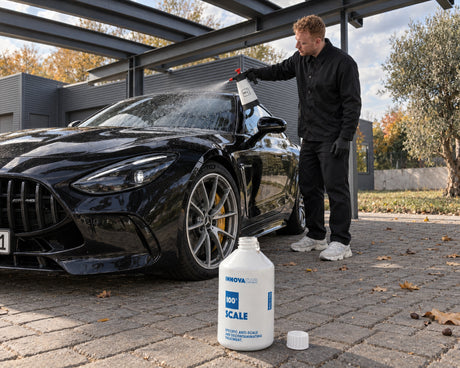
Togliere le macchie di calcare dai vetri dell'auto senza graffiarli
Daniel von Detailing1 |


Koch-Chemie × COLOURLOCK
COLOURLOCK "Old Leather Softener" ammorbidente per pelle vecchia indurita
Ammorbidente profondo per pelle vecchia, ridà morbidezza
How do you make hard leather soft again? With a softener that loosens the hardened fiber structure before any oils, conditioners, or color can even penetrate. For this purpose, COLOURLOCK "Old Leather Softener" works over hours and days instead of minutes—on rock-hard classic car seats, saddles, vintage furniture, belts, and bags.
The COLOURLOCK leather softener is a pre-treatment product, not a conditioner. It loosens the hardened fiber structure of old leather so that oils, conditioners, or color can actually be absorbed again. COLOURLOCK "Old Leather Softener" is made for the tough cases: classic car seats, saddles, vintage furniture, belts, and bags that haven't been touched for decades. It was developed by the leather specialist who has been supplying repair professionals since 1995 as the Leather Center (Lederzentrum) and is now part of Koch-Chemie.
Practical tip from Detailing1: The most expensive mistake when softening is heat. Advice circulates in forums to soften hard leather with a hairdryer, on a radiator, or in a tumble dryer. However, heat drives out exactly the residual moisture that keeps the fibers flexible and accelerates the hardening process. We regularly receive inquiries about classic car seats that have torn at the seat edge after such a "treatment." Instead, work at room temperature, apply thinly, give the leather twelve hours to rest, and prefer to repeat four times rather than applying one thick coat. A saturated seat that is greasy on the outside is just as hard on the inside as it was before.
Conditioning assumes that the leather can absorb something. A rock-hard piece of leather can no longer do exactly that—which is why the softener comes before conditioning, not alongside it.
It is classified accordingly in the COLOURLOCK range: as a leather pre-treatment, in a line with leather grease and scratch polish, not with the conditioning milks. This isn't a quirk of classification, but the sequence in which a saddler works. First, the material is made receptive again, then oil is added, and finally, color is applied on top.
The difference from conditioning is best defined by expectations. A conditioning milk works in minutes, and you see the result that same afternoon. A softener works over hours and days, and its progress isn't shown in shine, but in how a seat edge feels between your thumb and index finger. Anyone who measures one against the other will end up considering both a failure.
The second difference lies in the condition each is made for. Conditioning is maintenance for leather that still functions. Softening is restoration for leather that has already lost its flexibility. This is precisely why the softener is in the repair branch of the brand: in professional detailing, it is the step without which filler and color would not hold on an old seat.
In practical terms, this means for the sequence of your project: the softener is never the last product you use. It is the first. What comes next—conditioner for hardened leather, a repair, or recoloring—is a decision you make only once the leather can be bent again.
Hard leather has not simply lost oil. Its fiber bundles lie directly on top of each other without a lubricating film and become interlocked, and it is this interlocked state that creates the stiffness.
Leather consists of collagen fibers that are intertwined like thousands of the finest ropes. Tanning and greasing keep these fibers separated and able to slide, similar to oil between two metal surfaces. You can tell by this: you can fold healthy leather, and the fold disappears as soon as you let go.
Over decades, these oils migrate out of the material—sunlight and heating air accelerate this, while moisture actually washes them out, which is why soaked equestrian and motorcycle leather is notorious for drying out hard. What remains are fibers that lie against each other and stick together. The leather industry calls this state hornification (hardening). In everyday life, you recognize it by the fact that a fold cracks instead of yielding and remains in place when you let go of the leather.
And this is where the logic of conditioning fails. A conditioning grease needs open gaps to reach the fiber structure at all. In a stuck structure, it can no longer find any, stays on the surface, and becomes a layer of dirt. That is why the third coat of leather grease on a board-hard seat does nothing—it's not that there is too little oil involved; it simply cannot get inside.
The softener addresses this exact adhesion. It carries softening substances in a carrier system that is finer than any grease, deep into the dense structure, and makes the fibers move against each other again. For you, only one result counts: what previously accepted no conditioning now accepts some again.
Fold an inconspicuous area between two fingers. If the leather yields softly, re-oiling is enough. If it cracks and the fold remains, it is time for the softener.
The if-then logic behind it is short. If the leather can still be folded, only looks dull and dry, and the fold springs back on its own, use a conditioner for hardened leather with replenishing oil. If it creaks when bent, the fold remains as a hard edge, and the surface feels like cardboard, use the softener first. And if the color layer is already cracking or a tear is present at the fold edge, the point at which softening alone is sufficient has been passed.
From our consulting, we know the most common mistake here: many judge the leather by its appearance instead of its feel. A "barn find" always looks dramatic under dust and patina, but can often still be folded—that is an oil case. Conversely, evenly hardened seats from a dry interior look almost inconspicuous and crack at the first bend. Clean the area before testing, and decide with your fingers instead of your eyes.
Edges are a special case. Seat bolsters, entryways, saddle flaps, and belt holes harden significantly earlier than the protected area next to them because they are subject to bending and friction. It is perfectly normal for a seat to have two diagnoses at once. In this case, treat the hard zones with the softener and the rest with conditioner, rather than treating the entire piece of furniture or interior with one broad stroke.
For the professional context, the same test applies with a different goal. In detailing, it does not decide about conditioning, but whether a leather repair will last: on leather that breaks when bent, every filler and every color layer will tear again within a few weeks. That is why the softener is at the beginning of the chain and not at the end.
The process is unspectacular, and that is exactly where the art lies: clean, apply thinly, wait, check, repeat. The mistake almost always happens in the waiting.
It starts with cleaning. Old leather has a mixture of dust, skin oils, and old care residues on it, and a softener that you apply over it works against this layer first. A suitable leather cleaner removes it. Afterward, the leather must dry completely, otherwise, you will trap moisture inside.
COLOURLOCK "Old Leather Softener" is applied with a brush, sponge, or cloth in a thin, even layer. Then begins the part that most underestimate: the leather absorbs the product over hours, not minutes. After about twelve hours, evaluate the result and apply the next thin layer if necessary. With very dry leather, this rhythm requires a full day per pass.
Two techniques accelerate the whole thing more than any extra amount. First: move the leather between passes. Kneading a seat bolster by hand, bending a saddle flap several times, rolling a belt—the movement works the softener into fiber layers that leather lying still never reaches. Second: work on entire surfaces up to the next seam, not individual points, otherwise you will get streaks.
Expect to adjust your expectations the first time. Two passes often show little on a seat neglected for decades; the noticeable jump usually comes in the third or fourth. From daily life at Detailing1, we can say: whoever gives up after the second evening has missed the point where it starts to work. The fact that the area darkens somewhat during the process is normal for very dry leather and largely balances out with the subsequent conditioning.
Hardly any question is answered as often with home remedies as how to make hard leather soft. Almost all of these agents solve a different problem than yours.
WD40 and similar penetrating oils are solvents with an oil content. They make the surface supple for a short time, evaporate within days, and leave behind leather that is drier than before. Coconut, olive, and cooking oils may be absorbed, but they oxidize over time and turn rancid—the smell remains in the seat, and the color layer darkens patchily. Udder grease and beeswax lay on top as a barrier layer and subsequently prevent exactly the penetration that is important.
We often see leather on which several of these paths have been tried in succession. The typical case is a motorcycle saddle or a classic car seat with dark, greasy zones in areas someone treated generously, and board-hard zones next to them. Before anything sensible can happen there, the applied grease layer must be removed—the preparatory work then takes longer than the actual softening.
The softener itself also has clear limits, and these should be mentioned. It does not close cracks: where the fiber is already broken, the crack remains a case for filler and color from the repair range. It does not refresh color: faded and abraded areas remain faded; that is the job of dyeing and finishing. And it does not replace conditioning, but rather creates the condition in which conditioning can be effective again.
Regarding material, COLOURLOCK also draws a clear line. The softener belongs on smooth leather—pigmented or porous, in cars or on furniture. Nubuck, velour, and suede with their roughened surface are expressly excluded; there, every deep-acting treatment gums up the fiber pile. Faux leather and coated fabrics don't absorb anything anyway: what you apply remains sticky on the surface.
The final limit is saturation. Leather only absorbs up to a certain point, and anything above that remains as a film on the surface. A single thick application, therefore, does not make leather soft faster; it only makes it greasy—and you will have to remove this layer later with a degreaser before color will hold on it.
The softener is a tool for projects, not for appointments. Anyone who accepts this reclaims leather that most have already written off.
The choice of container follows the project, not the surface area. A saddle, a pair of seats, or a collection of leather goods can be managed through all necessary passes with COLOURLOCK "Old Leather Softener" in 250 ml. Those who regularly restore old interiors—detailers, saddlers, upholsterers—plan with the 1000 ml / 1 liter size because every object needs multiple treatments here, and consumption lies not in one application, but in its repetition.
What we at Detailing1 observe again and again: inquiries about this topic rarely come from everyday life, but from a specific occasion. An inherited car, a barn find, a saddle from the attic, a leather sofa from an estate sale. Almost always, it is about a piece that means something to someone—and almost always, the real question is not "will it be soft again," but "will I break it in the process." The honest answer: used thinly and patiently, you can do very little wrong. Used thickly, warmly, and quickly, on the other hand, you can do a lot.
If your leather passes the test and can still be folded, you don't even need this step—then the direct path is via conditioner for hardened leather. If you are facing a repair or recoloring, however, the replenisher is the partner of the softener: after opening the structure, it returns the oils so that the repaired area works with the leather later instead of tearing. You can find all further pre-treatment products one level higher under pre-treatment and repair from COLOURLOCK.
And the thought that carries this entire product group: leather that is hard is not broken yet—it has just become immobile. It only breaks the moment someone uses a hard seat as if it were soft. Every week you give to softening is a week in which the fibers do not break.
Troppa scelta in Ammorbidente per pelle di COLOURLOCK? Fatti aiutare a scegliere:
Daniel von Detailing1 |

Daniel von Detailing1 |

Daniel von Detailing1 |

Daniel von Detailing1 |

Jasper von Detailing1 |

Daniel von Detailing1 |

Daniel von Detailing1 |

Daniel von Detailing1 |

Jasper von Detailing1 |

Jasper von Detailing1 |

Daniel von Detailing1 |

Daniel von Detailing1 |