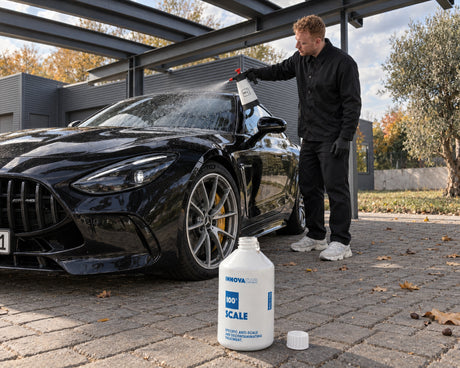
Togliere le macchie di calcare dai vetri dell'auto senza graffiarli
Daniel von Detailing1 |


Koch-Chemie × COLOURLOCK
Allround Textile Sealant "St0.01" Sigillante Tessuti Premium
Sigillante per tessuti ottimale per una protezione duratura
What is the COLOURLOCK Textile Sealant? A water-based impregnation for textile surfaces in cars: fabric roofs, Alcantara, upholstery, and short-pile mats. It is massaged in with a sponge rather than sprayed, cures over 24 hours, and lasts up to 24 months.
COLOURLOCK Textile Sealant is the impregnation for everything in your car made of fabric: fabric roofs, Alcantara, upholstery, and short-pile mats. Instead of coming from a spray can, it is water-based and massaged into the dry fibers using a microfiber sponge in a cross-hatch pattern — no solvents, no propellant gas, no fluorocarbon resins. The goal remains the same for all surfaces: water and stains stay on the surface instead of soaking into the fibers.
Practical tip from Detailing1: The most common cause for a sealant that stops beading after four weeks is residual moisture in the fabric. A fabric roof may feel dry on the surface after two hours in the sun, while the insulating layer underneath still holds water — and polymers that encounter moisture do not cross-link properly. The test takes ten seconds: press the back of your hand firmly against the fabric near a seam and hold it. If the skin feels cool or damp, the fabric isn't ready yet. A fan heater pointed at a specific spot won't help — it dries the surface faster than the core and gives you a false reading. It is better to plan for a full night of drying.
A textile sealant does not alter the surface, but rather every single fiber: a polymer film wraps around the fabric and removes its absorbency instead of creating a layer on top of it.
The reason lies in the construction of textiles. Between the fibers of a fabric roof or a seat cover, there are thousands of fine channels that draw liquid inward by themselves — capillary action, the same effect that draws oil into a candle wick. That is why a water droplet sits visibly on top of paint but disappears into fabric. In other words: on paint, you have time to wipe it off; on textiles, you don't.
This is exactly where the sealant comes into play. The polymers settle as a thin film around each individual fiber without sealing the spaces in between — the surface remains breathable yet loses its suction. Water remains as a droplet and rolls off; coffee, cola, and road salt solution stay on the surface long enough for a cloth to suffice. This is visible in the "beading": spherical droplets on a surface that previously soaked up every drop of rain.
Without this protection, every rain shower takes its toll. A roof that absorbs water takes days to dry instead of hours, remains damp in the fibers, and becomes brittle at the seams sooner. Here in Nordhorn, we almost never get inquiries about roofs in the summer — they come in March, when green edges appear along the seams after winter and the fabric feels dull. If you seal in the fall, you avoid this conversation.
The same bottle covers three surfaces that are subjected to completely different stresses: the fabric roof on the outside, Alcantara and upholstery on the inside, and short-pile floor mats.
The roof is the toughest case because it is the only textile outer skin on the car. It is exposed to UV radiation, rain, bird droppings, and pollen, and if the convertible is parked over the winter, also moss and algae. An impregnated roof absorbs less water and therefore holds onto less nutrient substrate — the green edges along the seams take much longer to appear at all. Acoustic fabric roofs with their multi-layered construction are built for exactly this treatment.
Alcantara in the interior has a different problem. The material is a microfiber fleece with a fine pile, and stains do not sit on the surface, but between the fibers. Whether Alcantara can be impregnated at all is one of the questions we receive regularly — the answer is yes, as long as the surface is clean and completely dry, and the pile is lifted again with a soft brush after curing. The feel and look remain because the film coats the fiber rather than covering it.
Upholstery fabric and short-pile mats are everyday cases: coffee on the commute to work, melted ice cream on the back seat, wet dogs after a walk. On unsealed fabric, you have seconds to decide whether it will become a stain; on sealed fabric, you have time to fetch a cloth. Deep-pile carpets, on the other hand, are not suitable — their long pile cannot be saturated evenly, and what is saturated unevenly will dry with stains.
There is only one product in this category, and it differs from off-the-shelf waterproofing sprays in exactly one respect: the application.
The Koch-Chemie × COLOURLOCK Allround Textile Sealant "St0.01" Premium Textile Sealant is not sprayed into the air but applied liberally with a microfiber sponge and massaged into the dry fibers in a cross-hatch pattern. The goal is an evenly wet, glossy film over the entire section, not a dotted surface. This takes longer than three rounds with a spray can, and it is the reason for the more uniform result: you can see at all times where product is and where it is not yet.
The formula is water-based and free of solvents and fluorocarbon resins — the fluorine compounds that were long responsible for the beading effect in classic impregnations and are disappearing from the European market. The water carries the polymers into the fiber and evaporates, after which they cross-link to form a cohesive film. This cross-linking takes up to 24 hours between 10 and 40 degrees Celsius, without rain or dew. Below 10 degrees, the matrix does not form; in scorching sun, the carrier water evaporates before the polymers can encapsulate the fiber. Practically speaking, this means: spring to early autumn outdoors, in winter only under cover.
When it comes to container sizes, the math is straightforward. The 500ml is designed for one roof or a complete set of seats and, depending on the absorbency of the fabric, is enough for one to three passes; those who regularly detail other people's vehicles should go for the 5-liter container. From our customer conversations, we know the most frequent mistake: not enough product for a large four-seater convertible. A roof that is stopped halfway through and finished only the following weekend will show the seam later as a visible line in the beading.
The sealant only holds on a fiber that is clean, rinsed out, and completely dry — three conditions, the middle one of which is skipped most frequently.
The process starts with cleaning using a suitable upholstery, textile & Alcantara cleaner. Apply the solution, work it into the fibers in the direction of the grain with a soft brush, let it sit briefly, and soak up the dissolved dirt. Anyone who scrubs across and in circular motions will mat the pile — and no sealant in the world will undo that.
The second step determines the result: rinse thoroughly. Interior cleaners contain preservatives that remain in the fibers and act like a release agent. The polymers will then fail to bond, and the beading will be weak or non-existent. On a roof, rinse with a soft stream of water until the water runs clear and foam-free; in the interior, a spray extraction cleaner with clear water performs the same task.
Then comes drying — the test of patience from the practical tip above — and only then the application. Before starting, mask off areas: rear windows, paint edges near the roof frame, door frames, and rims. Then work section by section, overlapping each pass slightly and finishing the surface in one go. The 24 hours of curing afterward are not a recommendation, but the actual work step: during this time, the film that you will later see on the roof is created.
In everyday Detailing1 practice: the inquiries that reach us after a failed impregnation almost always fall into two groups — sealed too early or rinsed poorly. A product defect is the rarest explanation. Those who plan a generous amount of time instead of just the afternoon save themselves from needing a second complete pass.
The textile sealant is an impregnation for fabric and nothing else. Three boundaries determine whether it is the right answer for your case.
First boundary: hard surfaces. On paint, clear coat, glass, aluminum rims, and polycarbonate headlights, the polymer cures into a greasy haze that no cloth can remove — in that case, machine polishing is the only solution. Masking is therefore mandatory, and anything that goes astray should be wiped off immediately with clear water and a microfiber cloth before cross-linking starts. Deep-pile carpets in the interior are on the negative list for another reason: their high pile cannot be saturated evenly.
Second boundary: color. A roof that has been turned gray by the sun over the years will not become black again through sealing. It preserves the state it finds. If the result remains too pale for you on an old roof, that is not a question of impregnation, but one of dyeing — this process is handled via Dyeing & Finish by COLOURLOCK and is a workday in itself.
Third boundary: expectations regarding durability. A cheap waterproofing spray from the drugstore will bead just as convincingly on the first day as anything else; the difference shows up after the fifth rain shower. This is exactly what customers report in our conversations: the effect is there and is gone again after a season. If you are already spraying every spring, that works fine. If you want to put in the effort once and have two years of peace, you are buying durability here, not the beading effect on the first day.
And a boundary revealed by photos from customer conversations: on a roof with old, dried-in bird dropping stains, the sealant lays over the spot instead of removing it. The edge remains visible and is subsequently harder to treat because the protective film must be removed first. Stains must be dealt with before sealing, not after — the appropriate cleaners for this can be found under Cleaning by COLOURLOCK.
The case is clearest with a textile fabric roof: it is the only surface on the car that is exposed to rain without protection and still consists of fabric.
A convertible with a fabric roof is therefore the main reason for this category — one application per season or every two years, and the afternoon pays off visibly. Next comes the interior with plenty of Alcantara and fabric, especially in family cars and with dogs on board. A vinyl or plastic roof, however, does not need this treatment: there are no fibers for anything to soak into, and the sealant cannot bond.
If your interior consists of leather, the answer lies in the neighboring categories instead of here. For pigmented smooth leather, the Genuine Leather Sealant is the right choice, for artificial leather and leather imitations the Artificial Leather Sealant, and for leather that needs to repel water, the Leather Oil & Impregnation. All three work with the same concept as the textile sealant, just on a substrate that absorbs its liquids differently.
Those who do not want to search for cleaners and sealants individually will find coordinated combinations under Sets by COLOURLOCK — there, you will also find the compilation that brings cleaner, sealant, and accessories for the roof in one box. All other protective products from the brand are listed one level higher: Back to Sealant & Impregnation by COLOURLOCK.
And the thought that carries this category: the real gain is not the beading effect you photograph on the day after. It is the drying time. A sealed roof absorbs less water, releases that small amount faster, and enters the night less damp — and it is exactly that, not the rain itself, that causes a fabric roof to age.
Troppa scelta in Protettivo tessuti di COLOURLOCK? Fatti aiutare a scegliere:
Daniel von Detailing1 |

Daniel von Detailing1 |

Daniel von Detailing1 |

Daniel von Detailing1 |

Jasper von Detailing1 |

Daniel von Detailing1 |

Daniel von Detailing1 |

Daniel von Detailing1 |

Jasper von Detailing1 |

Jasper von Detailing1 |

Daniel von Detailing1 |

Daniel von Detailing1 |