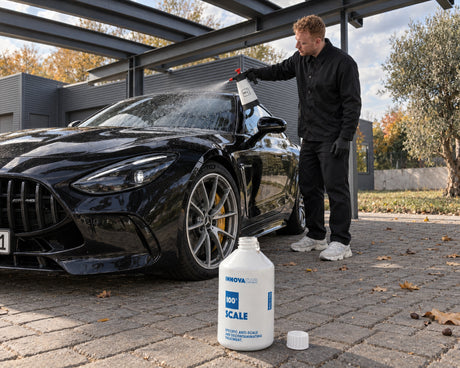
Togliere le macchie di calcare dai vetri dell'auto senza graffiarli
Daniel von Detailing1 |


Koch-Chemie × COLOURLOCK
COLOURLOCK "Pol Star" concentrato detergente per tessuto, pelle & Alcantara
Concentrato pH-neutral per tessuti, Alcantara e pelle liscia
What is the Upholstery, Textile & Alcantara Cleaner by COLOURLOCK? A pH-neutral cleaning concentrate for vehicle interiors: COLOURLOCK "Pol Star" is mixed with water in a ratio of 1:5 to 1:20 and cleans upholstery fabrics, carpet, Alcantara, and pigmented smooth leather. A protective component maintains existing waterproofing, while open-pore leathers are excluded.
The upholstery cleaner from COLOURLOCK is a concentrate rather than a ready-to-use mixture: COLOURLOCK "Pol Star" is diluted with water at a ratio ranging from 1:5 to 1:20 depending on the surface, making it suitable for cleaning the materials found in almost every vehicle interior—upholstery fabric, carpet, Alcantara, and pigmented smooth leather. The formula originates from the Koch-Chemie range and has continued under the COLOURLOCK label with its chemistry unchanged since the leather specialist was acquired. For you, this means one bottle, mixed to the exact strength that your seat, carpet, or Alcantara headliner currently needs.
Pro-tip from Detailing1: The most common mistake in upholstery cleaning is using too much liquid. Especially in spring, we receive inquiries about seats that smell musty after cleaning—almost always because the fabric was soaked and the foam core underneath absorbed the moisture like a sponge. An oversaturated seat takes up to 12 hours to dry, and it is precisely during this time that odors and water stains develop. Therefore: mist the solution finely rather than flooding it, work in sections, agitate with a soft brush, and remove the dissolved dirt with a short-pile microfiber towel or a wet-dry vacuum. Dry scrubbing on the stained spot does not help; it only drives the dirt deeper into the fabric.
Paint carries dirt on its surface; fabric absorbs it. Every ride presses skin oils, jeans abrasion, and road dust deeper into the fibers via seating pressure and friction; spilled coffee soaks in within seconds, and what the vacuum cleaner can no longer reach acts like fine sandpaper: the fibers become dull, colors fade, and the seat surface ages visibly faster than the rest of the interior. This is precisely why an automotive upholstery cleaner is not just a stronger version of an all-purpose cleaner, but a specialized discipline.
The actual work is performed by surfactants—molecules with two ends, one of which likes water and the other of which likes grease. The grease-loving end docks onto the dirt particle, and the water-loving end pulls it out of the fiber and into the cleaning solution. For you, this means: the dirt lifts up and can be wiped away, instead of just being distributed deeper while scrubbing. Water alone cannot achieve this because it simply does not dissolve grease.
Alcantara behaves differently than woven fabric. The material is a microfiber fleece with a fine pile—greasy patches on the steering wheel rim and side bolsters are not dyed dirt, but skin oils and hand cream that stick the fine fibers together. Anyone scrubbing here dry or in circles will mat the pile, and the area will remain permanently duller than its surroundings. Alcantara needs the same surfactants, just a much gentler touch.
Added to this is the reality: hardly any interior consists of just one material. A seat surface made of fabric, bolsters made of pigmented leather, headliner made of fleece, plus carpets and floor mats—anyone who mixes a separate bottle for each surface will eventually reach for the wrong one. This category answers this with a cleaner that covers all three material groups and regulates its strength via dilution.
The concentrate principle reverses the usual logic: the manufacturer does not determine the cleaning strength, you do. 1:10 is the starting point for upholstery and Alcantara, 1:5 only comes into play if the first pass on carpet or footwells is not enough, and for pigmented smooth leather, you should generally stick to the mild 1:20 solution. A ready-mixed upholstery cleaner, by contrast, brings the same strength to every case—too much for a light maintenance round, too little for a neglected used car.
The formula is pH-neutral, free of acids, alkalis, and bleaching agents. In short: it operates in the range that fabric dyes and the topcoats of pigmented leathers can tolerate even with repeated use. The dwell time is 30 to 60 seconds—longer provides no additional effect because the surfactant action reaches its plateau after that. Patience is not a virtue here, but thoroughness during removal is.
Remarkable about the formulation is the protective component: it does not attack existing hydrophobic coatings; factory upholstery treatments and aftermarket fabric coatings survive the cleaning. However, it cannot replace a sealant—whatever protection a deep cleaning removes must be rebuilt separately after complete drying.
Regarding container sizes: the 100 ml and 250 ml are for getting to know the product and already yield several spray bottles of solution at a 1:10 dilution. Those who regularly maintain the entire interior are covered long-term with the 1000 ml / 1 liter bottle—it covers everything from the Alcantara headliner to the trunk mat that arises between two deep cleanings.
The ring left after cleaning is a map of the damp area. While the fabric dries, moisture migrates due to capillary action—the fiber continues to soak up water like a wick—to the edge of the wet zone, carrying dissolved dirt and lime with it. The water evaporates there, and the debris remains. A ring is therefore rarely a sign of the wrong cleaner, but almost always one of an improperly treated area.
The first consequence: never treat just the spot. Clean the entire contiguous surface from seam to seam—the seam is the natural border where no transition will be visible. This feels like more work, but in reality, it saves it: a uniformly cleaned panel dries without an edge, whereas a spot-treated area almost always needs to be reworked.
The second consequence concerns the water itself. Tap water contains significant limescale depending on the region, and this lime remains as a pale film in the fabric when it dries. The photos we receive regarding ring inquiries almost consistently show dark upholstery—not because light-colored ones are less affected, but because the white lime film remains invisible there. Distilled water for mixing is the simplest insurance for this entire discipline.
The third variable is drying. Uniformly means: doors open, cross-ventilation, no localized heat—a hairdryer held on one spot extracts the water there faster than in the surrounding area and creates its own ring. A wet-dry vacuum removes residual moisture; what remains in the fabric after that dries in hours rather than overnight.
Before the first spray comes the vacuum cleaner—thoroughly, using a crevice tool in seams and gaps. Loose sand, crumbs, and pet hair that take two minutes to vacuum turn into streaks during the wet phase, which are then dragged across the entire surface. No step in upholstery cleaning has a better effort-to-result ratio.
Then work in sections: mist the solution finely, let it loosen briefly, agitate with a soft upholstery brush, and remove the dissolved dirt with a short-pile microfiber towel. For entire seat sets, a wet-dry vacuum takes over the removal—it extracts the solution along with the dirt from deep within, rather than just shifting it on the surface, and noticeably shortens drying time.
Alcantara gets its own protocol: damp instead of wet, in the direction of the grain instead of circular, and after drying, brush the pile back up with a soft brush. Greasy zones on the steering wheel rim require several mild passes—the one aggressive pass intended to solve it immediately leaves behind matted spots that remain duller than their surroundings.
The most sensitive surface is the headliner. Its cover is glued to foam backing, and saturation dissolves exactly that glue—the bubble in the headliner then remains permanently. From the Detailing1 daily routine: the most expensive interior damage reported by our customers is not seat stains, but extensively soaked headliners. Therefore, only dab lightly, never rub, and never flood.
The clearest boundary lies at leather without a topcoat. Aniline, semi-aniline, nubuck, and suede absorb cleaning solution like blotting paper—stains and discolorations are almost impossible to correct there. A water drop on an inconspicuous area will show you if your surface is affected: if it soaks in and darkens, it does not belong under the upholstery cleaner but requires the Aniline & Nubuck Cleaner from the same series.
Also on pigmented smooth leather, the 1:20 solution is for maintenance, not for heavy refurbishment. If skin oil is greasy in the seam or the driver's side is visibly graying, the two-stage Leather Cleaners from COLOURLOCK take over—mild for routine, strong for deep cleaning, both formulated exactly for these cases.
Odor is the third boundary. An upholstery cleaner removes odor sources on the surface; it cannot reach what is deep in the padding—smoke, pets, spilled milk. For this, the odor neutralizer COLOURLOCK "Fresh Up" is available, which binds odors instead of masking them. Clean first, then neutralize—in this order, the cause disappears as well.
And household remedies: dish soap, shaving foam, and laundry detergent foam uncontrollably and are difficult to rinse out of the fabric. We often see seats that have been pre-treated this way—upon cleaning, the surface foams up again, indicating so much surfactant remains in the fiber, and until then, the residue acts as a dust magnet, causing the upholstery to darken faster. A cleaner that is formulated to be low-residue is distinguished exactly by this point.
Honestly assessed: if you treat a single stain once a year, a ready-mixed upholstery cleaner is sufficient—the bottle is faster to grab, and the dosage question does not arise. The concentrate shows its strength as soon as entire surfaces are involved: the complete rear seat after a family vacation, the used car before the first season, the regular interior round throughout the year.
Entry is deliberately possible on a small scale: with the 100 ml or 250 ml, you can test the concentrate on your own surfaces before the 1000 ml / 1 liter becomes standard equipment. The working method remains the same in any case—vacuum, work from seam to seam, mix with distilled water, and thoroughly remove the solution.
Immediately after cleaning is the best moment for the next step: on freshly cleaned, completely dry fabric—and only there—a Textile Sealant from COLOURLOCK will adhere. It allows future stains to sit on top rather than soaking in, thereby extending the interval between cleanings, which is exactly what this category is about. You can find all other cleaners of the brand one level higher: Back to COLOURLOCK Cleaning.
And the thought that carries the category: upholstery that is free of grease and surfactant residue gets dirty more slowly because new dirt finds less surface to adhere to. Every thorough round extends the interval to the next one—those who work cleanly clean less often, not more often. That is the quiet gain that no bottle mentions on its label.
Troppa scelta in Detergente per tappezzeria, tessuti e Alcantara di COLOURLOCK? Fatti aiutare a scegliere:
Daniel von Detailing1 |

Daniel von Detailing1 |

Daniel von Detailing1 |

Daniel von Detailing1 |

Jasper von Detailing1 |

Daniel von Detailing1 |

Daniel von Detailing1 |

Daniel von Detailing1 |

Jasper von Detailing1 |

Jasper von Detailing1 |

Daniel von Detailing1 |

Daniel von Detailing1 |