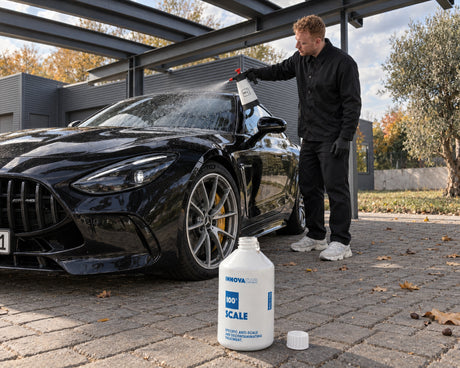


Togliere le macchie di calcare dai vetri dell'auto senza graffiarli
Daniel von Detailing1 |


Koch-Chemie × COLOURLOCK
COLOURLOCK "Leather Fresh" (Dull / Neutral) Base opaca e senza pigmento per ravvivare la pelle
Ravvivante pelle opaco e neutro
Koch-Chemie × COLOURLOCK
COLOURLOCK "Leather Fresh" (Neutral) base neutra per il ravvivante colore
Ravvivante pelle neutro per una finitura naturale
Koch-Chemie × COLOURLOCK
COLOURLOCK "Leather Fresh" (Glossy / Neutral) base neutra e lucida per ravvivare la pelle
Ravvivante lucido per pelle, colore neutro
Koch-Chemie × COLOURLOCK
COLOURLOCK "Nubuck Fresh" (Neutral) base ravvivante neutra per nabuk e pelli a poro aperto
Ravvivante neutro per nabuk e pelle scamosciata
What are COLOURLOCK color refreshers? The pigment-free stage of the dyeing process for leather that still has its color layer intact but looks tired. COLOURLOCK "Leather Fresh" balances out shiny spots on pigmented smooth leather, available in matte, neutral, or glossy finishes. COLOURLOCK "Nubuck Fresh" (Neutral) revitalizes nubuck, suede, and rough-out leather without matting the velvety structure.
COLOURLOCK color refreshers are color-neutral bases that restore an existing leather surface to a uniform state without applying pigment. They are used where the top coat is still intact but the surface appears uneven: greasy shiny spots on the steering wheel rim, dull seat cushions, or visible transitions after a repair. Two product families divide the work—COLOURLOCK "Leather Fresh" for pigmented smooth leather and COLOURLOCK "Nubuck Fresh" (Neutral) for open-pored rough leather.
If you need to match a specific color: The bases in this category are intentionally colorless. If your surface also requires pigment in the original factory color, COLOURLOCK mixes these same systems according to original color samples for common car brands—you can select the brand and color directly. Your entry point is here: Original leather colors by car brand.
Professional tip from Detailing1: Almost all inquiries we receive about this category describe the same outcome—the area is patchy after refreshing. The cause is almost never the product, but rather the pace. A hair dryer dries the surface first while there is still moisture underneath; if you apply the next layer, you trap that moisture. Just as often, the leather was still damp after cleaning. Our process for a steering wheel rim: clean it, let it dry thoroughly for half an hour, degrease it, then apply three ultra-thin layers with roughly ten minutes of drying time in between. What definitely does not work is one thick layer—it will be unevenly shiny, feel like lacquer, and can only be removed using a sanding pad.
At COLOURLOCK, refreshing is not a budget alternative to dyeing, but a separate, preceding stage—with its own products, its own application methods, and a specific question addressed to the leather.
The brand originated in 1995 at the Lederzentrum and has been supplying saddlers, detailers, and smart repair shops for three decades. Their work follows a fixed sequence: degrease, prime, fill, dye, top coat, and adjust additives. Every product in the line occupies exactly one position in that sequence, and the refreshers occupy the position before dyeing. Since the acquisition by Koch-Chemie, the line is sold in our shop as Koch-Chemie × COLOURLOCK—this doesn't change the sequence.
The dividing line is the condition of the top coat, not the age of the car. As long as the color layer is closed and the surface only looks dull, greasy, or uneven, it is a finish problem. It only becomes a color problem when the lighter substrate starts to show through. For you, this means: the cheaper path here is not the inferior one, but rather simply the correct one for most interiors—the full dyeing process is only worthwhile when pigment is actually missing.
In the daily life of Detailing1, this is also by far the most frequent pre-purchase question in this category, and it’s almost never a product-specific question. It usually comes as a photo of a driver’s seat bolster with a request for an assessment. Our response always depends on the same two details: whether a fingernail catches on the spot and how strongly it shines in raking light.
Both product families in this category are colorless. They restore structure, uniformity, and gloss levels, while the color itself is provided by the leather.
The Leather Fresh Neutral bases are made for pigmented, surface-dyed smooth leather—the standard in most cars. They use an elastic, water-based binder matrix that bonds with the PU top coat of modern automotive leathers rather than sitting on top like an independent skin. In other words, the film moves with the creases when you sit down because PU systems for leather are designed for elongation far beyond 170 percent. In everyday use, you’ll only notice one thing: the grain remains visible and the tactile feel remains that of leather.
For nubuck, suede, and open-pored rough leather, there is a dedicated base called Nubuck Fresh, and this is not a marketing gimmick. COLOURLOCK "Nubuck Fresh" (Neutral) settles onto the individual fibers without sticking them together or sealing the surface. Practically speaking, light abrasion marks blend back into the surface, and the velvety feel remains. A film-forming base would make the exact mistake here that cannot be reversed—it would glue the open structure shut, turning suede into a stiff, shiny plate.
What both intentionally cannot do is replace pigment. They don’t close color gaps, they don’t cover deep abrasion, and they don’t change colors. For that, the Leather Colors are available one stage further along, with the opaque COLOURLOCK "Leather Colour" and the stabilizing COLOURLOCK "Binder" (Neutral). The division of labor is clean: the refresher harmonizes an existing look, while the leather color builds a new top coat.
Within the Leather Fresh family, it is not the color that distinguishes the product, but the light refraction. This is exactly what the eye uses to identify a treated area—and exactly how it disappears again.
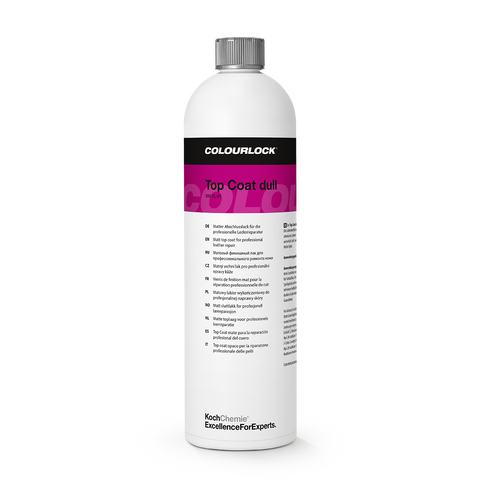
The matte version is the standard for modern interiors. COLOURLOCK "Leather Fresh" (Dull / Neutral) contains finely tuned matting particles that scatter light diffusely rather than reflecting it. Professionally, this value is measured in gloss units using a 60-degree measurement geometry; a matte leather finish is typically under ten units. In everyday terms: the greasy streak polished by jeans and hand sweat on the seat bolster and steering wheel rim disappears, and the surface looks as factory-original as the back seat next to it. The direct path to this is the matte Leather-Fresh base.
The glossy base works in the other direction. COLOURLOCK "Leather Fresh" (Glossy / Neutral) enhances reflection and restores optical depth to surfaces that have become dull—useful for decorative leather, furniture, handbags, and all surfaces that were silky-glossy from the factory. It is the wrong choice for a steering wheel for a very practical reason: more gloss means less grip, and a steering wheel rim that feels slippery is a step backward.
In between is the neutral base without gloss control, which simply balances out what has become uneven. If you want to refine the result even further, use the matting additive COLOURLOCK "Duller"—it lowers the gloss level in the mixture step by step instead of forcing you to choose between two fixed levels. This is the point at which detailers work with a test area rather than their gut feeling.
The two families share the preparation process but diverge during application. If you mix up the tools, you will produce the exact error patterns that are later reported as product defects.
For smooth leather, the work begins with a leather cleaner—mild for the standard surface, strong for heavily used grip zones. Then comes the degreaser COLOURLOCK "Degreaser" until the surface appears uniformly matte—otherwise, skin oils and care residues will form a barrier film that prevents the base from bonding properly. Apply using a dabbing sponge or a soft pad in small, circular motions, ultra-thinly, using several layers instead of one. Let it dry between layers, briefly go over it with a fine leather sanding pad if necessary, then apply the next layer.
Everything is different for nubuck and suede. Clean with the gentle aniline and nubuck cleaner; the surface must be completely dry afterward. COLOURLOCK "Nubuck Fresh" (Neutral) is sprayed on evenly from a distance of about 20 to 30 centimeters—do not dab and do not rub in. After it has dried thoroughly, raise the nap again with a nubuck or crepe brush—this step is not a refinement, but the moment the velvety look returns. Sparse spraying remains the rule, as too much material will clog the pores.
A special case, which occurs in cars more often than you might think, is perforated leather. Ventilated seats and center panels with hole patterns handle the base well as long as none of it runs into the holes—if it does, the material doesn't dry properly; it settles and permanently blocks the perforation. Therefore, dab target areas with a sponge instead of dragging it, keep the applicator relatively dry, and plan on applying one extra layer instead of one heavy one. For nubuck surfaces with hole patterns, the same rule applies to the spraying distance: more distance, less material per pass.
What applies to both methods is the environment. No water-based formula will bond cleanly at a cool 12 degrees in the driveway, and in direct sunlight, it will start to set before it has a chance to distribute. We recommend an interior at room temperature, open doors for ventilation, and time instead of hot air. In our experience, a steering wheel takes a good hour including drying breaks, and a complete set of seats takes an afternoon—and both look better than the same job done in half the time.
A color-neutral refresher makes a surface uniform. Where color is missing, it makes the color loss uniformly visible—this is the boundary that costs the most in this category.
We regularly receive messages from customers who have treated a faded driver’s seat bolster with a neutral base and were less satisfied afterward than before. The reason is physics, not botched work: before, the uneven gloss hid the lighter tone; afterward, the gloss is uniform and the pale spot stands out clearly on the seat. If you can see a color difference when looking across the surface in raking light, the refresher is the wrong step—in that case, the path leads through the Leather Colors or the Original leather colors by car brand, where the tone is mixed according to a color sample.
The second boundary is the substrate. COLOURLOCK "Leather Fresh" belongs on pigmented smooth leather with an intact pigment layer. Aniline leather without a top coat, nubuck, and suede are open-pored—on these, a film-forming base would clog the fiber structure, which is exactly why COLOURLOCK "Nubuck Fresh" (Neutral) exists. Despite its similar look, Alcantara is a pure synthetic material and belongs in neither family. A drop of water on an inconspicuous area settles the question in thirty seconds: if it beads off, the surface is coated; if it absorbs and darkens, it is open-pored.
The third boundary is structural and non-negotiable. Seats with side airbags have a predetermined breaking seam that must tear open in a defined way in the event of deployment; any film-forming product stiffens the material locally and has no business being there. Ripped seams, detached covers, and collapsed upholstery are jobs for a saddler—applying a refresher over a crater will only result in a uniformly matte crater. And to be honest about durability: no finish lasts forever on areas that are constantly gripped, such as the steering wheel rim. If you want to extend the effect, follow up with a top coat in the matching gloss level.
Two simple checks at the problem area answer the question faster than any product description: run your fingernail over it once, and look at it once in raking light.
If the nail doesn't catch anywhere, water beads off, and only a greasy shine is bothering you, the matte Leather-Fresh base is your product—the standard case for steering wheels, seat bolsters, and entry edges in modern cars. If the surface appears dull and flat, but was silky from the factory, reach for the glossy base. For nubuck, suede, and rough-out leather, there is no alternative to Nubuck Fresh, regardless of its condition. All neutral smooth leather variants, including the intermediate stage, can be found grouped under Leather Fresh Neutral bases.
If a lighter substrate is showing through or you see a genuine color difference, this category is over and the Leather Colors take over. For those who don't want to assemble items individually, the Color Sets contain the coordinated combinations of cleaner, base, and accessories that most first-time users start with. All other building blocks in the sequence are one level higher: Back to Dyeing & Finish.
And the thought that carries the whole category: the difference between a refurbishment you can see and one nobody can find is rarely the color tone. It’s the gloss next to it. That is why, for well-maintained leather, the color refresher is not the minor solution, but the precise one—it doesn't repair anything that isn't broken.
Troppa scelta in Ravvivacolore di COLOURLOCK? Fatti aiutare a scegliere:
Daniel von Detailing1 |

Daniel von Detailing1 |

Daniel von Detailing1 |

Daniel von Detailing1 |

Jasper von Detailing1 |

Daniel von Detailing1 |

Daniel von Detailing1 |

Daniel von Detailing1 |

Jasper von Detailing1 |

Jasper von Detailing1 |

Daniel von Detailing1 |

Daniel von Detailing1 |