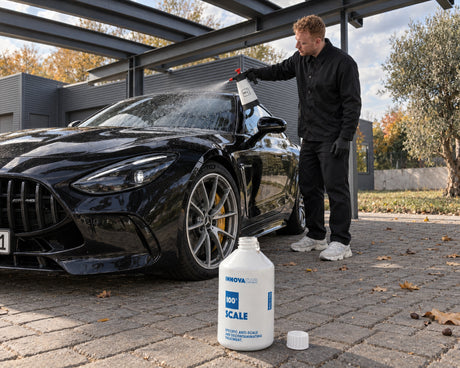
Togliere le macchie di calcare dai vetri dell'auto senza graffiarli
Daniel von Detailing1 |


Koch-Chemie × COLOURLOCK
COLOURLOCK "Leather Fresh" (Dull / Neutral) Base opaca e senza pigmento per ravvivare la pelle
Ravvivante pelle opaco e neutro
Koch-Chemie × COLOURLOCK
COLOURLOCK "Leather Fresh" (Neutral) base neutra per il ravvivante colore
Ravvivante pelle neutro per una finitura naturale
Koch-Chemie × COLOURLOCK
COLOURLOCK "Leather Fresh" (Glossy / Neutral) base neutra e lucida per ravvivare la pelle
Ravvivante lucido per pelle, colore neutro
What are COLOURLOCK's Leather Fresh Neutral bases? Pigment-free refresher bases for surface-dyed smooth leather; they are water-based and elastic. They provide the binder and sheen level—satin, matte, or glossy—while you mix in the color yourself using the appropriate leather dye. Professional-grade workshop chemistry for leather repair, not ready-to-use paint from a bottle.
COLOURLOCK Leather Fresh Neutral bases are colorless color refreshers for pigmented smooth leather: water-based binder dispersions without color pigment that dry into a thin, elastic film on the leather surface. What they provide is structure, adhesion, and sheen level. What they intentionally lack is color—which is added via the portion of leather dye you mix in yourself.
Pro-tip from Detailing1: When working with Neutral bases, things most often go wrong before any material is even involved—specifically when defining the work area. Almost every inquiry we receive describes spot-treating. It sounds sensible to address only the worn spot—but after drying, exactly that spot stands out more than before. The reason is not the color, but the fresh film: It reflects light differently than the aged surface next to it, even without any pigment. Therefore, always work from seam to seam rather than from spot to spot; the seam is the optical break line. And establish an untreated reference area beforehand to compare in daylight—the back seat is better for this than the passenger side, as it is rarely used and comes closest to the factory condition.
A Neutral base is not a diluted color. It is everything that makes up a leather dye, minus the pigments—the manufacturer appropriately calls them color binders.
Technically, this is a water-based polyurethane dispersion: tiny polymer particles floating in water; as the water evaporates, they settle together and grow into a continuous, stretchable film. This film performs three tasks simultaneously. It binds loose fibers of the abraded surface, it carries the matting or gloss agents that determine the level of reflection, and it is the layer into which pigment can later be embedded. Practically speaking: you decide on the feel and look with the base before any color is involved.
In our assortment, the bases are listed under color refreshers, one step before full recoloring. This isn't a matter of price class, but a question of condition: a refresher works on a layer of color that is still intact and merely looks tired. Where factory color has worn through and light-colored sub-surfaces appear, the work begins with opaque leather dyes, not here.
You can also use the color-neutral version completely without pigment. COLOURLOCK "Leather Fresh" (Neutral) then evens out dull and greasy-looking zones to a uniform level without affecting the tone—typical for steering wheel rims, entry edges, and seat bolsters that have worn shiny at different rates. To be honest: this intervention is not invisible. You change the look, just via the sheen rather than the color.
You don't choose the base based on taste, but based on the finish your leather has from the factory—and for automotive leather, this is almost always satin matte.
That is why COLOURLOCK "Leather Fresh" (Neutral) is the standard choice: it dries satin matte and thus lies at the same reflection level as a well-maintained stock interior. The deviations above and below are covered by the two specialists. The matte base, COLOURLOCK "Leather Fresh" (Dull / Neutral), intentionally goes deeper into diffuse scattering. It is the choice for surfaces that need to be matter than standard—steering wheels, for example, where gloss looks like it has been refurbished and also feels slicker.
The glossy base, COLOURLOCK "Leather Fresh" (Glossy / Neutral), works in the other direction. It builds up directed reflection and brings back optical depth where it belongs to the material: decorative interior parts, furniture leather, handbags, and fashion leather that come with a visible shimmer from the factory. On a satin-matte car seat, the same gloss would be a mistake.
One trap lies in the reference surface itself. Leather becomes shinier on its own over the years because friction and skin oils smooth out the grain—the driver's seat of a high-mileage vehicle therefore appears significantly shinier than the back seat of the same car. Anyone who aligns their result with this aged surface will end up dyeing the wear-and-tear into the finish, only to wonder why the fresh bolster gleams next to the back seat. The factory state is the benchmark, not the current state.
For fine-tuning, there is also the matting additive COLOURLOCK "Duller," with which the gloss of a mixed batch can be steplessly reduced. There is no way back, however: if a layer has dried too shiny, you cannot remove it with an additive, but must instead apply a matter layer over it. In our consultations, this is the more frequent complaint—not the wrong tone, but the wrong sheen.
The mixture is unspectacular and yet has an upper limit: according to the manufacturer, the base can handle 20 to 30 percent leather dye, no more.
This limit is not a precautionary value, but physics. Pigment particles sit as foreign bodies in the polymer network—the more there are, the stiffer and more brittle the dried film becomes. Automotive leather is compressed and stretched when getting in, and a brittle film cracks at these exact stress points first. You can tell by this: anyone forcing coverage via the pigment portion will find the first fine crack on the crease much earlier than someone who builds up the same coverage via several ultra-thin layers. For high opacity, it is not the mixture that is responsible, but the opaque paint from the leather dyes. Conversely, the math works the same way: anyone stretching a pre-pigmented tint with the base shifts the ratio back in favor of the binder—less opacity per layer, but a softer transition to the untreated surface.
You don't have to guess the tone itself: in the original leather dyes, the series colors are available as pre-formulated recipes, organized by vehicle brand. You approach the color via your model and not via a color chart. What even the best recipe cannot do is hit the exact mark on aged leather. Ten years of UV light and heat shift every stock color—and a pair of colors that match outside can diverge under interior lighting. This is why an area ends at the seam and not in the middle of the leather.
In practice, mix in small batches and write down the ratio—mixing again without notes is the second most common problem after the sheen level. Shake vigorously before each application so that binder and pigment are homogeneous. And never judge the result while wet: the mixture develops its final tone only once dry; when damp, it appears darker and glossier than it will in the end.
Water-based binders only adhere where there is nothing between them and the leather grain—and there is something on every used seat.
Skin oils, sunscreen, residues of old care lotions, and silicones from cockpit sprays form a razor-thin separating film that a mild leather cleaner will not remove. Therefore, cleaning must come before the base, followed by a degreaser. Raised, rough fibers in worn areas are subsequently leveled with a leather sanding pad without pressure. For leather that is generally crumbly or brittle, a stabilizing step using primer belongs before this; otherwise, you are working on a substrate that does not have structural integrity itself.
The application follows the data sheet and is deliberately boring: apply the base to a fine-pored sponge, never directly onto the leather, then distribute in a dabbing motion or in small circles from seam to seam. Dry each layer immediately with a hair dryer on a medium setting before applying the next. Larger areas are professionally sprayed using a spray gun in a fine mist. Remove excess with a slightly dampened cloth and do not polish it away—fresh polymer layers will re-dissolve under pressure.
The finishing touch is the top coat, and it is not an optional extra. A base on its own has no significant abrasion resistance; without a clear protective layer on top, the fresh layer will rub off against jeans seams and belt buckles. From our daily experience at Detailing1: for the first pass on a seat bolster, plan for an hour rather than twenty minutes—the larger part of which is waiting between layers. Anyone who rushes this will get clouds instead of a uniform surface.
Two conditions from the data sheet are often overlooked. The bases are water-based and thus sensitive to frost—a bottle that sits in the car or an unheated garage overnight in winter can flocculate and cannot be processed evenly thereafter. And before a contrasting seam comes within range of the sponge, it is masked off: masking tape is applied faster than a dyed-over seam can be restored.
A binder film is neither filler nor a replacement for color—and it does not belong on every type of leather.
The first limit is the lack of filling power. Fine scratches and dull zones disappear visually, but a crack or a split bolster does not. We tested this on a sample piece with an open edge: the film settles over the edge, looks fresh, and cracks again along the same line at the first bend. Anything that can be felt as an edge when running your finger over it must be closed beforehand with leather fillers.
The second limit is actual pigment loss. Where the factory color has worn through and the light-colored base shows, a weakly pigmented mixture only masks—it does not cover. At this point, COLOURLOCK "Leather Colour" is the right material, not the base.
The third limit is the substrate. Aniline leather, velour, nubuck, and Alcantara do not have a closed surface layer: the dispersion soaks uncontrollably into the open pores, glues the fiber surface, and turns a velvety feel into a patchy, hard surface. For nubuck and velour, there is a dedicated base available in Nubuck Fresh, which preserves the velvety nap instead of gluing it shut. When in doubt, test in an inconspicuous area before applying to the whole surface.
And one zone remains off-limits, regardless of skill: the side airbag tear seam in the outer seat bolster. It must open in a defined manner upon deployment, and any hardening layer applied over it changes this behavior. Anyone working there requires the expertise of a professional saddler—this is not a cosmetic issue.
Three questions lead to the right base, and the color is not one of them—it comes last.
First question: How does the adjacent surface shine? Stand at an angle to the window and look at an unused reference area in the grazing light. Standard satin-matte car leather gets COLOURLOCK "Leather Fresh" (Neutral). If it should be matter than the standard, such as on a steering wheel, COLOURLOCK "Leather Fresh" (Dull / Neutral) is the choice. If the material has a visible shimmer—decorative parts, furniture, handbags—COLOURLOCK "Leather Fresh" (Glossy / Neutral) is correct.
Second question: Do you need color or just evening out? Without pigment, the tone remains as it is, and you correct only the sheen. If the tone should be included, the color portion comes from the leather dyes—within the 20 to 30 percent range that the base can handle.
Third question: Do you want to assemble the chain yourself? If not, it is pre-packaged in the Leather Fresh sets, including application materials and, depending on the set, cleaner and protection. Anyone planning the complete setup will find the other components one level higher: Back to the color refreshers from COLOURLOCK.
The point we most often have to correct against gut feeling in consultations: anyone choosing the base after the color makes two mistakes. The color tone can be mixed, lightened, and matched over several layers. The sheen level is fixed once dry—you can only correct it by starting over from the beginning.
Troppa scelta in Basi neutre Leather Fresh di COLOURLOCK? Fatti aiutare a scegliere:
Daniel von Detailing1 |

Daniel von Detailing1 |

Daniel von Detailing1 |

Daniel von Detailing1 |

Jasper von Detailing1 |

Daniel von Detailing1 |

Daniel von Detailing1 |

Daniel von Detailing1 |

Jasper von Detailing1 |

Jasper von Detailing1 |

Daniel von Detailing1 |

Daniel von Detailing1 |