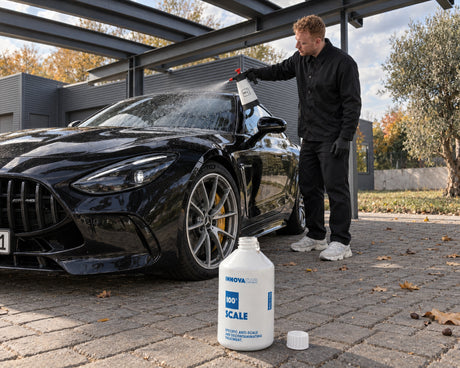
Togliere le macchie di calcare dai vetri dell'auto senza graffiarli
Daniel von Detailing1 |


Koch-Chemie × COLOURLOCK
COLOURLOCK "Crosslinker CD" Indurente
Film di colore più forte e finitura pro per la massima durata
What is the COLOURLOCK crosslinker? A reactive color additive for leather dyeing: COLOURLOCK "Crosslinker CD" crosslinker is added to the mixed leather color and top coat in small amounts and crosslinks their binders as they dry. It turns a soft paint film into a layer that resists friction, sweat, and cleaners.
COLOURLOCK crosslinkers are the hardeners for leather dyeing — known in the industry as crosslinkers. COLOURLOCK "Crosslinker CD" is added as a color additive to freshly mixed leather paint and top coat, where it connects the binder's polymer chains to one another. The parallel chains are transformed into a cohesive network. The dosage is determined by the substrate, not the color shade: one to two percent for leather, significantly more for artificial leather and hard plastic surfaces.
Expert tip from Detailing1: The crosslinker is the most reactive product in the entire dyeing process, and it does not forgive water. We regularly receive inquiries about steering wheel rims that were worn smooth again after just a few weeks despite using the crosslinker — and almost always, the additive was added to a damp mixing cup, stirred with a freshly rinsed stirring rod, or left open for days. What helps: Shake the bottle vigorously before every batch, stir again after letting it sit for about fifteen minutes, use a dry cup and a dry stirring rod, and seal it immediately after use. Only mix as much top coat with crosslinker as you can use in the next two to four hours. Anything left sitting too long is spent — saving it does not work with this product.
A dye job almost never fails in the middle of a surface. It comes off where fabric, skin, and metal rub over the same spot every day.
These zones are the same across all vehicles: the steering wheel rim between ten and two o'clock, the driver's seat bolster, the door entry edge, the armrest in the door; for furniture, the front seat edge and the armrest. Then there are the aggressors: jeans rivets and belt buckles as mechanical edges, rings and watch straps as point pressure, hand sweat, sunscreen, and cleaning residue as constant chemical loads. None of these points attack the color shade. They all attack the layer in which the color shade sits.
Affected individuals describe how this feels in forums in an astonishingly uniform way: in midsummer, you stick to the heated seat surface, color rubs off onto the cloth during cleaning, and light-colored trousers get a stain. This is not a color defect and not a care error. It is a paint film that becomes soft in heat and humidity because nothing holds it together.
The reason lies in the physics of the film. A leather paint is a dispersion of pigment and binder — as it dries, the water evaporates, and the binder particles flow together into a closed film. Without crosslinking, their polymer chains only lie next to each other, held by weak forces of attraction. Heat loosens these forces, as does moisture, and friction pushes the chains apart. In exactly this sequence, a dye job loses its surface.
That is why the crosslinker in this category is not an enhancer for the ambitious, but the difference between a dye job that survives a summer and one that does not. Everything else in the build-up determines how the surface looks. The crosslinker determines how long it looks that way.
A crosslinker is a reactive additive that creates chemical bridges between the polymer chains of the binder as it dries.
The visual equivalent is a pile of loose threads: you can pull it apart without breaking a single thread — the threads simply slide away from each other. If the same threads are knotted together at a thousand intersection points, a net is created that only gives way when the threads themselves break. For you, this means: the same paint, the same layer thickness, the same color shade — and yet a surface that absorbs significantly more friction before it wears off.
The measured value for this is wet rub fastness. It describes how many rub cycles a surface can withstand in a damp state before color transfers to the rubbing medium. In everyday life, this rubbing medium is not a testing machine, but your trousers on the seat bolster and your damp palm on the steering wheel rim. In other words: the exact complaint "the leather is staining" is a wet rub fastness that was too low.
The second effect concerns the surface itself. The crosslinker improves the friction values of the top coat and makes it more resistant — and because the layer can withstand more, it requires less material for the same durability. Top coat consumption therefore drops instead of rising. This is the point where many misclassify the additive: it is not an additional layer, it makes the existing one more resilient.
And from this follows the rule upon which the entire category depends: mix it fresh. As soon as paint or top coat contains the crosslinker, the reaction begins — in the cup just as on the leather. There is, therefore, no such thing as a pre-mixed supply bottle, and there cannot be. Anyone who has worked with two-component paint knows the logic: the product is created the moment you stir it together.
The dosage depends on the material under the paint, not the size of the surface. The data sheet covers four cases.
The standard case is the COLOURLOCK Top Coat & Finish: one percent crosslinker for soft furniture and clothing leather, two percent for robust, heavily used automotive and furniture leather. This is the decision between an armchair used twice a day and a driver's seat bolster that rubs over the sill edge every time you get in.
When genuinely changing colors, a second point is added. Then two percent extra goes into the COLOURLOCK leather paint, while the top coat remains at its one or two percent. The reasoning behind this is consistent: if the paint layer itself is the carrier of the look, it must not be the softest layer in the setup.
Artificial leather and vegan leather need more. Here, the data sheet specifies five percent in the leather paint and five percent in the top coat. For hard, plastic-like surfaces, the share rises to eight percent — in the COLOURLOCK plastic primer, the paint, and the top coat. These substrates do not absorb anything; they only offer a smooth surface. What holds there holds due to its own strength.
In practice, the dosage rarely fails due to the percentage value and often due to measuring. One percent of a small amount is just a few drops, and no one can estimate that reliably from the bottle. From the Detailing1 daily routine: for a steering wheel rim, about 30 to 50 ml of mixed top coat is sufficient, one percent of which is half a milliliter. We therefore recommend mixing cups with a scale or a precision scale with a tenth-of-a-gram resolution — both require one-time attention and remove the greatest source of error from the mix.
The crosslinker is the last product you pick up before spraying or applying. The entire preparation happens beforehand.
The sequence is defined by the data sheet: clean, degrease, prime, fill, dye, finish with top coat, adjust the finish using additives. The COLOURLOCK degreaser removes skin oils, care product residue, and silicone films; this is followed by priming and paint buildup. The complete process is listed under COLOURLOCK Dyeing & Finish. The crosslinker only intervenes in the last two steps — and only when the surface is ready for painting in front of you.
A clock starts ticking the moment you stir it in. The mixture remains optimally workable for two to four hours; after that, it is spent. Therefore, calculate backward: how many square centimeters can you manage in this window, and how many cross-layers do you want to apply? For a single seat bolster, this is generous; for a complete set, it is better to plan two batches instead of one large one — the second is mixed fresh when the first is done.
The second condition is dryness, and it is stricter than most expect. COLOURLOCK "Crosslinker CD" crosslinker reacts strongly with water: if left open or in contact with moisture, it becomes unusable without showing it. Shake well before each use and stir again after letting it sit for about fifteen minutes — otherwise, the paint layer could later dissolve upon contact with water. This exact point explains a large part of the cases in which the crosslinker seemingly did not work.
The same logic applies to storage: protect from frost and heat, keep the bottle consistently closed, do not store in a summer car or an unheated outdoor storage area. A crosslinker that has spent a winter in a metal shed is not a cost-saving measure but an incalculable risk.
A crosslinked film is only as good as the layer underneath adheres to the leather. Four limits should be on the table before purchasing.
We demonstrated the first one to ourselves. On a sample piece of smooth leather, we dyed two halves, one cleaned and degreased properly, the other only cleaned — both with the same mix of paint and crosslinker. On the degreased half, the film sits to this day. On the non-degreased half, it peels off in large, cohesive flakes with a fingernail, and that is exactly the irony: because the film is more heavily crosslinked, it does not come off as fine abrasion, but as a sheet. A crosslinker improves the film. It does not improve the connection to the leather.
The second limit is the substrate. Open-pored leathers — aniline, nubuck, suede — are deliberately not given a closed paint film because that would destroy their character. There, color freshening works with its own logic, for example via COLOURLOCK Nubuck Fresh, and pure care is handled via COLOURLOCK Aniline Leather Care. A crosslinker has no place in either case.
The third limit is the toughest and not chemical. Seats with side airbags have defined tear seams that must rip open exactly at that spot in an emergency. A crosslinked film is by definition stiffer than an uncrosslinked one — exactly the property you want on a seat bolster is a risk at the tear seam. Such surfaces belong to an upholsterer who professionally spares the seam. This is not a precautionary formula for adhesion, but the point at which a home project sensibly ends.
And the fourth: the crosslinker does not adjust anything related to the look. It does not match a color shade, fill cracks, or make hardened old leather flexible again. The degree of gloss is regulated by the matting additive, the feel is regulated by the COLOURLOCK Soft & Wax Slip handle additives. Anyone who doses too high will get a noticeably harder, plastic-like feel — the specified percentages are upper limits for their case, not recommendations to round up.
The answer depends on a single question: will the surface you are treating be rubbed in everyday life or just looked at?
If you are only freshening up the color of a faded rear seat, a door panel, or a furniture mirror, you can get by without it. The COLOURLOCK color fresheners are made for this case, and an additional hardener offers no measurable benefit there. Honestly: the largest part of the refresh jobs we receive falls into exactly this category.
The crosslinker is needed as soon as one of the friction zones is involved — steering wheel rim, driver's seat bolster, entry edge, armrest, front furniture edge — or as soon as the substrate is not genuine leather. Then the rule is: two percent in the top coat for robust automotive and furniture leather, one percent for soft furniture and clothing leather; when changing colors, an additional two percent in the paint, five percent on artificial leather, eight percent on hard plastic surfaces. The product behind this is COLOURLOCK "Crosslinker CD" crosslinker in the 50 ml bottle — the size fits the consumption amount, not the project size.
The remaining adjustment screws for gloss, feel, and consistency are one level higher: Back to COLOURLOCK Additives & Auxiliaries. If you are dyeing for the first time, it makes sense to complete a full buildup without special requests and fine-tune the gloss and feel on the second project.
And the thought that carries the whole category: the crosslinker is the smallest item in the entire dyeing project and the one with the greatest leverage. It costs you milliliters per batch and two minutes of stirring. It decides whether the driver's seat bolster still looks like it did on the day of dyeing after the first summer — or whether you will be degreasing, priming, filling, and dyeing a second time.
Troppa scelta in Crosslinker reticolante di COLOURLOCK? Fatti aiutare a scegliere:
Daniel von Detailing1 |

Daniel von Detailing1 |

Daniel von Detailing1 |

Daniel von Detailing1 |

Jasper von Detailing1 |

Daniel von Detailing1 |

Daniel von Detailing1 |

Daniel von Detailing1 |

Jasper von Detailing1 |

Jasper von Detailing1 |

Daniel von Detailing1 |

Daniel von Detailing1 |