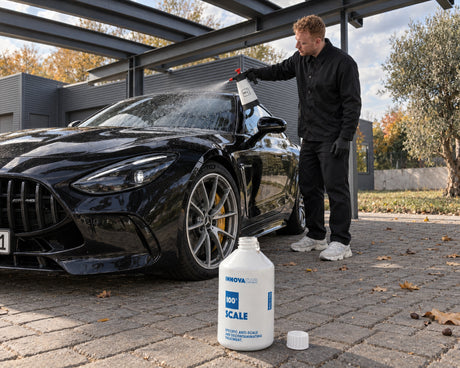
Togliere le macchie di calcare dai vetri dell'auto senza graffiarli
Daniel von Detailing1 |


Koch-Chemie × COLOURLOCK
COLOURLOCK "Binder" (Neutral) — riempitivo neutro per pelle fragile e screpolata
Primer neutro per preparare la pelle alla riparazione
What is COLOURLOCK Filler? A pigment-free binder for brittle, micro-cracked leather surfaces: COLOURLOCK "Binder" (Neutral) penetrates the weakened topcoat of pigmented smooth leather, elastically bonds loose fibers from within, and restores the surface's structural integrity for leather color and topcoat.
Filler is the work step between priming and coloring: a pigment-free, highly elastic binder that holds a brittle leather surface back together. The name is misleading — it does not actually dye anything. The filler fills micro-cracks in the existing pigment layer, binds frayed fibers, and creates the substrate required for leather color to be applied evenly and adhere permanently. At COLOURLOCK, this task is performed by the neutral Binder.
Professional tip from Detailing1: The most common mistake is already hidden in the term "filler" — many people expect a putty and apply it accordingly thick. That is exactly what ruins the result: a heavy layer dries on the outside, remains soft on the inside, becomes gummy, and tears sooner than the leather underneath. We regularly receive inquiries from customers whose refinished seat bolster showed fine cracks again after a few weeks, and almost always the first layer was applied too heavily. The opposite is correct: apply thinly using a sponge, swab, or brush, let it dry briefly, then apply the next layer. Two thin layers are better than one thick one — and if the surface still feels unstable after the second layer, add a third, not a thicker one.
When leather ages, the color disappears first, followed by its structural integrity. The filler takes care of the second part — the one you only notice when you touch it.
Pigmented smooth leather has a thin, closed topcoat on the grain. Sun, friction, and skin oils attack this polymer over the years: it becomes brittle, loses its bond to the fibers underneath, and develops microscopic cracks. This becomes visible long before a real crack appears — as a matte, rough zone on the seat bolster, entry edge, or steering wheel rim that feels dull and slightly fibrous. If you run your finger over it, there is a slight drag.
This is exactly where the binder comes in. It is a water-based dispersion, meaning ultra-fine polymer particles suspended in water. After application, the water evaporates, and the particles flow together into a cohesive film — coating chemistry calls this film formation. Because this binder is formulated to be thin and penetrating, this happens not just on the surface, but in the broken gaps of the old topcoat. In other words: It acts like a glue that pulls back together from the inside what has drifted apart.
Timing determines the effort. A surface that is merely brittle needs two to three thin layers and is then load-bearing again. The same surface a year later, with visible hairline cracks and frayed edges, additionally requires filler, intermediate sanding, and usually a complete recoloring from seam to seam. Taking the rough texture seriously early on saves you the elaborate process later.
There is one product in this category, and it intentionally has only one task: COLOURLOCK "Binder" (Neutral).
Neutral here means without any pigment. The binder does not change the color of the surface; it does not lighten, darken, or shift the gloss level toward a greasy look. This is why it also works where you do not want to change the color at all: a dark leather sofa with a rough seat can be stabilized without having to search for a color match.
Its typical areas of use are where clothing rubs constantly. In the car, these are the driver's seat bolster, entry edge, armrest, and steering wheel rim; in furniture, the front edge of the seat and the armrests; for bags, belts, and leather jackets, the crease and grip zones. In all these places, the topcoat is the first to become brittle, while the rest of the surface still looks flawless.
Two sizes cover realistic project needs. The 250 ml format is for a single bolster, a steering wheel, or a sofa edge — with enough left over for a second pass, which is almost always needed. The liter is the workshop size for complete seating sets that are stabilized over the entire surface before a spray gun is used. In our experience, DIY users are almost always right with the small container: the binder is applied thinly, and an opened bottle lasts a long time if stored frost-free.
Three product groups that all sound like repairs work on three completely different problems. Confusing them means working on the wrong type of damage.
Filler is for surface brittleness. No loss of material, no holes — the substance is still there, it just no longer holds together. This is the case where your fingernail doesn't catch anywhere, but the surface feels rough and crackles slightly when pressed.
Leather fillers are for the opposite case: actual loss of material. COLOURLOCK "Filler" (Black) and COLOURLOCK "Filler" (White) provide elastic mass for craters, nicks, and worn-through areas and are sanded finely after drying. If your fingernail catches in a crack, you need filler — not a binder. For deeper, heat-curing repairs, putty is available.
Opaque leather color finally provides pigment. COLOURLOCK "Leather Colour" builds a new color layer in thin coats when nothing of the original tone is left. It does not repair anything, it covers — and it only covers permanently if the surface underneath is sound.
This leads to a simple "if-then" logic. If the surface is rough but intact, start with the filler. If material is missing, start with the body filler and then use the filler over the transitions if necessary. If both are fine and only the tone looks dull, skip the whole process and stick to the color refresher. In our consulting, this is exactly the question we clarify most often: most customers overestimate their damage and underestimate the preparation.
A binder only binds to what it reaches. Anything between the binder and the leather is a release layer — and release layers are the reason why leather repairs fail.
That is why the process starts with cleaning using a leather cleaner and a soft brush, followed by the step almost everyone skips: degreasing with COLOURLOCK "Degreaser". It is only finished when a white cotton cloth no longer picks up any color. Anyone who uses brake cleaner, acetone, or denatured alcohol instead will remove the grease but also attack the tanning in the fiber — after that, no system from any manufacturer will hold in that spot.
On difficult, heavily silicone-contaminated, or very smooth surfaces, use a primer before the filler: COLOURLOCK "Leather Primer" as an adhesion bridge, COLOURLOCK "Blocker" as a barrier layer if denim dye transfer is showing through. With intact, cleanly degreased smooth leather, you can skip this step — but it is better not to for older leather with a long history of care products.
Then comes the binder, applied in several fine layers using a sponge, swab, or brush. Let it dry briefly between layers, sand lightly with a very fine leather sanding pad for deeper irregularities, and remove sanding dust with a microfiber cloth. The application temperature is about 18 to 24 degrees Celsius: below this, the polymer particles do not flow together cleanly; above this, the surface dries before the binder has penetrated.
Only then does the color application begin — depending on the case, with a color refresher or opaque leather color, finished with the top coat as a wear layer. Use the additives to adjust the finish: the Crosslinker makes color and top coat more durable, the Duller lowers the gloss level, and Soft Slip and Wax Slip determine the feel. At the end is the part that no product can shorten: chemical cross-linking takes 24 to 48 hours, and for that long, neither jeans nor re-greasing care products belong on the surface.
A binder can hold a weakened structure together. It cannot replace a destroyed one — and that line is sharper than most expect.
The first limit is the type of leather. Aniline, nubuck, suede, and Alcantara are open-pored and have no topcoat that could be stabilized. A binder will saturate the fiber structure there, make the surface stiff, and take away exactly what you bought the leather for. A drop of water in an inconspicuous spot clarifies this in thirty seconds: if it soaks in and darkens the spot, the leather requires aniline leather care, not a binder.
The second limit is actual loss of substance. If the fiber network beneath the grain is torn or punctured, no chemical can withstand the tensile forces that occur when sitting down — the repair will tear open again. The same applies to leather that has shrunk irreversibly due to decades of heat and feels like cardboard: the material will break next to the treated area upon the first flex. We prefer to say this beforehand rather than afterwards, because both cases will not improve with good intentions and three layers of binder.
The third limit is safety-relevant and non-negotiable. Seat bolsters with integrated side airbags have a predetermined breaking seam that must tear open precisely in the event of deployment. Any binder, filler, or top coat will stiffen the material there — none of those have any place on that seam. Such seams, detached covers, and saggy cushions are upholsterer work. Also be careful with perforated leather for seat ventilation: the binder will clog the fine pores if applied too heavily, and with the pores, the function disappears.
And an honest assessment of expectations: this is workshop chemistry, not a weekend polish. The sequence of degreasing, priming, filling, coloring, top coating, and additives follows the data sheet, not intuition, and the order is not optional. If you don't want the effort, you are better served with a color refresher for light cases — or with a professional detailer who does the surface in one pass.
Two checks on the damaged area clarify the decision faster than any product description: run your fingernail over it once, and place a drop of water on it once.
If the drop beads up and the nail doesn't catch anywhere, while the surface still feels rough, dull, and fibrous — then COLOURLOCK "Binder" (Neutral) is exactly right, and that is before any color comes into play. If the drop soaks in, your leather is open-pored and this category is the wrong one. If the nail catches in a crack, start with the body filler.
If the surface is stable again afterwards, the condition of the color determines the next step: only become dull, then the color refresher is enough; visibly worn off, then the opaque leather color and the top coat over it. If you don't want to assemble the components individually, you can find matched combinations in the repair kits. One level up are all the brand's color stages: Back to COLOURLOCK leather colors, and you can find the complete range under Dyeing & Finish.
The idea that supports this category is unspectacular and yet makes all the difference: the filler is the only step in the dyeing process that you don't see in the result — and the first one whose absence you do see. Any leather dyeing job that tears open again after months is the bill for a surface that was never load-bearing. Two thin layers of binder on an afternoon decide whether the work above it lasts for years or for a single season.
Troppa scelta in Colore riempitivo di COLOURLOCK? Fatti aiutare a scegliere:
Daniel von Detailing1 |

Daniel von Detailing1 |

Daniel von Detailing1 |

Daniel von Detailing1 |

Jasper von Detailing1 |

Daniel von Detailing1 |

Daniel von Detailing1 |

Daniel von Detailing1 |

Jasper von Detailing1 |

Jasper von Detailing1 |

Daniel von Detailing1 |

Daniel von Detailing1 |