




5 leather brush mistakes that roughen car leather
Daniel von Detailing1 |


THE COLLECTION
"Flex Brush" Microfibre Wheel Brush
Flexible Microfiber Wheel Brush for Safe Cleaning


Soft99
Digloss Kamitore Sponge Wheel Brush
Revolutionary wheel brush for flawless cleaning and shine


TUGA Chemie
Wheel brush for "Alu-Teufel "Spezial" (Green)"
Nylon-Nylex Wheel Brush 34cm with Memory Effect, acid-resistant


THE COLLECTION
Microfibre Wheel Brush Cover for the "Flex Brush" Microfiber Wheel Brush / Microfibre Wheel Brush
Microfiber cover for safe rim cleaning


Meguiars
Large Wheel Brush for Spokes and Rim Surfaces

Brake dust in the mitt grinds the paint. Two mitts, one wash.
Koch-Chemie
Wheel Brush Set "Wool" for Delicate Wheels
Koch-Chemie
Wheel Brush Set (Nylon Bristles)

GYEON
Q²M WheelBrush Wheel Brush (Microfibre)

Meguiars
Angled wheel brush for deep rim areas
What is a wheel brush? A long-handled brush that carries wheel cleaner and wash solution between the spokes and into the barrel, where your hand and wash mitt can't reach. What matters is the contact material and the design, chosen to suit your wheel's finish, spoke spacing and barrel depth.
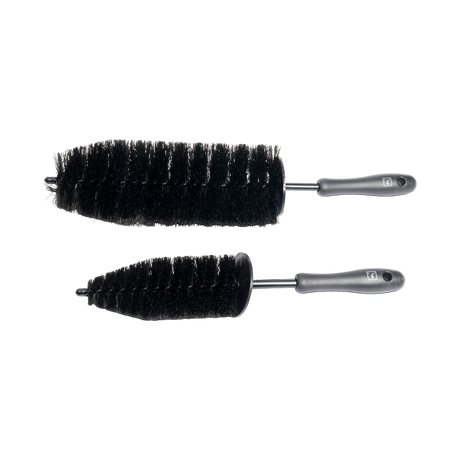
Wheel brushes are brushes with a handle and a contact head made of synthetic bristle, microfibre, lambswool or foam, built to pull loosened brake dust out of the gaps between spokes, out of the barrel and off the wheel face. They don't replace a cleaner: the chemistry loosens, the brush moves it. Our range comes from several brands and goes from nylon bristles to microfibre wrapped around a flexible core.
Detailing1's tip from the shop: Even a soft brush will scratch the wheel if it's been over the tyre sidewall first. Sand and rubber particles then sit in the fibres and grind across the finish on the next pass. So keep your wheel and tyre tools separate, ideally colour-coded, and use a dedicated tyre brush for the sidewall. The same separation applies to paint and interior: wheel tools stay on the wheels.
A wheel brush carries wheel cleaner and wash solution into the gaps between spokes, into the barrel and onto the backs of the spokes — exactly where a wash mitt gives up against the wheel's geometry.
Brake dust builds up where you can least reach it: behind the spokes, in the barrel and around the wheel nuts. If it stays put, the wheel looks clean from the front after washing and grey behind. The wheel cleaner breaks the layer down chemically; the brush supplies the movement that pulls the loosened dirt out of the corners.
This collection carries long-handled brushes for barrels and spokes — the tools for depth: long handle, slim head, a contact material that suits the finish. For the wheel face, the bolt circle and the wheel nuts, reach for a detailing brush; you'll find suitable models under Detailing brush. For an overview of every brush for interior, wheels and tyres, head to the parent category Brushes & detailing brushes.
Which cleaner suits which wheel is a question of chemistry and is covered under Rim cleaner. This page deals with the tool: material, length and construction. Those three points decide whether the wheel comes out clean and stays undamaged.
Do you even need a brush? On forums, some drivers reckon an old wash mitt is enough, and on wheels with a few widely spaced spokes and a shallow barrel, that works. As soon as the spokes sit close together or the barrel runs deep, your gloved hand can't get behind the spokes any more. From that point on, the brush isn't a luxury — it's the only way to get at the brake dust.
The contact material decides how much cleaning solution the brush carries, how it picks up brake dust and how delicate the surface you're working on can be.
Nylon bristles are the tough option. The TUGA Chemie Wheel brush for "Alu-Teufel "Spezial" (Green)" uses Nylon-Nylex, a synthetic fibre from the polyamide family that TUGA describes as acid-resistant and metal-free in construction. According to the manufacturer, bent bristles can be reshaped in hot water. What that means for you: the brush handles acidic and alkaline wheel cleaners, and you can bring it back into shape when the bristles splay.
The Koch-Chemie Wheel Brush Set (Nylon Bristles) also comes with nylon bristles, as a small and a large brush. With two sizes, it makes sense to do the face and spokes with the small one and the barrel with the large one. Nylon bristles are tough, chemical-resistant and reach deep into the barrel. On painted alloys in daily use, that's the hard-wearing choice; on polished or diamond-cut surfaces, go for a softer material.
Microfibre has no bristle tips. The fine fibres form a dense pile that traps brake dust instead of pushing it across the surface. The THE COLLECTION "Flex Brush" Microfibre Wheel Brush wraps this microfibre around a flexible core that bends into the barrel. You'll notice it straight away: the dust ends up in the fibre instead of on the wheel, so you need to rinse the fibre out after every wheel.
According to retailers, lambswool is softer than nylon and is sold for high-gloss, diamond-cut wheels and chrome. Foam heads also glide over the surface with no bristle tips. Both materials trap brake dust inside them, just like microfibre, and so need the same thorough rinsing.
| Contact material | Strength | Limit | Suits |
|---|---|---|---|
| Nylon synthetic bristle | tough, chemical-resistant, reaches deep into the barrel | bristle tips — use with care on high gloss | painted alloys in daily use |
| Microfibre | no bristle tips, picks up brake dust | holds on to dust — rinse after every wheel | painted, polished, coated and diamond-cut wheels |
| Lambswool | softer than nylon, according to retailers | holds on to dust — wash out thoroughly | high gloss, diamond-cut, chrome |
| Foam | glides with no bristle tips | holds on to dust — wash out thoroughly | delicate surfaces |
When a wheel brush scratches a wheel, comparison tests and detailing forums point to three causes: a bare wire core or metal parts on the head, bristles that are too hard, and brake dust trapped in the fibres.
A customer question we got about a wheel cleaner was simply: should I use a wheel brush? The real worry behind it is whether the brush will damage the wheel. Our answer: hard bristles can leave fine scratches on painted or polished wheels, and a microfibre brush is the gentle choice there.
The first source is metal. Some of the spoke brushes on the market build the head around a twisted wire. If that wire is exposed at the base of the bristles, or the protective cap at the tip comes off, metal touches the wheel.
So look for metal-free construction or a rubber-coated core. The TUGA brush is metal-free according to the manufacturer, and Meguiar's describes the microfibre head of the SUPREME Wheel Brush as free of bristles, wire and metal. On the Flex Brush, the microfibre completely covers the flexible core, so according to the product description you never touch the wheel with hard parts.
The third scratch source is one you bring along yourself. Brake dust and sand caught in the fibres turn any soft material into an abrasive. Neither nylon nor wool is completely scratch-proof. What makes the job safe is plenty of cleaner or shampoo solution acting as a lubricating film, and fibres that stay clean.
Two limits belong here too. Wheel tools never go on the paint, not even the softest version, because they carry brake dust over from the wheel. And acid-resistant only means the brush survives an acidic cleaner. Whether your wheel can handle that cleaner is something the cleaner's instructions tell you, not the brush.
The right wheel brush comes down to three things on your wheel: the surface finish, the narrowest gap between the spokes and the depth of the barrel.
For the finish, there's a simple if-then rule. If the wheel is polished, diamond-cut, chromed, high-gloss burnished, powder-coated or matt, use microfibre or lambswool. For diamond-cut wheels we recommend a soft microfibre brush together with an acid-free cleaner. If it's a painted alloy in daily use, it can take a soft nylon bristle too, as long as you work wet.
Spoke spacing decides the head size. For the Meguiars SUPREME Wheel Brush Large, Meguiar's specifies at least 4 cm at the narrowest point. If the spokes are closer together, as on delicate multi-spoke designs, you need a slim head or a flexible brush that bends through the gap, like the Flex Brush.
The barrel decides the length. The GYEON Q²M WheelBrush (Microfibre) comes in 37 and 47 cm, and according to Meguiar's so does the SUPREME Wheel Brush. For big wheels with a deep barrel, the longer version is the better pick; for small wheels and the spoke faces, the shorter one does the job. The TUGA brush sits in between at 34 cm with a wide bristle head.
What retailers sell as a barrel brush isn't a separate category — it's a long-handled brush with a slim head for the space behind the spokes. When choosing, make sure the head is narrow enough for your tightest gap and the handle long enough to keep your grip and hand in front of the spokes.
One limitation, to be honest: depending on the wheel design, no brush can reach the whole barrel, and a chunky head limits the reach even further. If your wheels have very tight spokes and a deep barrel, a slim, flexible brush will get you furthest. Whatever's left after that is a limit of the wheel, not the brush.
Only start brushing once the wheel cleaner has had time to dwell on the cool, pre-rinsed wheel — the dwell time loosens the brake dust and the brush pulls it out.
The order is always the same. The wheel has to be cool; a hot wheel straight after a drive makes the cleaner dry on. Rinse off loose dirt with clean water, apply the wheel cleaner according to its manufacturer's instructions and let it work for the stated time. Which cleaner suits your finish is something to check beforehand under Rim cleaner.
Then comes the elbow work. Do the wheel face, bolt circle and wheel nuts with a detailing brush or short brush, then the barrel with the long-handled brush. Move the brush through each gap with light pressure — the cleaner has already done the work. Between wheels, dunk the brush in its own bucket and rinse the brake dust out of the fibres; a grit guard at the bottom of the bucket keeps it down there.
Finally, rinse the wheel and wheel arch thoroughly with water before anything dries on. The first time, working the barrel takes longer, because you're still learning which angle gets the brush through which gap. After a few washes you'll know your wheels inside out.
Baked-on brake dust doesn't need a stronger arm — it needs a second round of cleaner. More pressure on the brush just rubs loosened particles across the surface. What else you can do about stubborn deposits is covered in our guide to baked-on brake dust.
Which wheel brush you need depends on whether your wheels have tight spokes, a deep barrel or a delicate finish; sometimes two brushes is the honest answer.
If your wheels have lots of spokes and a delicate finish, the Flex Brush with microfibre around a flexible core is the obvious place to start. If you run painted alloys with a deep barrel, the nylon bristles of the TUGA brush or the Koch-Chemie set with small and large brush cover both face and barrel.
There are two jobs a wheel brush doesn't do. The tyre sidewall needs a dedicated brush from Tyre brushes: microfibre, wool and foam give too much on rubber, and even a nylon wheel brush tolerates tyre contact but isn't built to scrub the sidewall. Then there's hygiene, because tyre grime shouldn't get into the fibres that go back over the wheel afterwards. That also applies to brushes sold as wheel-and-tyre brushes: use them for one of the two surfaces, not both.
We don't stock wheel brushes as drill attachments; Koch-Chemie's Drill Brush Sets are meant for carpets and textiles and live under Interior brushes. On the wheel, stick with a hand brush, where you control pressure and angle yourself.
We haven't found an independent wheel brush test from Stiftung Warentest or the ADAC. There are comparisons from trade magazines and scene blogs, and they boil down to three points: microfibre for delicate surfaces, slim flexible heads for tight spokes, long handles for the barrel. That's exactly how this page is laid out. Everything on wheels and tyres together is under Wheel and tyre cleaning.
The brush lasts a long time if you rinse it clean after every use, let it dry completely and store it away from paint towels and interior tools. With the Flex Brush, you swap out the THE COLLECTION Microfibre Wheel Brush Cover for the "Flex Brush" Microfiber Wheel Brush instead of replacing the whole brush. You get to choose the fibre, but not how clean it is: that happens in the rinse bucket, after every single wheel.
Too much choice in Wheel brushes? Get help picking:
Eine Felgenbürste ist eine Stielbürste mit einem Kopf aus Kunstborste, Mikrofaser, Lammwolle oder Schaumstoff. Sie holt gelösten Bremsstaub aus Speichenzwischenräumen und Felgenbett, wo Hand und Waschhandschuh nicht hinkommen. Den Schmutz löst der Felgenreiniger, die Bürste liefert nur die Bewegung. Für Radmuttern und Lochkreis nimmst du einen Detailing-Pinsel.
Kalte Felge vorspülen, Felgenreiniger nach Herstelleranleitung auftragen und einwirken lassen. Dann Front und Radmuttern mit dem Pinsel, das Felgenbett mit der Stielbürste bearbeiten, mit wenig Druck. Die Bürste zwischen den Felgen im eigenen Eimer ausspülen und am Ende alles gründlich abspülen. Bei eingebranntem Bremsstaub lieber ein zweiter Reiniger-Durchgang als mehr Kraft.
Nylonborsten sind chemikalienbeständig und robust, gut für lackierte Alufelgen im Alltag, etwa die TUGA-Felgenbürste. Mikrofaser hat keine Borstenenden und hält Bremsstaub fest, statt ihn zu schieben, wie die Flex Brush. Lammwolle ist laut Händlern weicher als Nylon und für Hochglanz, glanzgedrehte Felgen und Chrom gedacht. Weiche Materialien musst du nach jeder Felge ausspülen.
Das hängt von der Tiefe deines Felgenbetts ab. Die GYEON Q²M WheelBrush gibt es in 37 und 47 cm, Meguiar's nennt für die SUPREME Wheel Brush dieselben Längen, die TUGA-Bürste misst 34 cm. Für große Felgen mit tiefem Bett nimmst du die lange Variante. Prüf außerdem die engste Speichenlücke: Meguiar's verlangt für seine Bürste mindestens 4 cm.
Sie kann, wenn Metall oder Schmutz die Felge berührt: blanker Draht am Kopf, eine abgelöste Schutzkappe oder Bremsstaub und Sand in der Faser. Absolut kratzsicher ist kein Material, deshalb arbeitest du nass mit viel Lösung und spülst die Bürste nach jeder Felge aus. Auf polierten, glanzgedrehten und matten Finishes nimmst du Mikrofaser oder Wolle mit metallfreiem Kern.
Besser nicht. Mikrofaser-, Woll- und Schaumköpfe geben auf der Reifenflanke zu sehr nach, und auch Nylon-Felgenbürsten sind nicht zum Schrubben der Flanke gebaut. Dort arbeitet eine festere Reifenbürste den Schmutz aus dem Gummi. Dazu kommt die Hygiene: Reifenschmutz in der Faser soll nicht zurück auf empfindliche Felgenoberflächen. Halte Felgen- und Reifenwerkzeug getrennt und spül beide im eigenen Eimer aus.
Daniel von Detailing1 |

Jasper von Detailing1 |

Daniel von Detailing1 |

Daniel von Detailing1 |

Daniel von Detailing1 |

Jasper von Detailing1 |

Jasper von Detailing1 |

Daniel von Detailing1 |

Daniel von Detailing1 |

Daniel von Detailing1 |

Daniel von Detailing1 |

Daniel von Detailing1 |


