Clean a Tesla screen: what the Model Y touchscreen can take
Daniel von Detailing1 |


SONAX
PROFILINE GummiPfleger rubber & tyre care
GummiPfleger — Professional Rubber & Tire Care
Treat the rubber before the first frosty night and it opens in the morning.
Which rubber care product suits your car? The surface decides: a door seal needs different care from an interior mat that must retain its grip. Here you can find care for suitable exterior surfaces and rubber flooring, with clear guidance on application, finish and each product's limits.
Rubber care for cars is a treatment for already-clean rubber parts that refreshes and looks after their surface, depending on the product. Door seals, tyre sidewalls and interior mats perform different jobs. Their specified uses therefore matter more than similar colours or packaging. Choose care to suit the part and the result you want; applying a dressing will not repair a damaged rubber seal.

A practical tip from Detailing1: Set out 2 separate applicators: one for exterior care and one for mat care. An applicator is a tool, such as a soft sponge, that helps you spread the product precisely. Do not then use the same sponge on the floor mat. This keeps exterior dressing off a surface that needs to stay grippy beneath your shoes.
Suitable care refreshes clean rubber surfaces, while cracks, loose profiles and damaged seals call for inspecting the part rather than adding more dressing.
Start by checking the condition. If the surface is simply dirty, clean it before treating it. If a seal is torn or no longer sits correctly, a glossy film will not solve the problem. Nor will adding more product necessarily restore an area that still feels hard or damaged after cleaning. Assess the rubber without a layer of dirt hiding its condition.
A door seal presses against another surface when the door closes. A tyre sidewall stays visible outside. A floor mat supports your shoes. These different roles explain why the same darker look is not enough to choose a product. A cared-for sheen may suit the sidewall; a mat's finish must first suit its use in the footwell. The product must specifically cover that job.
For door and boot seals, find a more focused selection under rubber seal care. This broader category also helps you choose for other rubber surfaces. Follow the vehicle instructions for special window channels, flocked profiles or unusual coatings. A general “for rubber” statement does not answer every material question.
The same distinction matters when looking for something to soften rubber again. Care can maintain and refresh the intended surface. That is not a promise to restore aged material, lost shape or a damaged sealing edge. If the door still leaks or the profile looks wrong, investigate the cause in the part itself. Repeated rubbing does not replace that check.
Door seals and exterior rubber need suitable exterior care, while rubber mats require a product intended for grippy interior surfaces and a final check.
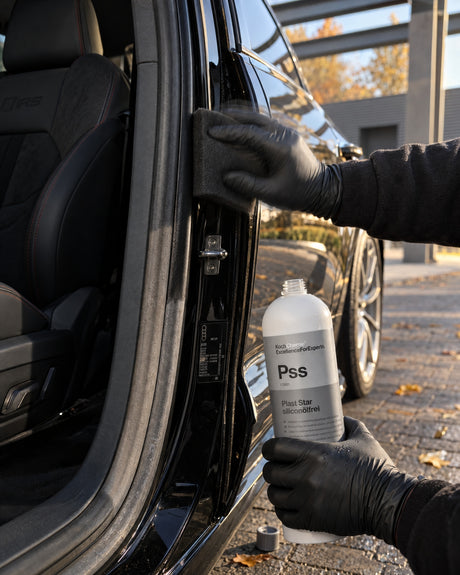
Koch-Chemie Plast Star "Pss" Premium Kunststoffpflege siliconölfrei in 1000 ml / 1 Liter is intended for exterior plastic and rubber parts, tyres and door seals. Koch-Chemie describes a satin finish: a subtle sheen that makes the surface look even. The stated use on door seals includes protection against freezing shut. For this application, use a sponge.
Koch-Chemie Gummifix "Guf" Gummi- und Kunststoffpflege in 1000 ml / 1 Liter is intended instead for interior rubber mats and plastic flooring. The manufacturer describes it as non-greasy and suitable where grip is wanted. Apply it with a spray bottle or sponge as instructed. This does not establish any additional exterior use.
Both names may appear when you search for rubber care, but they perform different jobs. If you treat a door seal and then want to refresh the floor mats, change both product and applicator. Neither job requires an especially thick layer. What matters is a suitable surface, even application and the correct dry finish for the product.
The related plastic care range also contains products with very different uses. Care for exterior trim is not automatically suitable for dashboards or mats. Read the individual product's scope when rubber and plastic sit next to each other. Sharing a colour does not make them one uniform surface to treat.

Silicone-oil-free describes a formulation. It replaces neither suitability for the specific part nor the required compatibility test.
“Silicone-oil-free” means the product contains no silicone oil. This is part of the Pss name, and Guf is described in the same way. It does not mean they are water-based or behave identically on every rubber. You do not need a supposed universal rule about ingredients. The specific combination of product, surface and application method matters more.
Test compatibility first in an inconspicuous area, as Koch-Chemie instructs. Assess the colour, evenness and result after drying. A previously treated seal may behave differently from an untreated one; you cannot identify an unknown coating from its black colour alone. Follow any special vehicle requirements and resolve uncertain suitability before treating the whole surface.
On tyres, distinguish the sidewall from the tread. Pss must not reach the tread; the manufacturer also excludes pedals and steering wheels, where slipperiness is unwanted. Keep application to the intended area. A sponge gives you control at the edges without spreading the product onto adjacent parts.
Koch-Chemie also describes Pss as UV-stable. This means the treatment resists ultraviolet sunlight. It suits exterior use, but does not establish a fixed protection period for every car. Nor does it replace a material check. Correct application still matters more than a single technical term on the label.
Household remedies are not automatically equivalent shortcuts. Glycerine, silicone spray and a formulated dressing are different products with their own limits. To use a substitute, you need reliable evidence that it suits your particular seal. A familiar ingredient name alone provides neither a dose nor approval for contact with neighbouring materials.
Clean the intended area, let it dry and spread the selected care evenly according to its instructions, then check the dry result on the part.
Remove loose dirt first and clean the part with a suitable product. Remove cleaning residue and let the surface dry. Both Pss and Guf require a clean, dry starting surface. With doors open, work so you can reach the entire seal. You can treat the top of a removable floor mat more evenly outside the cramped footwell.
For Pss, put the product on a soft sponge and spread it evenly over the intended surface. Rub it in and let it dry. The manufacturer's video shows follow-up work with a soft cloth when needed. This is not a general requirement for vigorous buffing; the aim is an even satin finish without excess left behind.
Apply Guf evenly with a suitable spray bottle or sponge to the clean, dry mat or intended plastic flooring. Let the treated surface dry here too. Check its grip before using it again. If the mat remains slick or slippery, it must not go back beneath your shoes in that condition. Consult the product and material instructions for the next step.
One fixed waiting time for both products would not be reliable guidance. Neither Pss nor Guf specifies a fixed drying time in minutes. Allow enough time to dry and judge the actual result. Covering a wet layer straight away with another application makes checking harder. Nor can you work out a general amount to use from the bottle size.
Work with ventilation and follow the protection and storage instructions on each container. Close the bottle after dispensing. For preparing specifically for frost, the guide to caring for door seals before frost explores seal care further. The selection here stays focused on the different surfaces around a car.

At Detailing1, the job guides the selection: Pss cares for suitable exterior surfaces, while Guf targets interior mats and plastic flooring where grip is wanted.
Pss is a suitable starting choice for door seals and compatible exterior plastic or rubber parts. Its satin look complements the part. For more frequent larger jobs, Plast Star "Pss" is also available in a 10-litre container. Choose that amount for your actual needs, not an assumed number of cars you can treat.
Guf is the more targeted choice for suitable interior rubber mats and plastic flooring. The 1-litre bottle and 10-litre container hold the same product for that purpose. The larger version is therefore not a stronger treatment. If you work on different areas of the car, clearly mark the tools used for each and store them separately. That keeps their roles clear for the next job too.
Product reviews available at Detailing1 add practical context. Pss has 22 reviews recorded. One customer praises how it applies and specifically mentions testing an area first. Another likes the refreshed appearance of the bumpers. These are individual application experiences; they do not prove a particular durability on your vehicle.
Guf has 21 product reviews available. Positive comments describe a good result with little effort. There is also feedback about slippery floor mats despite following the instructions. That experience is a reason to take the final check seriously. A treatment intended to maintain grip is not a guarantee for every mat, starting condition or application.
If you first need to work out whether the job calls for cleaning, care or another treatment, the wider plastic and rubber selection helps put it in context. For the specific choice here, the manufacturer's instructions and the part remain decisive; a customer review does not broaden material suitability.
Further care depends on the condition and use of the treated surface, while a careful final check shows whether the current application is even.
Start with one specific question: which part do you want to treat? For a suitable exterior seal, that points to Pss; for a compatible interior mat, to Guf. If you only want to prepare the seals for winter, you do not need additional mat care for that job. If you tackle both, treat them as separate tasks with their respective products.
Durability means the time a treatment remains effective on the surface. Koch-Chemie describes Pss as working for months, without setting a fixed maintenance calendar for every use. Washing, weather and wear on the part influence when to check again. A general deadline is less helpful than inspecting the clean, dry surface.
After the job, check the seal for even coverage and the mat for grip as well. Put the separate applicators away only once it is clear which product each was used with. Store the care products closed and according to their storage instructions. The next application then starts with a suitable product and clearly assigned tools, rather than an unidentified sponge from the accessory box.
Good car rubber care ultimately suits the use of the treated part. Once dry, the door can close normally against its seal, and the treated mat remains fit for the footwell. That practical result is your benchmark. More gloss, a thicker layer or a larger container do not, on their own, make a better result.

Too much choice in Rubber care? Get help picking:
Add Detailing1 as a preferred source on GoogleChoose rubber care for the part. Koch-Chemie Plast Star "Pss" is intended for suitable exterior plastics, rubber parts and door seals. Gummifix "Guf" is intended for interior rubber mats and plastic flooring. Choose by those uses, follow the vehicle instructions and test compatibility in an inconspicuous area first.
Clean the seal with a suitable product and let it dry. Test the care product in a hidden area first. Apply Pss evenly with a soft sponge, rub it in and let it dry. Use a soft cloth afterwards if needed. Follow any additional vehicle requirements for special profiles.
Seal care is intended for the particular profile’s function; Pss also describes protection against door seals freezing shut. Interior mats additionally need grip underfoot. Guf is designed for that purpose. The intended uses are not interchangeable: similar material colours do not turn an exterior dressing into mat care.
No. Silicone-oil-free means no silicone oil, not universal material suitability or a water-based formula. The intended use, vehicle instructions and an inconspicuous test still decide. Pss excludes pedals, steering wheels and tyre treads, for example. Special coated or flocked profiles need their own appropriate instructions.
First clean the seal with a material-safe method and check its condition. Suitable care can maintain and refresh the surface, but cannot repair cracks or reliably restore lost shape. If the profile stays hard, damaged or leaky, investigate the cause in the part. More dressing does not replace that check.
Check the clean, dry surface according to its condition and use. Koch-Chemie describes Pss as effective for months, without a fixed interval for every car. Washing and weather affect the care needed. Check interior mats for grip after drying too. Adding another layer is not an automatic solution to an unsuitable result.
Check the product and vehicle instructions for the specific profile. This guide covers suitable door seals treated with Koch-Chemie Plast Star "Pss", not interior mats or special profiles without appropriate approval. Also check the seal for cracks and correct fit.
Clean the seal with a material-safe method, remove cleaning residue and let the surface dry. Pss is used on clean, dry surfaces. Care does not replace a necessary repair.
Test Pss in an inconspicuous area first. Assess material compatibility and the dry result before treating the rest of the seal. Specific vehicle instructions take priority.
Put the product on a soft sponge, spread it evenly over the suitable seal and rub it in. Keep it off adjacent surfaces that are not approved. Do not then use that applicator on interior mats.
Let the treatment dry. Use a soft cloth afterwards if needed, as shown in the manufacturer’s video. Check for even application before closing the door normally again. No universal number of minutes is specified.
Daniel von Detailing1 |

Daniel von Detailing1 |

Daniel von Detailing1 |

Daniel von Detailing1 |

Daniel von Detailing1 |


Daniel von Detailing1 |

Daniel von Detailing1 |

Daniel von Detailing1 |

Daniel von Detailing1 |

Daniel von Detailing1 |

Daniel von Detailing1 |