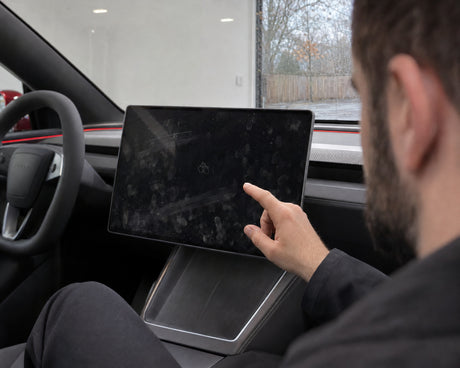
Clean a Tesla screen: what the Model Y touchscreen can take
Daniel von Detailing1 |


SONAX
XTREME Tyre + Plastic Cleaner Tyre & Plastic Cleaner
Tyre + plastic cleaner – combo cleaner for wheels & exterior plastics


Meguiars
Xtreme Cling Wheel Cleaner with Color Indicator, 24 fl oz (709 ml)


CarPro
"ReTyre" Tyre & Rubber Cleaner
Clean and care for tires thoroughly

Which tyre dressing survives the next rain comes down to the formulation.


Soft99
Soft99 4-X Tire Cleaner Tyre Care
Revolutionary spray system for innovative tire shine


GYEON
Alkaline basic cleaning for coattable tire sidewalls
D-CON
Powerful tire cleaner for rubber and plastic
Tyre cleaners remove road dirt and old dressing residue from the sidewall. Choose according to the contamination, material compatibility and the care step you plan next. With SONAX XTREME Reifen+KunststoffReiniger, the right tool, specified dwell time and thorough rinsing work together; this cleaning step does not create lasting shine.
Tyre cleaners are cleaning products for the rubber sidewall of a tyre. Depending on the formula, they loosen traffic film, greasy residue and old dressings so you can assess the actual condition and apply suitable care afterwards. They differ from shine-only products and wheel cleaners without approval for rubber. A brown sidewall does not automatically call for the strongest chemicals: protective ingredients built into the rubber can also cause the colour.

Day-to-day from Detailing1: Plan the SONAX product's 3–5 minutes together with the rinse that follows. Have the right tool ready before spraying. Work only on an area you can control through to complete removal. A ready water supply is more useful than another spray onto residue that has already started drying.
A tyre sidewall can turn brown from road dirt, but also from protective ingredients migrating out of the rubber compound and becoming visible at the surface.
Michelin specifically distinguishes these causes: ordinary road dust and brake dust are possibilities alongside those ingredients. Colour alone therefore tells you neither how strong a cleaner needs to be nor whether the tyre is damaged. Start with what you want to remove. Light surface dirt and a layer of old dressing are different jobs, even if both initially look dark or patchy.
For routine cleaning, Michelin recommends mild soap and water. A specialist product becomes particularly relevant when you want to remove suitable stubborn residues or old dressings. SONAX lists oil, grease, silicone residue and old dressing layers among its targets. That gives you a concrete reason to choose it: buy a product for an existing job, rather than pre-emptively choosing the supposedly strongest bottle for every colour change.
If a brown tone remains after a proper wash or returns later, it does not prove the cleaning was done badly. Repeated, increasingly aggressive scrubbing would be an unjustified response to colour alone. Reassess the surface after rinsing. Cleaning can remove accessible residue; it cannot permanently stop every cause of natural surface changes.
Expectations about blackness need separating too. Clean rubber does not have to shine like fresh paint. If you also want a darker, matt or glossy look, that decision belongs to tyre care. It will not fix visible damage or doubts about condition. Do not simply hide those areas with a dark finish; have the tyre professionally assessed when needed.
If you want to clean tyres, your desired result determines whether a dedicated cleaner, a combined care product or an approved wheel cleaner makes sense.
For targeted preparation, SONAX XTREME Reifen+KunststoffReiniger 750 ml offers a clear sequence: loosen residue, agitate and rinse thoroughly. The manufacturer treats subsequent care as a separate step. You can therefore choose the finish independently, rather than buying into the shine of a combined product during cleaning.
Other formulas combine these jobs. Soft99 explicitly describes its 4-X Tire Cleaner as cleaning and providing silicone-based care. That is a different function, not evidence of better deep cleaning. If you are preparing the surface for a particular follow-up product, its instructions should determine whether a remaining care film fits the planned application.
| Product function | Suitable goal | Important limit |
|---|---|---|
| Cleaning without a promised protective film, such as SONAX XTREME Reifen+KunststoffReiniger | Remove dirt and old dressing before a separate finishing step | Rinse thoroughly after agitation; choose shine and care separately |
| Combined cleaning and care, such as Soft99 4-X Tire Cleaner | Combine cleaning with an expressly intended care effect | Not automatically suitable preparation for every later protective product |
| Wheel cleaner explicitly approved for tyres | Treat the surfaces approved for the specific wheel | Rubber compatibility does not replace approval for the particular wheel finish |
The exact product matters particularly in that last case. Meguiar’s restricts HOT RIMS G9524EU to factory-painted wheels and expressly excludes certain other surfaces. A shared wheel-and-tyre name is therefore not enough for every wheel. Check the specific cleaner's instructions and the surface before treating both areas in one pass.

The right tool helps clean the sidewall, while a suitable working area and a ready water supply should make complete removal of the cleaner possible.
A stiff brush is not a universal requirement. SONAX specifically names its MultiSchwamm or ReifenPinsel for this product; the official application video shows the sponge on the sidewall. CARPRO, by contrast, specifies a medium-stiff brush for ReTyre. The buying decision is straightforward: choose a tool suitable for your surface and the relevant product instructions, rather than borrowing a recommendation from another formula.
Pay attention to the boundary between rubber and wheel when agitating. A tool suited to the textured sidewall may not suit a delicate wheel surface. Material compatibility therefore covers not just the liquid but also tool contact. Keep its working face clean and guide it deliberately over the intended area instead of casually scrubbing neighbouring surfaces.
Do not start on hot surfaces. SONAX excludes treating them and requires the cleaner not to dry on. That does not establish a universal waiting time after driving. Check the actual conditions and postpone the job if you cannot control application through to thorough rinsing. The minutes on the label are not permission to ignore a surface that is already drying.
The working area also needs a suitable way to rinse away loosened dirt and cleaner completely. The manufacturer specifies a strong water jet or pressure washer. This does not set a universal pressure or nozzle distance for tyres; vehicle, wheel and equipment instructions also apply. Plan these requirements before application and follow the wash area's rules instead of hunting for a solution during the dwell time.
With the SONAX cleaner, even application, agitation and three to five minutes of dwell time belong together before loosened dirt is thoroughly rinsed away with water.
Shake the bottle before use and twist the spray nozzle open. Spray the intended dirty surface generously and evenly. These instructions specify neither a fixed number of sprays nor millilitres per tyre. Tyre size, texture and contamination do not justify inventing a consumption standard here. What matters is a clear application onto the area you actually intend to work on.
Work the cleaner in with the suitable tool specified. Sidewall lettering and contours deserve as much attention as the smooth area. This mechanical help is part of the manufacturer's process, but it does not replace rinsing afterwards. Use the tool for controlled agitation and do not assume that lots of foam proves better results or a completed clean.
Follow the specified 3–5 minutes and do not let the cleaner dry. Then rinse the product and loosened dirt away thoroughly. A half-minute recommendation for another product is no more relevant here than general advice from a washing guide. If you change products, check the new product's own process instead of carrying over a familiar dwell time.
After rinsing, inspect the surface without cleaning foam covering it. If residue remains, first identify it and check the appropriate follow-up treatment instead of extending the dwell time at will. Follow the preparation instructions for the care product you intend to use next; GYEON and servFaces explicitly require a dry tyre in their relevant procedures. Complete drying is also part of finishing before storage, not an optional substitute step.

Assess the cleaning result after thorough rinsing, then choose and apply a matt or glossy care finish according to that product's own instructions.
Foam gives clues about the work, but it is not a universal measurement method for every formula. CARPRO and GYEON describe repeating the process when needed and take foam colour into account. SONAX specifies its own sequence of tool use, dwell time and rinsing. Do not turn these into one rule requiring every tyre to be worked repeatedly until every cleaner produces only white foam.
Conversely, little foam is not enough evidence of weak performance. In the individual CarTime application report on the SONAX product, low foam was described alongside visible dirt removal. That is a limited observation, not a comparative win. For your process, the clearer question remains: has the intended residue been loosened and removed, or is liquid still hiding the actual surface condition?
For a care finish, follow that product's own instructions. Preparation and drying need to suit it; an arbitrarily thick layer is no shortcut around skipped cleaning. A combined care product may also be applied differently from a separate sealant. Neither a universal waiting time before driving nor a general durability figure follows from the term tyre care.
Choose the finish deliberately and keep the relevant care products off the tread and brakes. Soft99 expressly states these limits for its combined product. An evenly dark appearance is also no replacement for a technical tyre inspection. Find suitable products for rubber and wheels under wheel and tyre cleaning; the surfaces remain different even within this shared working area.
Tyres should be clean and completely dry before storage; Continental's advice does not require an additional glossy dressing layer for this purpose.
That makes the storage goal different from the look you want on a car in use. Continental recommends water, cleaner and a brush for cleaning, followed by complete drying. The manufacturer also points out that tyres contain their own protective ingredients. You do not need to add a dressing for storage merely because you are concerned about a lack of shine. Clean and dry can already be the finished state here.
During regular use, actual need is more useful than a rigid calendar too. Light dirt does not automatically call for the same effort as an old dressing film. Michelin recommends mild soap and water for routine cleaning. Before any more intensive work, check which residues are actually a problem and whether the chosen cleaner is intended for them. These recommendations do not establish a fixed number of thorough cleans per year.
Pack size should match realistic consumption. The specific SONAX product described is the 750 ml bottle; it does not come with a promised number of complete wheel sets. Larger quantities are available under cleaners in canisters, where the relevant formula's instructions need checking again. A larger container changes neither material approval nor the care needed during application and rinsing.
Store the cleaner according to its labelling; SONAX requires frost-protected storage. That keeps the choice clear for the next use too. A suitable tyre cleaner does a limited, useful job: removing the residues it is designed for. What follows depends on your actual goal — product-appropriate care for your preferred look, or completely dry tyres for storage, without forcing an extra shine step.

Too much choice in Tyre cleaner? Get help picking:
Add Detailing1 as a preferred source on GoogleBrown sidewalls can result from protective ingredients built into the rubber migrating to the surface. Michelin also identifies road dust and brake dust as possible causes. Colour alone therefore proves neither a defect nor dirt alone. Clean according to the contamination and assess the condition afterwards, rather than scrubbing harder just because of the shade.
First remove suitable dirt and old dressing residue with an appropriate product according to its instructions. Rinse thoroughly and assess the sidewall once dry. Clean rubber does not have to shine. For a deliberately darker or glossy look, choose suitable tyre care afterwards; cleaning alone does not guarantee a lasting deep-black finish.
Cleaning alone cannot guarantee a permanently black appearance. Choose suitable tyre care for your desired finish and follow its preparation, application and maintenance instructions. Returning brown colour can also relate to protective ingredients in the rubber. More frequent aggressive cleaning is therefore not automatically the right answer to every colour change.
Only if the specific product is intended for this rubber application. It must also suit your wheel finish. A shared wheel-and-tyre name does not approve every surface. Check both material areas and the relevant instructions separately; do not borrow the dwell time or tool choice from a different cleaner.
The instructions for your chosen care product decide. In the GYEON and servFaces cleaning procedures described, complete drying is explicitly required before subsequent protection. Combined cleaning and care products may have different requirements. Do not apply one fixed waiting time to every product; check that the sidewall is properly prepared for the next step.
For storage, Continental recommends clean, completely dry tyres; an additional care layer is not needed for this purpose. Tyres already contain their own protective ingredients. Remove suitable dirt and let the tyres dry thoroughly before storing them. Wanting visible shine on the car is a different job from preparing tyres for storage.
This procedure describes SONAX XTREME Reifen+KunststoffReiniger 750 ml on suitable surfaces. It does not replace compatibility checks or the instructions for the vehicle, wheel and wash area. Other formulas may require different tools and dwell times.
Check that the intended surface is suitable for SONAX XTREME Reifen+KunststoffReiniger 750 ml and follow the vehicle, wheel, tool and wash-area instructions. Do not work on hot surfaces. Have a suitable tool and appropriate means of thorough rinsing ready.
Shake the bottle before use and twist the spray nozzle open. Spray the intended dirty surface generously and evenly. This manufacturer procedure does not specify a fixed quantity per tyre or number of sprays.
Work the cleaner in with a tool suitable for the surface. SONAX names its MultiSchwamm or ReifenPinsel. Work deliberately across the sidewall and its contours, paying attention to adjacent wheel surfaces; these must also be suitable for the treatment.
Follow SONAX's stated 3–5 minutes of dwell time and do not let the product dry. Keep the working area manageable so you can control the surface and subsequent removal. Do not carry over another cleaner's waiting time.
Thoroughly rinse away loosened dirt and the cleaner. SONAX specifies a strong water jet or pressure washer; also follow vehicle, wheel and equipment instructions. This statement does not establish a universal pressure setting or nozzle distance.
Assess the sidewall after rinsing. Prepare it for any subsequent care according to that product's instructions and let it dry if required. Let tyres dry completely before storage; Continental says extra dressing is not needed for that purpose. Cleaning guarantees neither lasting shine nor repair of tyre damage.
Daniel von Detailing1 |

Daniel von Detailing1 |

Daniel von Detailing1 |

Daniel von Detailing1 |

Daniel von Detailing1 |


Daniel von Detailing1 |

Daniel von Detailing1 |

Daniel von Detailing1 |

Daniel von Detailing1 |

Daniel von Detailing1 |

Daniel von Detailing1 |