


5 leather brush mistakes that roughen car leather
Daniel von Detailing1 |


SONAX
XTREME Ceramic Tyre+Wheel Detailer Quick-Detailer
2-in-1 Ceramic Care: Cleans, protects, and conditions tires and rims


D-CON
Wheel & Rim Wax "V2" Rim Sealant
Shine & long-lasting protection for all rim surfaces


Dr. Wack "P21S"
P21S "Felgen-Detailer" Quick Detailer for Wheels
Heat-Resistant Wheel Detailer with Strong Beading Effect
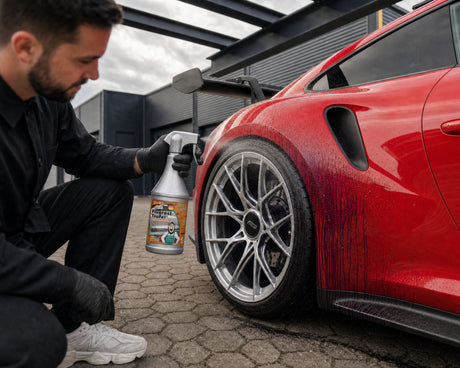
Iron particles react purple and dissolve
Message us on WhatsApp and we will find the right protection for your car.
What does a wheel sealant actually do? It lays a smooth, heat-resistant layer on the wheel that hot brake dust struggles to stick to. On your next wash it runs off with the water instead of baking on. At Detailing1 you'll find ceramic coatings for long durability and wheel waxes for an easy start.
Rim sealing means applying a protective layer that cures on the cleaned wheel and makes the surface smooth and dirt-repellent. It doesn't keep brake dust off the wheel — it takes away its grip. What would normally settle into the pores of the wheel finish and bake on at the next stop now just sits on top. The real demand here is heat resistance, because a wheel gets far hotter in use than any body panel.
Detailing1's tip from the shop: We often get questions about dull haze and rainbow smears on the wheel a day after application. The cause is almost always the same: the product was applied but not buffed off. Every one of these coatings flashes off after a short time, and whatever excess is still sitting on top as a film cures into a so-called high spot. So always work one spoke or one section at a time and buff with a clean microfibre towel as soon as the surface starts to go matte. A second look under raking light from a shallow angle shows you every area you missed — while you can still remove it.
A wheel sealant doesn't stop brake dust. It stops it sticking — and that's the whole difference day to day.
Brake dust isn't dust in the usual sense. Every time you brake, the pad grinds across the cast-iron disc and flings iron filings outwards, landing red-hot on the wheel. They hit hard enough to embed themselves in the wheel finish instead of bouncing off.
The cured layer slides in between. It fills the microscopic roughness of the wheel finish and lowers the surface energy — the surface's willingness to bind foreign particles. In practice: the hot filing finds no pit to anchor itself in and just sits on top of the layer.
Then there's the water behaviour. On a sealed wheel, water pulls together into beads and runs off in channels instead of sheeting and sitting there. It takes the loose dirt with it, and the wheel dries without limescale rings from tap water.
The real gain is time. An unsealed wheel with baked-on brake dust needs acidic cleaner, a brush and patience. A sealed wheel gets washed in the same round as the paint, and Rim cleaner goes from a weekly job to an occasional deep clean.
The limits are part of the deal. No coating of this kind lasts forever, and none makes the wheel immune to kerbs or winter road salt. If you expect to not touch your wheels for a whole year, you'll be disappointed. What's realistic is a wheel that stays clean with little effort for as long as the layer holds.
Where it goes decides the product. A wheel works in a temperature range where classic paint care simply gives up.
The numbers behind it are plain and clear. In normal traffic, brake discs sit at 200 to 300 degrees, and well above that on a long mountain descent or after an emergency stop from high speed. Via the hub, the bolts and radiant heat, 80 to 120 degrees reaches the wheel itself, depending on the design.
Carnauba wax, the classic of paint care, melts between 80 and 87 degrees. That puts it right in the everyday range of a working wheel. A hard wax for the bodywork is therefore gone from the wheel in a few weeks — not a product flaw, just the wrong place for it.
Ceramic wheel sealants work with silicon compounds instead, which form a network of silicon and oxygen as they cure. Picture a very fine glass lattice that lays itself over the wheel finish and bonds with it. The upshot: at the temperatures where a wax goes soft, this layer doesn't even flinch.
Anyone with dark brake dust haze on light wheels knows what heat does to unprotected brake dust. The iron particle burns into the finish at the next warm stop, keeps corroding there and stains the area around it brown. From that point on, only chemistry that also puts the wheel finish under strain will help.
That gives you a simple rule for choosing. Pick a product the manufacturer explicitly specifies for wheels. Chemically it's a close relative of the products under Lacquer sealing, but the load is completely different — and that's exactly why manufacturers keep the two separate.
The category splits into three types that differ in durability, effort and how much prep they demand.
Ceramic coatings top the table for durability. The Koch-Chemie Ceramic Rims „Cr0.01" ceramic coating for wheels belongs in this group and goes on with an applicator pad and dropper bottle. Application takes care and a properly clean wheel, but in return the layer lasts the season.
On the same level sits the SONAX PROFILINE CeramicCoating „CC" Rim from the pro line. It's aimed at users who already work with coatings and have the routine of degreasing, applying and buffing off down pat.
Wheel waxes are the pragmatic alternative. The Dr. Wack P21S „Wheel Wax" Wheel Sealant is much more forgiving to apply. You spray it thinly onto the dry, cool wheel, let it haze briefly and buff with a soft towel.
The D-CON Wheel & Rim Wax „V2" Rim Sealant goes in the same direction. Both give you visible beading and deep gloss straight away. According to the manufacturer, the P21S wheel wax lasts at least three to four washes depending on use, while the D-CON is due again after about two to three months. So you top up far more often than with a coating.
The third group is spray sealants, which you apply to the still-wet wheel after washing and then dry off. They last a few weeks. Their real value lies elsewhere: as a top-up on an existing coating they keep the beading going without you having to touch the base layer.
The most common reason a sealant disappears in patches after four weeks isn't the product. It's the fifteen minutes before.
It starts with a deep clean. Loose brake dust comes off with Rim cleaner and a brush, embedded iron particles need an iron remover. Anything still sitting in the surface at this point gets locked in by the sealant and keeps working underneath.
Next up is degreasing. An isopropanol-based panel wipe takes off the last oil and silicone residue from cleaners, old wax or excess tyre shine. Think of it like cleaning a window before you stick a sticker on it. In real life, this one wipe decides whether the layer lasts three months or a year.
The wheel has to be cool to the touch. On a warm surface the product flashes off so fast that you're too late buffing and smears are left behind. Cool to the touch means you can grab the spoke without flinching. After a brisk drive, that can easily mean a forty-minute wait.
Dry is the third condition, and it's often underestimated. Water from the wheel bolts, the valve area or the transition between spokes and barrel runs out during application and leaves a visible trail through the fresh layer. Blow it out with compressed air or wipe it out with a dry towel first.
What we see day-to-day: one step few people bother with pays off — take the wheel off. Only then can you get to the inner barrel, and that's where most of the brake dust sits. A wheel that's sealed on the outside and untreated on the inside looks the same as before after every drive in the rain, because the dirt migrates from the inside out.
Application itself is nothing fancy, but it has a strict rhythm. Stick to it and you get an even layer with no patches.
Work in sections. Wet an applicator pad with a few drops, then go over one spoke or a quarter of the wheel in overlapping passes, once lengthwise and once crosswise. That way no spot gets missed, and you keep track of which area has been sitting for how long.
After application, the layer flashes off. At twenty degrees that takes one to three minutes depending on the product, less in summer. You'll see it as a light haze spreading across the surface. That's exactly when the clean microfibre towel comes in and takes off the excess before it hardens.
After that, the layer needs peace and quiet. Most manufacturers state twelve to twenty-four hours without water for wheel coatings until they've fully cross-linked. Try not to drive through rain during that time, and for the first week wash the car only with clean water and pH-neutral shampoo.
Then the maintenance phase starts, and it's quickly explained. Acidic wheel cleaners stay on the shelf as long as the layer is meant to work, and a pH-neutral shampoo is all you need for washing. If you're doing the tyres in the same go, you'll find the right products under Tire care.
Being honest about expectations includes the time involved. The first time, four wheels with cleaning, degreasing and applying will take you half an afternoon, and the first wheel takes longest. The second round next year is about two hours, because you've got the routine down and the pre-clean is less work.
Three questions get you to the answer: how much does your brake dust, how much time do you want to put in, and what is the wheel made of.
If you drive a car with a beefy brake setup and light-coloured wheels, a ceramic coating is the economically sensible choice. The Koch-Chemie Ceramic Rims „Cr0.01" ceramic coating for wheels covers exactly that and lasts a season. The effort comes once, the payoff is spread over every wash of the year.
If you already work with coatings and want a system from a single brand, go for the SONAX PROFILINE CeramicCoating „CC" Rim. It needs a confident routine and rewards it with a layer that holds up even on hard-working front wheels.
If you first want to see what a wheel sealant does in everyday life, start with a wax. The Dr. Wack P21S „Wheel Wax" Wheel Sealant and the D-CON Wheel & Rim Wax „V2" Rim Sealant need little learning and show the effect right away. Top up as soon as water stops beading cleanly on the wheel.
With polished aluminium, open-pored forged wheels or matte-painted wheels, check the manufacturer's approval before you buy. These surfaces are sensitive, and a glossy coating on a matte wheel stands out immediately. If in doubt, drop us a quick message with a photo — we'll sort it out faster than any chart.
If you're after the bigger picture: cleaners, care and protection for the whole wheel are under Tyres and wheels, the matching protection for the bodywork under Lacquer sealing. Sealing wheels and paint in the same session saves set-up time, because the degreaser, applicator and towels are already laid out.
Too much choice in Rim sealing? Get help picking:
Daniel von Detailing1 |

Jasper von Detailing1 |

Daniel von Detailing1 |

Daniel von Detailing1 |

Daniel von Detailing1 |

Jasper von Detailing1 |

Jasper von Detailing1 |

Daniel von Detailing1 |

Daniel von Detailing1 |

Daniel von Detailing1 |

Daniel von Detailing1 |

Daniel von Detailing1 |


