

What a car leather sealant protects and what it doesn't
Daniel von Detailing1 |


Koch-Chemie
Teerwäsche A "Tea" Bitumen & Tar Remover
Perfect bitumen and tar removers for a flawless finish
Koch-Chemie
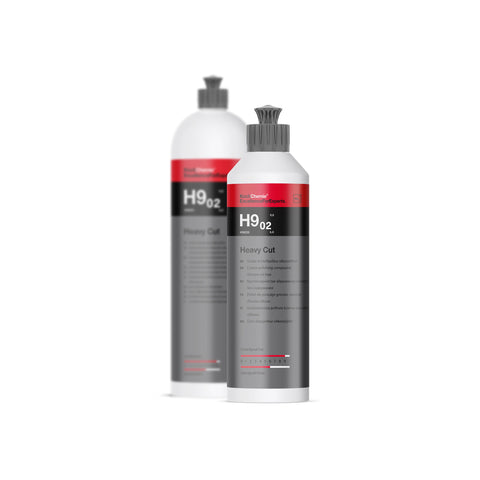
Heavy Cut "H9.02" Heavy Compound
Silikonölfreie grobe Schleifpolitur für tiefe Kratzer bis P1200


Koch-Chemie
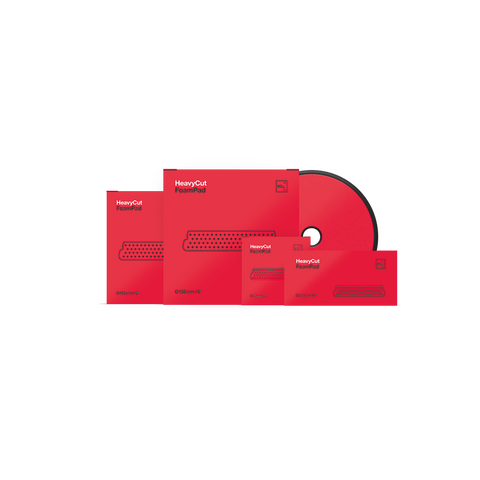
Heavy Cut Foam Pad "Rot" Abrasive Cutting Foam / Polishing Pad (2024)
Extremely abrasive polishing pad for deep scratches and weathering
Koch-Chemie
One Cut & Finish "P6.02" High-Gloss Polish with Sealant
Effective high-gloss polish and sealant for scratch removal


Koch-Chemie
Micro Cut Soft Foam Pad "Violett" (Soft) Anti-Hologram Foam / Polishing Pad (2024)
Soft polishing pad for delicate paints and a streak-free finish
Koch-Chemie
Fine Cut "F6.01" Cutting Polish (Fine)
Fine abrasive polish for brilliant deep gloss and perfect paintwork


Koch-Chemie
Fine Cut Foam Pad "Gelb" Medium-Hard Cutting Pad / Polishing Pad (2024)
Medium-hard sanding sponge for medium to deep scratches
Koch-Chemie
Micro Cut "M3.02" Micro-Abrasive Polish
For the removal of holograms & scratches on all paint types


Koch-Chemie
One Cut Foam Pad "Orange" Medium-Cut 2-in-1 Polishing Pad (2024)
Polishing pad for scratch removal and finishing in one step
Koch-Chemie
Micro Cut & Finish "P3.01" Micro Cutting Polish with Carnauba Wax
High-gloss micro-abrasive polish with integrated carnauba wax


The Rag Company
Car Wash 320GSM Microfibre Cloth
Fulfill your vehicle care with premium microfiber technology


THE COLLECTION
"Allround / Coating 245" short-pile edgeless microfibre cloth (245 GSM)
Short-pile edgeless microfiber cloth for precise removal
Koch-Chemie
Clay Spray "Cls" Clay Lube for Decon Clay
Advanced lubricant spray for the application of cleaning clays


THE COLLECTION
"Allround / Coating 300" short-pile edgeless microfibre cloth (300 GSM)
Low-pile 300 GSM microfiber cloth with extra substance
Koch-Chemie
Lack-Polish green "P1.03" Finishing Polish
Finish-Politur mit Schleifgrad 1,0 & Glanzgrad 9,5 für alle Lackarten
Koch-Chemie
Micro Cut "M2.02" High-Gloss Anti-Hologram Polish
Innovative polish for the permanent removal of holograms


Koch-Chemie
Polish & Sealing Foam Pad "Green" Soft Finishing Sponge / Polishing Pad (2024)
Extra soft finishing pad for a flawless finish


Koch-Chemie
Micro Cut Hard Foam Pad "Violett" (Hard) Anti-Hologram Pad / Polishing Pad (2024)
Hologram-free finish on high-solid paints with a hard polishing pad


THE COLLECTION
"Allround 365" short-pile edgeless microfibre cloth (365 GSM)
Short-pile Edgeless Microfiber Towel with more volume


Koch-Chemie
Metal Polish "Mep" Metal Polish
Effective Metal Polish for Shine and Protection


SONAX
PROFILINE OS "02-06" High-Gloss Polish with Sealant (One-Step)
OS 02-06 — High-Gloss Polish with Sealant (One-Step)
Koch-Chemie
Heavy Cut "H8.02" Heavy Compound Polish
Extremely powerful polish with maximum cut
Koch-Chemie


Koch-Chemie
Pro Allrounder Towel "315GSM" Microfibre Polishing Cloth
Premium Microfiber Polishing Cloth for Car Care

Car polish at Detailing1 uses aluminium-oxide abrasive to take off a wafer-thin layer of clearcoat and open up a level, glossable surface underneath. The range runs from heavy cutting compound through finishing polishes for hologram-free gloss to all-in-one polish with a sealant, plus special cases for gelcoat, glass and metal. Brands stocked are Koch-Chemie, SONAX, GYEON, Meguiar's, CarPro and ZviZZer.
Koch-Chemie
Heavy Cut "H9.02" Heavy Compound
Silikonölfreie grobe Schleifpolitur für tiefe Kratzer bis P1200
Koch-Chemie
One Cut & Finish "P6.02" High-Gloss Polish with Sealant
Effective high-gloss polish and sealant for scratch removal
Koch-Chemie
Fine Cut "F6.01" Cutting Polish (Fine)
Fine abrasive polish for brilliant deep gloss and perfect paintwork
Koch-Chemie
Micro Cut "M3.02" Micro-Abrasive Polish
For the removal of holograms & scratches on all paint types
Koch-Chemie
Micro Cut & Finish "P3.01" Micro Cutting Polish with Carnauba Wax
High-gloss micro-abrasive polish with integrated carnauba wax
Koch-Chemie
Lack-Polish green "P1.03" Finishing Polish
Finish-Politur mit Schleifgrad 1,0 & Glanzgrad 9,5 für alle Lackarten
Koch-Chemie
Micro Cut "M2.02" High-Gloss Anti-Hologram Polish
Innovative polish for the permanent removal of holograms
SONAX
PROFILINE OS "02-06" High-Gloss Polish with Sealant (One-Step)
OS 02-06 — High-Gloss Polish with Sealant (One-Step)
Koch-Chemie
Heavy Cut "H8.02" Heavy Compound Polish
Extremely powerful polish with maximum cut

Koch-Chemie
Lack-Polish violett "P2.03" Abrasive Gloss Polish
Abrasive high-gloss polish, correction and high gloss in one step


SONAX
PROFILINE EX "04-06" High-Gloss Polish (Finish)
Silikonöl-, & Staubfreie Hochglanzpolitur für Exzenterpolierer


Koch-Chemie
"ShineSpeedPolish" Finishing Polish (High Gloss)
Gives your vehicle a flawless high gloss finish

At Detailing1, polishing pads and sanding sponges decide — through hardness and cell structure — how much clear coat a polish actually cuts, from the coarse sanding sponge to the soft finishing pad for sealing. The range runs from foam pads in every grade through wool and microfibre to the felt pad for glass, in sizes from spot correction to the big panel. Brands on the shelf: ZviZZer, Koch-Chemie, SONAX, Rupes, FLEX and GYEON.
Koch-Chemie
Heavy Cut Foam Pad "Rot" Abrasive Cutting Foam / Polishing Pad (2024)
Extremely abrasive polishing pad for deep scratches and weathering
Koch-Chemie
Micro Cut Soft Foam Pad "Violett" (Soft) Anti-Hologram Foam / Polishing Pad (2024)
Soft polishing pad for delicate paints and a streak-free finish
Koch-Chemie
Fine Cut Foam Pad "Gelb" Medium-Hard Cutting Pad / Polishing Pad (2024)
Medium-hard sanding sponge for medium to deep scratches
Koch-Chemie
One Cut Foam Pad "Orange" Medium-Cut 2-in-1 Polishing Pad (2024)
Polishing pad for scratch removal and finishing in one step
Koch-Chemie
Polish & Sealing Foam Pad "Green" Soft Finishing Sponge / Polishing Pad (2024)
Extra soft finishing pad for a flawless finish
Koch-Chemie
Micro Cut Hard Foam Pad "Violett" (Hard) Anti-Hologram Pad / Polishing Pad (2024)
Hologram-free finish on high-solid paints with a hard polishing pad


Koch-Chemie
Micro-Cut Pad "Violet" Polishing Pad Foam Cutting Pad


SONAX
SONAX PROFILINE ExzenterPad medium polishing pad
Orbital Pad medium — Medium-cut polishing pad for DA orbital polishers


SONAX
PROFILINE ExzenterPad hart polishing pad
ExzenterPad hart — Profi-Polierpad für DA-Exzenterpolierer


FLEX
Backing Plate "M14" (Cushioned)
Damped polishing pad with M14 thread for precise polishing


Rupes
"D-A" Coarse (9.MF Series H) Microfibre Polishing Pad Blue
Extreme cutting performance and perfect results for hard clear coats


Rupes
"D-A" Medium Wool (9.NW Series M) Wool Polishing Pad Yellow
Flexible Wool Polishing Pads for Perfect Results

Poliermaschinen unterscheiden sich in ihrer Bewegung und in der Führung unter Last. Exzenter mit Freilauf, Zwangsrotation und reine Rotation erfüllen unterschiedliche Anforderungen an Kontrolle und Abtrag. Hub, Padgröße, Antrieb und Zubehöranschluss werden nach der geplanten Arbeit gewählt; das Werkzeug arbeitet immer als Teil eines Poliersystems.
FLEX
Backing Plate "M14" (Cushioned)
Damped polishing pad with M14 thread for precise polishing

Rupes
BigFoot "LHR15" Mark V 15mm Random Orbital Polisher Ø125mm
Precise and quiet thanks to innovative technology

FLEX
"Special" Backing Plate (Cushioned) for FLEX Dual-Action Polishers
Damped backing plate for FLEX random orbital polishers


FLEX
Velcro hook and loop backing pads for the FLEX PXE 80 in Ø30/50/75mm
FLEX
FLEX "XFE 2 15 14-EC C" 15mm Random Orbital Polisher with Free Spin Ø150mm
Professional orbital polisher for a hologram-free finish

Rupes
BigFoot "LHR21" Mark V 21mm Dual Action Polisher Ø150mm
Ergonomic design and innovative technology

Rupes
BigFoot "LHR21" Mark III 21mm Random Orbital Polisher Ø150mm
Professionelle Poliermaschine für schnelle und effektive Fahrzeugaufbe


FLEX
Interchangeable eccentric drive PXE 80 in rotary, 3, 6, and 12mm
FLEX
"XCE 2 8 14-EC C" 8mm Dual-Action Polisher with Forced Rotation Ø150mm
Forced Rotation Polisher for Precise Paint Correction

Rupes
BigFoot "LHR15" Mark III 15mm Random Orbital Polisher Ø125mm
Efficient and ergonomic polishing machine for professionals
FLEX
"PE 2 14-EC C" Rotary Polisher Ø150mm
Professional Rotary Polisher for Maximum Paint Correction

Rupes
BigFoot "LH19E" Rotary Polisher Ø125mm
High-performance rotary polisher for professional car care
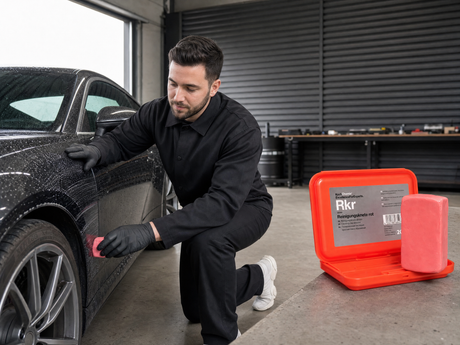
Lackvorbereitung entfernt haftende Rückstände und bereitet die Oberfläche auf Politur oder Schutz vor. Reinigungsknete arbeitet mechanisch, ein passendes Gleitmittel unterstützt die Führung und Lackentfetter nehmen geeignete Öl- und Fettfilme ab. Die Reihenfolge richtet sich nach dem Zustand und dem anschließenden Oberflächenaufbau.
Koch-Chemie
Teerwäsche A "Tea" Bitumen & Tar Remover
Perfect bitumen and tar removers for a flawless finish
Koch-Chemie
Clay Spray "Cls" Clay Lube for Decon Clay
Advanced lubricant spray for the application of cleaning clays
Koch-Chemie
Koch-Chemie
Koch-Chemie Reinigungsknete "Rkb" Mild "Blau" Clay Bar
Gentle cleaning for paint and glass with detailing clay
TUGA Chemie
Flugrost-Teufel® Iron Fallout Remover
Acid-free rust remover with color change for paint and rims
Koch-Chemie
Cleaning Clay "Rkr" Abrasive "Red" Clay Bar
Abrasive cleaning clay for heavily soiled paints


GYEON
Q²M Iron (REDEFINED) Iron Remover
pH-neutral rust remover with gel formula and color indicator


Meguiars
Ultimate Iron Remover — Fallout & Iron Remover
Chemical rust remover with color indicator — purple = reaction


INNOVACAR
Effective rust remover for rims and car body


GYEON
Q²M TotalRemover Wax and Coating Remover
Q²M TotalRemover - wax and coating remover before


INNOVACAR
"DL" Lube Clay Bar Lubricant Spray
Efficient Lubricant for Clay Bar and Polishing Pads
The Rag Company
Effective paint cleaning and ideal preparation for wax and polish.
Spezialpolituren sind auf Materialien außerhalb des gewöhnlichen Lack-Poliergangs ausgerichtet. Glas, Metall, Scheinwerferkunststoff und freigegebene Lackschutzfolien verlangen unterschiedliche Arbeitsmedien und Rezepturen. Beschichtung und Defektart bestimmen die Auswahl; eine Lackpolitur ist nicht automatisch die passende Lösung für jede glatte Fläche.
Koch-Chemie
Metal Polish "Mep" Metal Polish
Effective Metal Polish for Shine and Protection


Koch-Chemie
Gelcoat One Cut "Gp6.01" High-Gloss Polish with Sealant for Gelcoats and Boat Paint (Marine Line)
Efficient one-step polish for gelcoats and boat paints with high gloss
Soft99
Glaco Glass Compound Roll On Glass Cleaner
Dual-Compound Glass Cleaner — Preparation for Sealants
Koch-Chemie
Headlight Polish 2 "Hlp2" high-gloss headlight polish with sealant
High-gloss headlight polish with integrated sealant


Koch-Chemie
Gelcoat Heavy Cut "Gh8.01" Heavy-Cut Compound for Gelcoat and Boat Paint (Marine Line)
Effectively removes deep scratches & hazing from heavy weathering


Koch-Chemie
Gelcoat Fine Cut "Gf6.01" Fine Cutting Polish for Gelcoat and Boat Paint (Marine Line)
Cutting polish for effective removal of medium scratches & oxidation


Koch-Chemie
Gelcoat Micro Cut & Finish "Gp3.01" Finishing Polish for Gelcoat and Boat Paint (Marine Line)
Finishing polish for effective removal of fine scratches and holograms


SONAX
PROFILINE HeadlightPolish Headlight Polish
HeadlightPolish — Polish for polycarbonate headlights
Koch-Chemie
Koch-Chemie Headlight Polish 1 "Hlp1" Heavy-Cut Headlight Polish
Fast scratch removal for heavily weathered headlights


SONAX
PROFILINE GlassPolish Glass Polish (Cerium Oxide Chemical-Mechanical)
GlassPolish - Cerium Oxide Glass Polish Chemical-Mechanical


Koch-Chemie
Extremely abrasive polish for effective removal of deep scratches


Soft99
Glass Compound Z Glass Cleaner
Revolutionary glass cleaning for streak-free clarity
Polierzubehör ergänzt den Poliergang dort, wo saubere Arbeitsmedien und passende Handhabung über das Ergebnis mitentscheiden. Pad-Reiniger lösen Rückstände, während weiteres Zubehör den Arbeitsablauf unterstützt. Die Auswahl folgt dem verwendeten System und Material; gereinigte Pads werden vor dem nächsten Einsatz vollständig vorbereitet.
The Rag Company
Car Wash 320GSM Microfibre Cloth
Fulfill your vehicle care with premium microfiber technology
THE COLLECTION
"Allround / Coating 245" short-pile edgeless microfibre cloth (245 GSM)
Short-pile edgeless microfiber cloth for precise removal
THE COLLECTION
"Allround / Coating 300" short-pile edgeless microfibre cloth (300 GSM)
Low-pile 300 GSM microfiber cloth with extra substance
THE COLLECTION
"Allround 365" short-pile edgeless microfibre cloth (365 GSM)
Short-pile Edgeless Microfiber Towel with more volume
Koch-Chemie
Pro Allrounder Towel "315GSM" Microfibre Polishing Cloth
Premium Microfiber Polishing Cloth for Car Care


D-CON
Happy End Edgeless 450GSM Microfibre Cloth
Fluffy microfiber cloth for streak-free, gentle car care


THE COLLECTION
"Dual Pile" long- and short-pile microfibre towel (420 GSM)
Double-sided microfiber towel for a precise finish


Koch-Chemie
Polish and Sealing Towel 520GSM Microfibre Cloth


Koch-Chemie
Coating Towel 300GSM Microfibre for Ceramic Coatings


The Rag Company
Eagle Edgeless 500GSM Microfibre Cloth
Ultimate 500GSM for perfect results without scratches.

Koch-Chemie
Masking Tape "50m" (Residue-Free Tape)
Precise Residue-Free Masking Tape

Koch-Chemie
Fine Fiber Towel synthetic-leather drying cloth

What actually happens when you polish a car? A polish uses fine abrasives to take off a thin layer of clear coat and levels scratches down to their base. The cut removes material, the finish brings the gloss back. At Detailing1 you'll find the polishes, pads and machines for both.
Car polishing means using abrasives to take off a wafer-thin layer of clear coat until the bottom of a scratch sits level with the paint around it. Nothing gets filled in. How much comes off isn't down to the polish alone — it's the interplay of polish, pad, machine and speed. That's why every polishing job starts with one question: how much clear coat is actually left?
Detailing1's tip from the shop: What we see day-to-day: the most common beginner mistake isn't the wrong polish, it's starting with the harshest one. We regularly see paint that's been hit with a heavy compound and a hard pad when all it had was light wash marring. Instead, mark out a test spot of about 40 by 40 cm somewhere discreet, say low down on the driver's door, and start with the mildest combo on your shelf. If it does the job, you've saved clear coat. If it doesn't, step up one level — and you'll know exactly why you need it.
A polish doesn't repair a scratch. It lowers the surface around it until the scratch disappears, because light no longer catches its edge.
The paint build-up is always the same: metal, primer, base coat with the colour, clear coat on top. You only ever polish the clear coat, and on a factory finish that's around 40 to 50 µm thin — about half the thickness of a sheet of printer paper. Right underneath sits the colour.
Go too far and you'll see it on the pad before you see it on the paint. A coloured haze on the foam means you're through the clear and that spot only comes back with a respray. That's exactly what makes polishing a different game from washing or sealing.
A paint thickness gauge takes the guesswork out. It shows in microns how much paint is sitting on a given spot and reveals differences you'd never guess from the outside. Edges, body lines and wheel arches carry less material to begin with than a flat bonnet, because the paint runs away from these zones when it's sprayed.
That gives you a simple rhythm. Wash weekly, seal two or three times a year, polish only when needed and with plenty of time in between. On most cars that's a handful of times over their whole life — each time when the paint genuinely has defects, not just when it looks a bit dull.
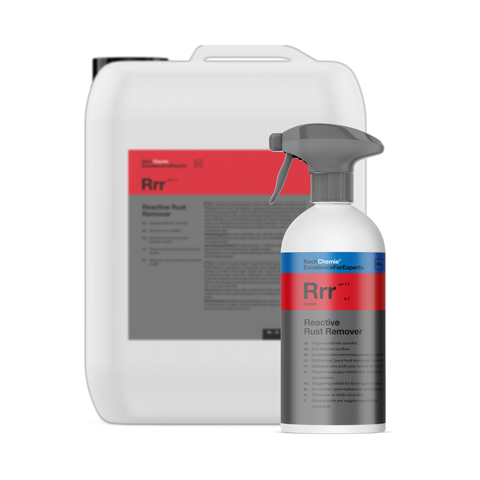
And prep always comes first. Every particle still stuck in the paint turns into a cutter under the pad and drags a fresh trail across the panel. Wash before you polish and check for leftover contamination. Bring in iron remover and clay bar when needed, the clay with a proper lubricant. The full process is under Paint preparation.
Cut means removal, finish means refinement. Both stages work with abrasives, yet they chase two completely different goals on the same panel.
The cut is all about material. A coarse, sharp abrasive bites into the clear coat and takes out scratches, holograms and dull oxidation. The Koch-Chemie Heavy Cut „H9.02" Heavy Compound is the strongest stage for heavily scratched paint, the Koch-Chemie Fine Cut „F6.01" Cutting Polish (Fine) the middle option for normal wear and tear.
After the cut, the paint is clean but not pretty. The coarse pass leaves its own very fine scratch pattern, which shows up in sunlight as a milky haze. That's exactly what the finish takes out: its abrasive is smaller and keeps breaking down as you work, so removal tapers off towards zero by the end. The Koch-Chemie Micro Cut „M2.02" High-Gloss Anti-Hologram Polish is our go-to answer here.
For a lot of cars, one pass is enough. One-step polishes combine correction and finish in a single step. How much gloss you get depends on the specific product and the result on your paint. The Koch-Chemie One Cut & Finish „P6.02" High-Gloss Polish with Sealant is one of our best sellers in this category and lays down a sealant on top.
Even gentler is the Koch-Chemie Micro Cut & Finish „P3.01" Micro Cutting Polish with Carnauba Wax. It removes hardly any material, but smooths out the grey haze on older paint and leaves carnauba wax behind as a protective layer. For a car that's basically fine and just needs its depth back, that's the more honest route than a cutting compound.
Whether you go one step or two is decided on the test spot, not at the shelf. If a one-step combo takes the scratches out of the test spot to your satisfaction, there's no reason to work harder. All cutting and finishing stages at a glance are under Polishes.
The polish brings the abrasive, the pad brings the firmness, the machine brings the movement. Only together do the three give you a specific level of cut.
Pads are graded by firmness, and most brands colour-code them. At Koch-Chemie the range runs from the Heavy Cut Foam Pad „Rot" Abrasive Cutting Foam / Polishing Pad (2024) through the medium One Cut Foam Pad „Orange" Medium-Cut 2-in-1 Polishing Pad (2024) and the Fine Cut Foam Pad „Gelb" Medium-Hard Cutting Pad / Polishing Pad (2024) down to the soft Micro Cut Soft Foam Pad „Violett" (Soft) Anti-Hologram Foam / Polishing Pad (2024).
At the very end of the line sits the Polish & Sealing Foam Pad „Green" Soft Finishing Sponge / Polishing Pad (2024). It barely cuts at all — its job is to spread sealants and waxes evenly. Run a cutting compound on it and you'll rightly wonder why nothing's happening.
At SONAX, the SONAX PROFILINE ExzenterPad hart polishing pad and the SONAX PROFILINE ExzenterPad medium polishing pad play the same roles. The design matters: DA pads are matched to the machine's throw and behave differently from pads for rotary machines. Wool pads cut harder than any foam and belong in experienced hands on hard paint.
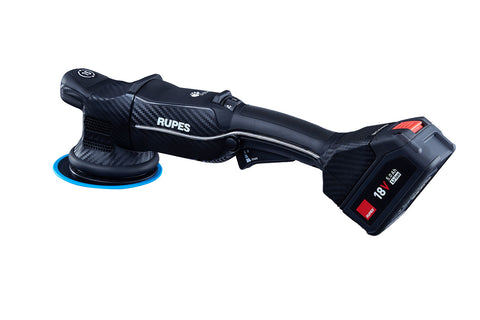
On the machine side there are three types. A dual action (DA) spins the pad freely and stops the rotation as soon as you lean on it, which all but rules out burn marks and makes it the safe pick for beginners. Forced rotation locks throw and spin together, so it works faster while staying forgiving. The classic rotary has the most cut and, in the wrong hands, creates exactly the holograms we'll get to later. The range is under Polishing machines.
Two practical details come with that. The pad diameter should be about 15 to 25 mm larger than the backing plate, otherwise the plate edge will eventually hit the paint. And a pad is saturated after about two panels: it stops taking up polish, heats up and starts smearing. Brushing it out or swapping it costs you twenty seconds and saves the result. The full range is under Polishing Pads.
The same polish-and-pad combo gives you a completely different result depending on how you work it. Three things decide that: machine speed, pressure and how fast you move across the panel.
You work the speed in stages. Spread the polish, then pick the working speed according to the product's instructions. For Koch-Chemie Heavy Cut "H9.02", the manufacturer specifies medium speed and medium pressure; how you finish off the pass also depends on the polish you're using.
Pressure, too, depends on polish, pad, machine and the manufacturer's instructions. On a DA you can check it directly: draw a line across the pad with a marker. As long as the line visibly rotates, the machine is working. If it stands still, you're pushing too hard and just dragging the pad across the paint.
Arm speed decides how much time the abrasive gets to work. A section of about 40 by 40 cm has proven itself, worked in four to six slow passes, each overlapping by half, in a cross-hatch pattern — first horizontal, then vertical. Rush it and you're just spreading polish around instead of using it.
Heat is the silent troublemaker. The paint can feel hand-warm, never hot, and no polish belongs in direct sun. If the polish dries out under the pad, it stops cutting and starts smearing. A fresh drop is then better than another pass on dry ground.
Edges, body lines and narrow pillars need special treatment. There's less clear coat there, and the pad only sits on part of its face, which drives up the pressure per square centimetre. Taping off with Masking tape is the quickest protection; alternatively, finish the edges by hand with a soft applicator.
Holograms are fine, arc-shaped scratch marks that float over the paint like a three-dimensional haze in direct sun or spotlight. In the scene they're also called buffer trails.
They almost always come from one of three causes: an abrasive that's too coarse with no finishing step afterwards, a rotary running too fast, or a pad that was already loaded and dry. They're most obvious on dark paint; on silver and white you often only spot them once the car is parked outside in the sun.
The reason they show up so late lies in the polish itself. Besides the abrasive, it contains oils and solvents that soak into the freshly opened paint and visually fill in fine marks. As long as that film is there, you're looking at a better result than you actually achieved. A few washes later the film is gone — and the marks are back.
A panel wipe sorts that out. The right inspection cleaner removes polishing oils and residue on suitable surfaces. Koch-Chemie Panel Preparation Spray "Pps" is intended for solvent-resistant surfaces; check colourfastness and material compatibility beforehand. In plain terms: after the wipe-down you're looking at the bare clear coat and your real result, instead of kidding yourself.
The process is simple. After a polish without built-in protection, wipe the panel down with a suitable inspection cleaner and a clean microfibre towel, then check it under raking light. If you want to keep the protection from a combo polish, only remove the polish residue as per the manufacturer's instructions. A handheld LED light with a focused beam shows you more than any ceiling light, because it creates a hard reflection that gives away every flaw in the paint.
If you find holograms, the answer is a finishing pass, not another round of cutting. The Koch-Chemie Micro Cut „M2.02" High-Gloss Anti-Hologram Polish goes on with a matching Micro Cut pad as per the manufacturer's instructions. Only once the panel stays clean after the wipe-down does protection go on — everything for that is under Sealing and care.
You polish when the paint has defects you can see and feel. If it just looks dull, it's often the sealant that's due, not the machine.
The fingernail test gives you a quick first sort. Whether a scratch can be polished out depends on how deep it is and how much paint you have to spare; how it feels under your nail doesn't settle that on its own. And a spot that feels smooth doesn't prove a visible scratch can be safely polished out either.
The classic case is swirls — the fine circular wash marks from brush car washes and old sponges that look like a spider's web in the sun. A one-step combo is usually enough for those. If you're polishing for the first time, the Koch-Chemie One Cut & Finish „P6.02" High-Gloss Polish with Sealant on the One Cut Foam Pad „Orange" Medium-Cut 2-in-1 Polishing Pad (2024) is the combo with the biggest safety margin.
With deeper marks, bird-dropping etching or oxidation, the test spot decides whether correction is possible and which stages you need. If the paint reserve allows a heavy correction pass and the test spot justifies it, work with the Koch-Chemie Heavy Cut „H9.02" Heavy Compound on the Heavy Cut Foam Pad „Rot" Abrasive Cutting Foam / Polishing Pad (2024) and lay the finish on top with the Micro Cut Soft Foam Pad „Violett" (Soft) Anti-Hologram Foam / Polishing Pad (2024).
Boats are a special case. Gelcoat isn't clear coat but a pigmented polyester layer that goes on much thicker and chalks heavily under UV. That's what the Koch-Chemie Gelcoat One Cut „Gp6.01" High-Gloss Polish with Sealant for Gelcoats and Boat Paint (Marine Line) is built for, tuned in a way that would be too aggressive on car paint.
And if you're not sure whether it needs polishing at all: wash the car, decontaminate it via Paint preparation and then take a look under raking light. Clean paint regularly looks better than expected. Whatever still bugs you then is the reason to get the machine out — everything else is a question of protection, not removal.
Too much choice in polishing? Get help picking:
Daniel von Detailing1 |

Daniel von Detailing1 |

Jasper von Detailing1 |

Daniel von Detailing1 |

Daniel von Detailing1 |

Daniel von Detailing1 |

Jasper von Detailing1 |

Jasper von Detailing1 |

Daniel von Detailing1 |

Daniel von Detailing1 |

Daniel von Detailing1 |

Daniel von Detailing1 |


