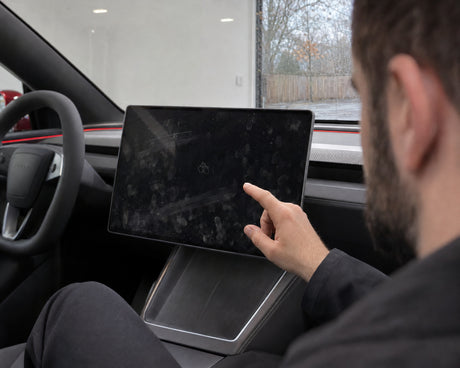
Clean a Tesla screen: what the Model Y touchscreen can take
Daniel von Detailing1 |


Koch-Chemie
Exterior Wash Mitt 640GSM Microfibre Wash Mitt Black + White

INNOVACAR
"Micron Wash Mitt" Microfibre Wash Mitt 1 piece / 18 x 27 cm / Black/White
Double-sided microfibre wash mitt, super absorbent
TUGA Chemie
Wash Mitt (Microfibre) for "Shampoo-Teufel" 1 piece / 16 x 23 cm / White / Turquoise / Pink
Microfibre wash mitt with internal seam for two-bucket hand washing


Dr. Wack "A1"
A1 "Waschhandschuh" Wash mitt (microfibre) 1 piece / 18x29cm / Light blue
Deep pile on both sides for the hand wash — 800 g/m², over 500 ml


Meguiars
Microfiber Wash Mitt with Long Pile for Hand Washing


Meguiars
Paint-friendly microfiber wash mitt for hand washing

Meguiars
Detailing Mitt Wash Glove 1 piece
Versatile Microfiber Cleaning Glove for interior and exterior


GYEON
Q²M WheelMitt EVO microfibre wash mitt for wheels (1250 GSM) Blue / White

GYEON
Q²M Smoothie EVO Microfibre Wash Mitt (1250 GSM) Blue / White
D-CON
Chenille Wash Mitt Microfibre Wash Glove Black
Absorbent, scratch-free, and lint-free chenille wash mitt
D-CON
Chenille Wash Mitt Microfibre Wash Glove Neon yellow
Absorbent, scratch-free, and lint-free chenille wash mitt
D-CON
Chenille Wash Mitt Microfibre Wash Glove Blue
Absorbent, scratch-free, and lint-free chenille wash mitt
The Rag Company
Chenille Microfibre Wash Mitt Blue
Special microfiber blend for efficient and safe cleaning
The Rag Company
Chenille Microfibre Wash Mitt Green
Special microfiber blend for efficient and safe cleaning
The Rag Company
Chenille Microfibre Wash Mitt Red
Special microfiber blend for efficient and safe cleaning


The Rag Company
The Cyclone Ultra Microfibre Wash Mitt Blue
Special microfiber blend for efficient and safe cleaning
The Rag Company
The Cyclone Ultra Microfibre Wash Mitt Black
Special microfiber blend for efficient and safe cleaning
A microfibre wash mitt holds wash solution and carries it across the vehicle's surface. When choosing one, look at how it stays on your hand, how its washing faces are built and how you clean it afterwards. Even similar-looking mitts can have different washing and drying instructions.
A microfibre wash mitt is a textile car-washing tool that slips over your hand. You use it with wash solution on a vehicle you have already rinsed. Its fine fibres pick up liquid and loosened dirt. The cuff, internal seams and outer surface affect how you control it. The material name alone tells you neither whether both sides do the same job nor whether the mitt can go in the washing machine.

Detailing1's tip from the shop: Set aside two separate washing tools for paintwork and wheels, even if both are microfibre. A mitt used on wheels should not go onto the paint afterwards. Assign each tool its own bucket before you start. If your mitts look alike, clearly labelling their storage spots helps keep their jobs separate.
Microfibre and chenille describe different features of a wash mitt, so a model can use fine textile fibres while also having a surface made up of thicker fibre strands.
Colour and shape are the first things you notice. The orange face of the Hybrid Wash Mitt looks different from an evenly fluffy washing surface. Meguiars specifically calls it chenille microfibre. Chenille is therefore not an alternative that necessarily falls outside the microfibre category. Choosing this type means choosing a particular surface structure and its intended use.
The raised fibres are called the pile. Their length and density can vary, but neither gives you a fixed measure of cleaning performance. The wash solution, dirt and handling also need to be right. An especially fluffy surface does not mean you can skip pre-washing or regular rinsing. Trapped particles matter with every construction.
A weight specification only tells part of the story, too. Koch-Chemie lists 640 grams per square metre for the Exterior Wash Mitt. That is the weight of a square metre of textile. It is neither the total weight of the mitt nor a guaranteed water capacity. Avoid comparing this figure in isolation with a mitt whose internal padding or faces are built differently.
For a wider comparison with other washing materials, head to the parent category, wash mitts. Within the microfibre range, look closely at the actual construction. Two products with the same material description can feel quite different when you put them on, turn them over and clean them afterwards. Those differences help you choose for your own wash area and equipment.
A well-fitting microfibre wash mitt stays manageable when loaded with wash solution; its internal division, cuff and outer dimensions each tell you something different about its construction.
The centre seam inside the Exterior Wash Mitt divides the finger area. Together with the elasticated cuff, it is designed to keep the mitt in place. This internal support differs from a loose pouch in which your hand can move freely. Whether the shape feels comfortable still depends on your hand and how you like to hold it. The manufacturer does not specify a fixed hand-size chart for it.
Read dimensions carefully as well. The German manufacturer data gives 26 × 21 cm for the Exterior Wash Mitt. INNOVACAR lists 18 × 27 cm including the elasticated cuff. These figures do not let you rank the exact usable washing area. The direction of measurement and whether the cuff is included affect the comparison; a longer outer edge need not mean more contact area on the paint.
The INNOVACAR mitt also has an absorbent sponge layer inside. That is part of its construction, while both outer faces use soft microfibre. So look beyond the dry fabric. In use, the mitt will be loaded with wash solution. You should be able to hold and place it securely without constantly clenching your hand to keep it where you want it.
Before its first outing, check the washing faces, cuff and seams. Remove any visible foreign material and put damaged tools aside before they touch paint. Slip the dry mitt on and turn it as you would when using the other side. This gives you a feel for whether the cuff is comfortable and the internal support suits your hand.

Two sides on a wash mitt do not automatically mean two functions: some repeat the same washing surface, while others are designed around a specific care system.
INNOVACAR describes soft microfibre on both outer faces of the Micron Wash Mitt. That gives you two sides intended for the same washing job. The internal sponge and elasticated cuff complete the construction. It keeps the choice straightforward: you want a washing tool and do not need to pair a special protection side with a particular shampoo.
The Hybrid Wash Mitt takes a different approach. Its orange chenille-microfibre side handles the wash itself. The grey plush side picks up and spreads the protective ingredients in the matching Hybrid Ceramic Wash & Wax. Here, the colours tell you which side does what. It is more than a difference in appearance.
The protection comes from the product you use. A Hybrid mitt does not turn any shampoo into a sealant. Meguiars also says both faces can be used for cleaning with its other shampoos. The right pairing therefore depends on the shampoo you already have and its instructions. The product name alone does not settle that choice.
First decide whether you want a regular hand wash or the combined wash-and-protect routine described here. Choosing the right car shampoo is part of that decision. Follow its own dosing instructions, rather than judging by the mitt's size or colour. A second face is no substitute for rinsing, either: clean dirt out of the tool instead of merely turning it over.
With the two-bucket method, you rinse the mitt separately from the fresh wash solution, removing collected dirt from the tool before moving on to the next section.
One bucket holds wash solution mixed as instructed; the other holds clean rinse water. Clean the mitt in the rinse bucket before putting it back into the shampoo. Detailer Richard Tipper describes this routine in Porsche's article on hand washing a car. Keeping the buckets separate is intended to stop collected dirt going straight back into your wash solution.
Rinse the vehicle thoroughly before the first contact. Work on cool surfaces and keep out of direct sunlight, as described in the Porsche routine. Then start at the top and work down to the lower sections. A heavily soiled lower panel is a poor starting point for a mitt that still needs to touch the upper paintwork.
Keep the washing face flat against the wet area and clean the mitt regularly. Koch-Chemie's short manufacturer clip shows a hand fully inside the mitt, first in the foam bucket and then on a door and side window. That does not establish a fixed amount of pressure. If residue will not shift, scrubbing harder with dirty material is not the answer; check what suitable pre-cleaning is needed instead.
A dirt guard can be part of the bucket setup. Koch-Chemie refers to regular cleaning against its Bucket-Set, while INNOVACAR recommends its Det Bowl. This accessory does not replace rinsing. You can put together your setup in the wash buckets category. Rinse the mitt even before finishing a large section if it has already picked up noticeable dirt.
Keep wheel-washing tools and water separate. The Porsche feature calls for a dedicated bucket for this area. Do not take a mitt straight from the wheels back onto the paint. Separating jobs is especially useful when several similar-looking wash tools are ready to go: decide which one belongs on which surface before starting.
After the contact wash, rinse shampoo residue thoroughly from the car with clean water, following your shampoo's rinsing instructions. Then pick up the remaining water with a clean microfibre drying towel, as the Porsche routine also describes. Your used wash mitt is not the tool for that job. Clean it to its own manufacturer's instructions and let it dry; the care section explains the differences between hand and machine washing.

When choosing a microfibre wash mitt, verifiable construction details and care instructions are more useful than a blanket ranking based on softness, weight or a single test result.
The Koch-Chemie Exterior Wash Mitt belongs on your shortlist if you value a centre seam, elasticated cuff and transport bag. Make room for hand washing in your routine. The bag is handy for the journey home from the wash area; if you only want a machine-washing routine, factor in that care difference before buying.
The INNOVACAR "Micron Wash Mitt" combines matching microfibre faces, an internal sponge layer and permission to machine wash at up to 30 °C. That is a different set of features, not automatically a higher quality tier. Choose it if it fits your routine. Its dimensions include the cuff, so they describe the outside rather than promising a fit for a particular hand size.
The Meguiars Microfibre Wash Mitt 1 piece also has an independent comparison behind it: AUTO BILD gave it an overall grade of 1.9 in its August 2026 test. Water uptake and glide stood out positively, while cleaning performance was not class-leading. That balance of strengths and limitations is more useful than an unqualified test-winner claim.
The test also sets out its conditions. Scratch testing used a black plastic panel with defined contamination and weight loading. That is a comparative test method, not a guarantee for every vehicle's paint. A good result still calls for clean water and careful rinsing. The grade describes the tested combination and should not be read as a blanket promise for every mitt from the brand.
Choose the Meguiars Hybrid Wash Mitt specifically when you want to use its two sides in the shampoo system described above. Rather than comparing brands alone, match each candidate to the job you actually need it to do. Machine care, internal hand support and coordinated side functions are different reasons to choose a mitt. They will not matter equally at every wash spot.
Microfibre wash mitts have no universal washing temperature or tumble-drying approval, so clean yours according to the specific model's instructions and current label.
Koch-Chemie specifies hand washing at no more than 30 °C for the Exterior Wash Mitt. Tumble drying, ironing and bleaching are ruled out. These instructions appear in the manufacturer's data sheet. The common assumption that every microfibre product can go in the machine at 40 °C does not apply here. Looking like another mitt does not extend its care instructions either.
INNOVACAR, by contrast, permits machine washing at up to 30 °C for the Micron Wash Mitt and recommends its SM Micron Shampoo for cleaning the textile. Do not wash it with other textile types; fabric conditioner, bleach, tumble drying and ironing are also excluded. Fabric conditioner is a laundry additive. If the instructions rule it out, leave it out rather than assuming a softer feel will benefit your washing tool.
Meguiars describes the Microfibre Wash Mitt as machine washable and gives the same care option for the Hybrid Wash Mitt. That does not establish a shared temperature or tumble-dryer setting. Check the current label on the model you receive for those details. Approval for a similarly named mitt or an older pack is no reliable substitute.
After cleaning, the mitt needs to be clean and dry for the next wash. For drying the vehicle itself, use suitable drying towels. Keep these jobs separate in storage too, so you do not mix up a used wash tool with a towel ready for use. There is no substantiated fixed replacement interval after a certain number of washes for the models compared here.
One final distinction matters with the Koch-Chemie model: the waterproof bag protects during transport, but the manufacturer explicitly says not to store the wet mitt inside it. Keep the bag upright on the journey home, then take the mitt out. Aftercare is only finished once the mitt has been cleaned and dried completely. That way, quickly packing up after washing the car does not mean skipping its care.

Too much choice in Microfibre wash mitts? Get help picking:
Add Detailing1 as a preferred source on GoogleA microfibre wash mitt is a textile tool for wet hand washing a vehicle. Its fine fibres hold wash solution and loosened dirt as you guide the washing face with your hand. The name does not define one standard construction: the Meguiars Hybrid Wash Mitt 1 piece, for example, has two sides with different functions.
Use the textile detergent specified by your mitt's manufacturer. INNOVACAR recommends its SM Micron Shampoo and machine washing at up to 30 °C for the "Micron Wash Mitt" 1 piece / 18 x 27 cm / Black/White. Fabric conditioner and bleach are excluded. Car-shampoo dosing instructions are not instructions for cleaning the textile afterwards.
Two washing faces can be built alike, as on the Micron Wash Mitt. On the Hybrid Wash Mitt, they do different jobs: orange handles washing and grey spreads the protective ingredients in the matching Hybrid Ceramic shampoo. The mitt itself contains no sealant. With other Meguiars shampoos, the manufacturer says both sides are suitable for cleaning.
Only explicit approval for the specific model permits tumble drying. Koch-Chemie rules it out for the Exterior Wash Mitt in Black + White / 26x21 cm, as does INNOVACAR for the Micron Wash Mitt. Machine washable does not automatically mean tumble-dryer safe. Check the current label instead of copying another microfibre product's care routine.
Yes. Dirt particles picked up by the mitt can leave marks as contact continues. Pre-rinse the car and regularly clean the mitt in a separate rinse bucket. Even a good test result is no scratch-free guarantee: AUTO BILD used a plastic panel for comparative testing. Use separate washing tools for wheels and paintwork.
Clean the mitt after use, but the machine is not the right route for every model. Koch-Chemie requires hand washing at up to 30 °C for the Exterior Wash Mitt; INNOVACAR permits machine washing at up to 30 °C for the Micron Wash Mitt. Let it dry afterwards, and do not store the Koch-Chemie mitt wet inside its closed transport bag.
Work on cool vehicle surfaces out of direct sunlight. Check the mitt for visible foreign material and damage. Set aside separate washing tools and a dedicated bucket for the wheels.
Mix the wash solution in one bucket according to your car shampoo's instructions. Fill the second with clean rinse water. Do not use one blanket dose for different shampoos.
Rinse the vehicle thoroughly before touching it with the mitt. Then load the clean mitt with wash solution.
Start with the upper sections of the vehicle. Keep the wet mitt's washing face flat against the surface, then work down to the lower areas. Use each side according to your model's instructions.
Clean the mitt regularly in the rinse bucket before loading it with more wash solution. A dirt guard does not replace this rinsing step. Do not use a mitt on paintwork after using it on the wheels.
After contact washing, rinse shampoo residue thoroughly from the vehicle with clean water. Follow your shampoo's rinsing instructions. Pick up the remaining water with a clean microfibre drying towel; the used wash mitt is not intended for this job.
Clean the used mitt according to its care label. Koch-Chemie requires hand washing at up to 30 °C for the Exterior Wash Mitt; INNOVACAR permits machine washing at up to 30 °C for the Micron Wash Mitt. Neither permits tumble drying. Let the mitt dry afterwards and do not store the Koch-Chemie mitt wet in its closed transport bag.
Daniel von Detailing1 |

Daniel von Detailing1 |

Daniel von Detailing1 |

Daniel von Detailing1 |

Daniel von Detailing1 |


Daniel von Detailing1 |

Daniel von Detailing1 |

Daniel von Detailing1 |

Daniel von Detailing1 |

Daniel von Detailing1 |

Daniel von Detailing1 |