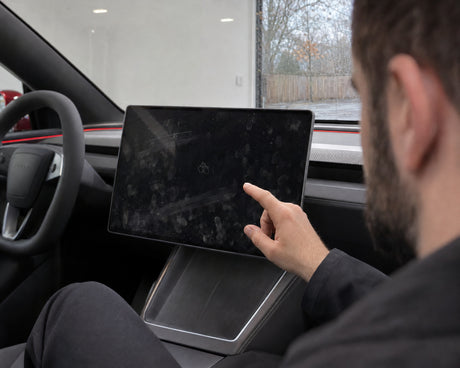
Clean a Tesla screen: what the Model Y touchscreen can take
Daniel von Detailing1 |


Koch-Chemie × COLOURLOCK
COLOURLOCK "Pol Star" cleaner concentrate for fabric, leather & Alcantara
pH-neutral cleaner concentrate for fabric, Alcantara & smooth leather

SONAX
XTREME Upholstery+Alcantara Cleaner (Propellant-Free) Upholstery Cleaner
Upholstery + Alcantara Cleaner — propellant-free, neutralizes odors

SONAX
XTREME Polster+AlcantaraFleckEntferner Upholstery Cleaner
Upholstery + Alcantara stain remover – spot cleaner for fabric

SONAX XTREME Polster+AlcantaraReiniger lifts skin grease without soaking the wheel.
Alcantara cleaners help you loosen dirt on microfibre surfaces approved for treatment. Choose between a concentrate you dilute yourself and a ready-to-use cleaner. Checking the material, using a suitable soft tool and thoroughly removing residue all belong together. Judge whether the surface is clean once it has dried.
An Alcantara cleaner is a cleaning product its manufacturer expressly specifies for Alcantara. This synthetic microfibre material resembles suede, but needs its own compatibility check and suitable care. Surfactants, the active cleaning ingredients, help loosen dirt; a cloth or suitable sponge helps you work the surface and remove residue. The product instructions determine dilution and dwell time. A cleaner replaces neither the vehicle’s care instructions nor damaged or already worn fibres.

Detailing1 practical tip: Calculate your concentrate mix before filling the bottle: at Pol Star’s permitted ratio of 1:10, add 100 ml of cleaner to 1000 ml of water, giving 1100 ml altogether. Choose a clean bottle with enough capacity and label the mixture. Have the cloth for removing residue ready before treating your hidden test area. That settles dilution and aftercare before you tackle the whole seat.
Alcantara is a synthetic microfibre material with a leather-like surface. Its resemblance to suede does not justify using the same care products or assuming any cleaner is suitable.
The name identifies a particular material. In everyday use, other velvety seat coverings are often called Alcantara even when they are another microfibre or genuine suede. Check your vehicle’s specification and care instructions before choosing a product. Similar colour or feel is not enough to tell these materials apart.
A single seat can also combine several materials. The textile centre section, a smooth side bolster and a printed detail may need different treatment. Choose according to the surface you intend to work on. A cleaner’s suitability for Alcantara initially concerns that covering; it does not replace an additional check of the adjoining materials.
The pH value classifies a water-based solution as acidic, neutral or alkaline. The common advice to clean Alcantara only with pH-neutral products is too simplistic. Pol Star is neutral and expressly suitable. SONAX also specifies its pump spray for Alcantara, although the safety data sheet lists pH 9–10. That does not make arbitrary all-purpose cleaners suitable. The particular product, its current instructions and compatibility with your covering remain decisive.
Conventional leather care therefore does not automatically belong on Alcantara after cleaning. Lederzentrum, for example, expressly excludes its Leather Care and Leather Shield products for this material. A product suitable for a neighbouring leather bolster is not suitable for the seat’s centre section simply because they are close together. Separate these care tasks during preparation.
If you also want to clean ordinary fabric upholstery or carpets, the car upholstery cleaners category offers further choices. The wider category expands the selection, not the approved uses of an individual cleaner. For Alcantara, follow the appropriate product application and start with a small hidden test area.
A ready-to-use Alcantara cleaner saves mixing, while a concentrate lets you control dilution and prepare the quantity of cleaning solution needed for each job.
If you want to measure your own dilution, Koch-Chemie × COLOURLOCK "Pol Star" 1000 ml / 1 Liter offers that approach. The cleaner concentrate for textiles and Alcantara is diluted within the specified range according to the dirt. The litre figure refers to the contents of the bottle; it is not the quantity of prepared cleaning solution.
A 1:10 mixture means one part cleaner plus ten parts water. You can therefore combine 50 ml of product with 500 ml of water to make 550 ml of working solution. What matters is that the ratio suits your task and the product instructions. A stronger mixture is no substitute for checking material compatibility.
For a routine without measuring dilution, SONAX XTREME Polster+AlcantaraReiniger (Treibgasfrei) 500 ml is the ready-to-use option. The Alcantara cleaner in a pump spray follows its own instructions. “Treibgasfrei” means propellant-free and describes the packaging type. It does not mean every SONAX can has the same contents or every variant the same application.
For Pol Star, Koch-Chemie describes a short dwell time without specifying a fixed number of seconds. The named SONAX pump spray, by contrast, specifies 5–10 minutes. Do not transfer a time from another cleaner or an old tip for different packaging to your product. Leaving a cleaner on longer does not replace removing the dirt afterwards either.
In a Trusted Shops review for Pol Star, one buyer describes the concentrate as economical in use. That is one person’s experience, not a fixed promise about how many seats you can clean. The actual dilution and surface area help you plan. Compare further products you can dilute yourself under upholstery cleaner concentrates.

A soft tool suitable for the particular surface supports gentle cleaning, while the label “leather brush” alone does not establish suitability for Alcantara.
Loose dust does not always require cleaner straight away. For regular care, Alcantara specifies a soft brush, a dry cloth or a vacuum cleaner. Choose a suitable attachment or nozzle and work carefully. If dry care removes the existing dust, an additional wet-cleaning step is not automatically necessary for that task.
For occasional damp care, the material manufacturer recommends a lightly dampened white cotton cloth. Printed cloths or printed kitchen paper can transfer colour and are therefore poor choices. When cleaning with a particular product, its tool requirements also apply. Pol Star, for example, describes gentle work with a sponge or microfibre cloth in the main direction of the fibres.
Do not use an existing leather brush simply because of its name. Check which materials it is intended for and whether its bristles suit the delicate surface. Start out of sight and avoid vigorous scrubbing. Without suitable tool compatibility, a brush from another care task is not a dependable shortcut. Use a suitable soft cloth or the specified sponge as directed.
Separate working the cleaner in from removing residue. A cloth already holding visible loosened dirt needs changing or rinsing as you continue. With SONAX, repeatedly rinsing the damp cloth is part of the finishing process. Continuing to drag a dirty cloth face across the covering will not help you judge whether residue remains.
On a steering wheel, compare the proposed method especially carefully with the vehicle instructions. This is a fixed grip surface with adjoining components, not a removable seat cover. The cleaners for Alcantara steering wheels selection keeps that task separate. Washing-machine instructions for removable covers do not apply to the steering-wheel rim.
Blot a freshly spilled liquid first. Planned surface cleaning, by contrast, follows the product instructions evenly and then removes loosened residue from the covering.
With a fresh spill, the first priority is containing the contamination. Absorb excess liquid with a clean, absorbent cloth instead of spreading it by rubbing hard. Alcantara’s stain guidance calls for working from the outer edge towards the centre. Check the kind of residue before turning a single stain into a large wet-cleaning job.
For the surface cleaning itself, aim for an evenly treated area. SONAX recommends continuous surfaces and controlled application for its pump spray. One seat section gives you a manageable area. Keep the dose and movement even within it and watch the transitions to other materials. More visible foam is not, on its own, evidence of better cleaning.
Check colourfastness and compatibility beforehand in an inconspicuous place. That applies even when the cleaner expressly names Alcantara. You still do not know what previous treatment or repairs the covering may have had. If the test area changes undesirably, do not simply continue over the whole seat.
An old, unidentified stain is harder to diagnose. Discolouration, an attached residue and surface damage are different problems. The stain removers for Alcantara category addresses this more specific task. Individual product suitability still applies; a product name alone promises no solution for every stain type and every history.
Wanting a quick result should not lead to mixing assorted household remedies. Follow the specific product instructions instead of combining glass cleaner, shaving foam or an arbitrary stronger cleaner by feel. If the checked method brings no clear improvement, professional assessment is more useful than increasing pressure, concentration or repeated treatment of the same spot.

You can meaningfully assess Alcantara cleaning only once the covering is fully dry, because moisture and the position of its fine fibres alter its appearance.
Include drying in your plan. An area just wiped with a damp cloth is not yet a reliable guide to whether colour and texture look even. Alcantara recommends gentle brushing with a soft brush after drying. This is careful finishing work, not a reason to scrub stubbornly at a noticeable patch.
A fixed waiting time for every vehicle would be inaccurate. Moisture introduced, covering construction and ambient conditions vary. Do not use the cleaner’s dwell time as the seat’s drying time. The stated 5–10 minutes for the SONAX pump spray belong to cleaning before removing residue with a cloth; the job is not automatically complete afterwards.
Do not try to speed things up with intense local heat. Lederzentrum advises against hairdryers, direct sunlight and maximum seat heating on damp Alcantara. Steam is not a general recommendation from the material manufacturer either. A method in a video does not replace these limits, even if the covering shown initially looks similar.
If the surface still looks unusual after controlled cleaning, drying and gentle finishing, the cause may go beyond removable dirt. Cleaner will not regrow missing or worn fibres. Nor is a hard, shiny patch sufficient reason to use sandpaper or a more aggressive cleaner. A specialist can help assess unexplained changes more precisely.
For genuinely removable Alcantara covers, the manufacturer describes machine washing at around 30 °C with mild detergent and no spin cycle. This requires a suitable removable cover and must agree with the vehicle or cover instructions. It does not make an installed car seat machine-washable; its components and overall construction remain a different task.
A textile sealant is an optional, separate care step for suitable clean, dry coverings. It neither replaces cleaning nor belongs on every grip surface.
If you are considering additional protection after cleaning, first clarify its intended use. Koch-Chemie × COLOURLOCK Allround Textile Sealant "St0.01" Premium Textilversiegelung 500 ml is one such follow-on option. Lederzentrum also mentions the textile sealant for suitable coverings in connection with Alcantara. It is a protective treatment, not another cleaner for remaining stains.
The manufacturer requires the surface to be clean, fully dry and free of product residue before application. Only then is the treatment spread thinly and evenly with a suitable sponge. Protect adjoining surfaces and allow the sealant itself to dry fully afterwards. A seat merely wiped on the surface and still damp does not meet these preparation requirements.
The grip limitation is particularly important: Koch-Chemie excludes surfaces where slipperiness is undesirable. This selection therefore offers no recommendation to seal an Alcantara steering wheel. Displays and polycarbonate are also outside the intended surfaces. A general reference to textiles must not override these specific restrictions.
The cleaner choice remains independent of that. If you want to work without mixing, the expressly suitable SONAX pump spray fits that routine. If you want to prepare your own solution within a specified range, Pol Star is the concentrate option. Both need correct application; an additional protective product cannot retrospectively make unsuitable cleaning safe for the material.
Finish cleaning with a dry inspection rather than another bottle on spec. If the covering is clean and unchanged, you can decide on suitable protection. If questions remain about its surface or grip, resolve them first. That keeps care tied to the actual condition of your Alcantara and the task still outstanding.

Too much choice in Alcantara cleaner? Get help picking:
Add Detailing1 as a preferred source on GoogleAlcantara is a synthetic microfibre material that resembles suede in appearance and feel. According to its manufacturer, it consists of polyester and polyurethane. Follow the specific material and vehicle care instructions. Leather care is not automatically suitable, and similar-looking coverings from other brands must not receive the same treatment without checking.
Remove loose dust first and test the cleaner and tool in a hidden area. Use an expressly suitable product according to its dilution and application instructions. Work gently, then remove loosened residue with a clean damp cloth. Avoid hard rubbing and unnecessary soaking; assess the covering only once fully dry.
A ready-to-use cleaner such as SONAX XTREME Polster+AlcantaraReiniger (Treibgasfrei) 500 ml needs no dilution. COLOURLOCK "Pol Star" is a concentrate mixed with water between 1:5 and 1:20 according to the task. Choose by routine and material compatibility. Neither format replaces a preliminary test or thorough residue removal.
The name leather brush alone does not establish suitability for Alcantara. Check its intended materials and the cleaner’s tool guidance. Alcantara specifies a soft brush for dry care; Pol Star describes gentle work with a sponge or microfibre cloth. Test out of sight, avoid strong pressure and do not assume one brush suits every covering.
The material manufacturer allows suitable removable Alcantara covers to be washed at around 30 °C with mild detergent and no spin cycle. Air-dry afterwards and gently use a soft brush. Also check the vehicle or cover instructions. These washing directions do not generally apply to installed seats, steering wheels or other fixed components.
Let the covering dry fully, then gently brush it with a soft brush as the material instructions allow. Moisture and fibre direction can alter its appearance. If the patch remains noticeable, distinguish dirt from wear and seek specialist advice when unsure. More pressure, sandpaper or stronger cleaner is not a general solution.
Establish whether the seat surface is genuinely Alcantara and what care the vehicle specifies. Gently remove loose dust with a suitable vacuum, dry cloth or soft brush. Absorb fresh liquid first without spreading it through hard rubbing.
Check the cleaner and tool in an inconspicuous area for unwanted changes. Use a ready-to-use cleaner as instructed or dilute a concentrate at the specified ratio. Product suitability does not replace testing on the actual covering.
Treat a manageable continuous area according to the product instructions using a suitable soft tool. Avoid unnecessary soaking and vigorous scrubbing. Dilution and dwell time remain product-specific; do not transfer timings to other cleaners.
Remove dirt and cleaning residue with a clean damp cloth as the product specifies. Rinse the cloth accordingly or switch to a clean face. Do not simply leave loosened residue to dry in the covering.
Allow the covering to dry fully, then gently brush with a soft brush according to material guidance. Avoid intense local heat and assess the dry result. Seek specialist advice for persistent unexplained changes instead of increasingly aggressive treatment.
Daniel von Detailing1 |

Daniel von Detailing1 |

Daniel von Detailing1 |

Daniel von Detailing1 |

Daniel von Detailing1 |


Daniel von Detailing1 |

Daniel von Detailing1 |

Daniel von Detailing1 |

Daniel von Detailing1 |

Daniel von Detailing1 |

Daniel von Detailing1 |