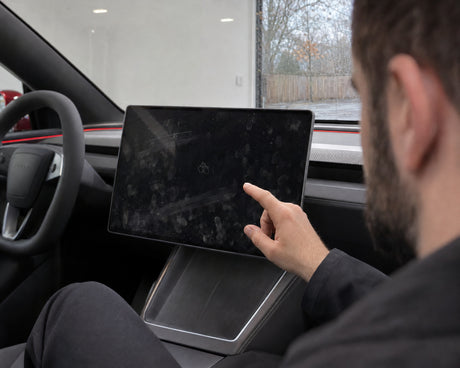
Clean a Tesla screen: what the Model Y touchscreen can take
Daniel von Detailing1 |


Koch-Chemie
Green Star "Gs" Universal Cleaner
Highly alkaline APC concentrate for workshops, engine bays and lifts
Koch-Chemie × COLOURLOCK
COLOURLOCK "Pol Star" cleaner concentrate for fabric, leather & Alcantara
pH-neutral cleaner concentrate for fabric, Alcantara & smooth leather
Koch-Chemie
Multi-Purpose Cleaner "Mzr" All-Purpose Cleaner
Alkaline cleaner concentrate with pH 12.5 and Daimler approval

SONAX
XTREME Upholstery+Alcantara Cleaner (Propellant-Free) Upholstery Cleaner
Upholstery + Alcantara Cleaner — propellant-free, neutralizes odors
Get loose dirt out before the cleaner pushes it into the fibres.


Meguiars
FOAMING FLOORMAT and Carpet Cleaner for Car Mats & Carpets
Textile cleaners for a perfect finish

GYEON
Q²M FabricCleaner Textile Cleaner
Textile Cleaner – deep acting for seats, carpets, headliners


Soft99
Fabric Seat Spot Remover stain remover
Efficient stain remover for textile surfaces


Soft99
Fabric Seat Cleaner Upholstery Cleaner
Revolutionary deep cleaning for car fabric covers

SONAX
XTREME Polster+AlcantaraFleckEntferner Upholstery Cleaner
Upholstery + Alcantara stain remover – spot cleaner for fabric

Pol Star lifts hand oils and jeans dye off pigmented seats

Message us on WhatsApp, from Alcantara to plastics.
Car upholstery cleaners loosen dirt in seat fabrics and carpets approved for their use. Here you can choose ready-to-use foam or concentrates you dilute yourself. What matters is your material, the right dilution and removing residue afterwards. Alcantara needs explicit product suitability.
A car upholstery cleaner is a cleaning product for textile covers and carpets. Its surfactants, the active washing ingredients, help loosen dirt. You then need to remove dirt and cleaning residue from the fabric with a clean damp cloth or a suitable machine. Dilute a concentrate as its manufacturer directs, or use a ready-to-use product directly. Suitability for your seat fabric and the intended method decide which option fits.

A practical tip from Detailing1: Have a clean cloth ready for removal before spraying. Work evenly across a complete section of the seat, rather than making just the stain wetter and wetter. With SONAX XTREME Polster+AlcantaraReiniger (Treibgasfrei) 500 ml, remove residue after the specified 5–10 minutes using a damp cloth that you rinse repeatedly. Judge the result once dry before deciding on another pass.
A suitable cleaner matches your seat material and the intended method; a low pH alone does not replace that specific suitability.
Fabric, Alcantara and leather can sit side by side in one seat. Start with the vehicle's care instructions and identify the area you actually want to clean. Approval for textile upholstery does not automatically extend to every leather side bolster. Even with a familiar product, test a hidden area first: the colour and surface should remain unchanged after treatment.
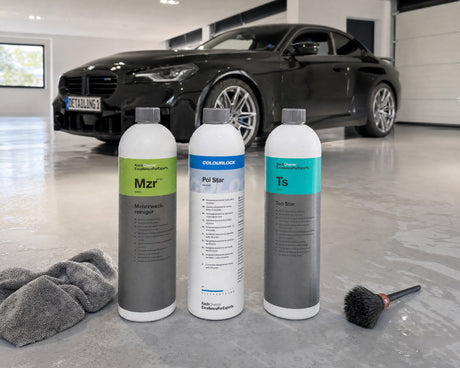
COLOURLOCK "Pol Star" as a 1-litre concentrate is a suitable starting option for cleaning textiles and Alcantara according to their specific material approval. It is pH-neutral, at pH 7. That gives you a clear chemical classification first; suitability comes from the manufacturer's stated use. Apply the solution in a controlled amount and remove it afterwards.
The SONAX pump spray makes a useful comparison: its safety data sheet lists pH 9–10, yet SONAX explicitly specifies it for Alcantara. “Only pH-neutral products can go on Alcantara” would therefore be a false general buying rule. Equally, a neutral value does not mean every leather or delicate interior surface can be treated without testing. Product description, method and fabric must match.
Only looking after that fine, suede-like fabric? The Alcantara cleaner selection helps settle the material question before dilution. With unfamiliar upholstery, start with the vehicle instructions. A stronger cleaner does not solve uncertainty about material suitability. This matters especially when nearby surfaces or older repairs could come into contact with the cleaning process.
A ready-to-use cleaner removes the mixing step, while a concentrate lets you prepare the solution needed for your job within the manufacturer's dilution instructions.
If you occasionally clean a seat and do not want to mix a solution, a ready-to-use product fits that routine. SONAX XTREME Polster+AlcantaraReiniger (Treibgasfrei) 500 ml dispenses foam from a pump spray. “Treibgasfrei” means propellant-free and describes the packaging. It establishes neither a particular cleaning performance nor that the product is identical to every other SONAX format.
A concentrate needs more preparation but gives you a specific dilution choice. Koch-Chemie specifies 1:5 to 1:20 for Pol Star: one part product to five to twenty parts water. At 1:10, for example, add 50 ml cleaner to 500 ml water to make 550 ml solution. Use a suitable bottle with enough capacity and clearly record the mixture you chose.
The calculation tells you how much working solution you have. It does not tell you how many car seats you can clean. Area, dirt, fabric and application vary too much for that. In a Trusted Shops review for Pol Star, a buyer praises how far it goes. That is one product experience; your planning should still follow the intended dilution and the job.
For a focused comparison, browse upholstery cleaner concentrates. Compare the method too: Green Star specifies 1:10 to 1:20 for interior and textile cleaning, while Mehrzweckreiniger Mzr gives a general range of 1:5 to 1:50. These ranges belong to their products. A mix suited to another cleaner or an exterior surface is not a universal recipe for seats.
Prepare only a sensible amount for the planned task and follow the product's storage instructions. More concentrate in the bottle does not automatically improve the result. It first changes the dilution, and therefore the conditions under which you judge material compatibility and residue removal. The instructions are a better guide than the amount of foam.

When cleaning by hand, thorough vacuuming first, a hidden-area test and removal of loosened residue work together to remove loosened dirt and leave a clean surface.
Vacuum loose crumbs and dust first. That stops you working them further into the fabric when it is dampened. Then test colourfastness and compatibility in an inconspicuous area. For a fresh spill, absorb it first instead of rubbing hard and spreading it wider. Especially on delicate fabrics, distinguish a fresh mishap from a planned full-area clean.
Follow your chosen product for the cleaning itself. For the propellant-free XTREME cleaner, SONAX describes light dampening, working the foam in evenly and treating the whole connected area. Keep dwell time and moisture under control. A seat need not be soaked deep down for its surface to be cleaned. Watch the fabric as you work and avoid unnecessary pressure.
After this SONAX product's specified 5–10 minutes, remove residue with a clean damp cloth and rinse it repeatedly. Pol Star instead describes a short dwell without a general fixed number of minutes. Do not carry the timing or amount applied from one bottle over to the other. The complete method for the selected cleaner is what counts.
A cloth that has picked up dirt should not transfer it to the next section. Switch to a clean face or rinse the cloth as instructed. Finish connected areas evenly. This is a sensible way to reduce uneven transitions, not a guarantee that every old water mark or discolouration will disappear completely.
Finally, the fabric needs time and air to dry. How long it takes depends partly on the moisture introduced and the conditions around the car. Plan the clean for a time when you will not need the seat straight away. One fixed number of hours for every material would be unreliable. A stronger scent does not tell you whether the upholstery is dry either.
In spray extraction, a suitable cleaning machine introduces liquid into an approved fabric and extracts it again, rather than simply collecting dry dust.
This method can make sense for a more thorough area clean, but it needs the right combination of machine, cleaner and material. Searches for “upholstery cleaner” can mean the liquid or the machine. This selection covers cleaning products. A bottle does not replace an extractor, and an ordinary dry vacuum must not simply be used to pick up cleaning liquid.
Check the machine instructions for suitable products and doses. Koch-Chemie additionally specifies a defoamer when its cleaners are used with relevant machines. This controls foam in the intended system. Use it as directed, not as permission to fill any tank with any high-foaming cleaner. Your upholstery must still be approved for the method.
Koch-Chemie Mehrzweckreiniger "Mzr" 1000 ml / 1 Liter is an option for alkali-resistant textiles. Alkaline means a pH above the neutral range; Mzr's product data sheet lists pH 12.5. This classification helps you take the alkali-resistant material requirement seriously. It is not an instruction to use it across Alcantara or leather in general.
Koch-Chemie Green Star "Gs" 1000 ml / 1 Liter also has a specifically described interior and textile application. For that use, the manufacturer gives 1:10 to 1:20, followed by residue removal with a damp cloth or suitable wet vacuum. Do not work on hot surfaces or let it dry on. A broad all-purpose application does not establish suitability for every delicate fabric.
The practical question stays the same after every pass: have you removed enough of the liquid you put in? A full tank of dark dirty water does not prove a specific percentage of cleaning performance. Judge the fabric, the clean working process and later the dry result instead. If you cannot reliably establish material or machine suitability, a professional assessment is more useful than trying more water.

Alcantara needs explicitly suitable cleaning with little moisture and gentle working; a cleaner cannot rebuild worn fibres.
The material manufacturer recommends gentle care and warns against vigorous rubbing. A lightly dampened white cloth also avoids the risk of dye transfer from a printed cloth. For stain treatment, absorb fresh residue first. Do not simply pour cleaner onto the material. Controlled work matters, not covering the whole seat in as much visible foam as possible.
Steam is not a general shortcut for Alcantara: its manufacturer does not recommend steam machines. Nor should you use a stiff brush just because it helped on a robust carpet. Browse COLOURLOCK textile and Alcantara cleaners for suitable product types. Then match the exact method to your fabric.
If a mark remains visible after cleaning, it may be a material change as well as remaining dirt. Worn fibres, damaged colour or an older repair cannot be undone with unlimited cleaning passes. That is why checking after drying belongs in the process. Only then can you sensibly judge whether another material-appropriate pass is warranted.
Keep the same distinction with odours. Removing visible dirt is a specific task; fragrance is not proof that the cause has gone. Look for spilled residue and damp areas instead of adding more scent. If the problem remains despite a clean, dry surface, investigate the cause. The term upholstery cleaner does not establish a general disinfection or odour-free guarantee.
The right choice combines material suitability with your method, so you start with an appropriate product and judge the result reliably only once fully dry.
If you want to work without mixing on approved textiles or Alcantara, the SONAX pump spray is a clear option. If you want to dilute a solution yourself for these materials, include Pol Star in the comparison. Mzr and the described Green Star application fit the discussion for explicitly alkali-resistant textiles. Choose by fabric and method, not bottle size alone.
A general test winner cannot make that decision for you. Comparison tests examine particular products and variants under set conditions. Their results do not automatically transfer to another packaging format or every type of dirt. For your seat, current instructions are more useful: which surface is approved, what dilution applies, and how should residue be removed?
Good car upholstery cleaners belong in a complete, manageable job. Identify the material, dilute appropriately, clean with control, remove loosened dirt and allow enough drying time. The most important final step needs no more cleaner: look at the dry fabric. Then decide from the actual result instead of treating a still-damp area again too soon.

Too much choice in Upholstery cleaner? Get help picking:
Add Detailing1 as a preferred source on GoogleUse a cleaner approved for your particular seat fabric. Upholstery cleaners loosen dirt, then a clean damp cloth or suitable machine removes the residue. Fabric, Alcantara and leather need different approvals. Check the vehicle instructions too, and test the product in a hidden area first.
Vacuum loose crumbs and dust and test compatibility in a hidden area. Apply the suitable cleaner with control as instructed, working evenly across connected sections for an area clean. Remove dirt and residue with a clean damp cloth or suitable machine. Let the fabric dry fully before judging the result.
Choose by fabric and method. SONAX XTREME Polster+AlcantaraReiniger (Treibgasfrei) 500 ml is ready to use; dilute COLOURLOCK "Pol Star" as instructed. Both are approved for Alcantara. Suitable alkaline cleaners are an option for alkali-resistant textiles. A test win for one variant replaces neither current material approval nor checking your application.
Use only cleaners and doses suited to both your machine and the seat fabric. Approval for cleaning by hand is not automatically enough. Koch-Chemie additionally specifies a defoamer for relevant machine use. Follow both instructions and collect liquid only with suitable equipment, never an ordinary dry vacuum.
Dwell time depends on the product. For XTREME Polster+AlcantaraReiniger (Treibgasfrei) 500 ml, SONAX specifies 5 to 10 minutes after working it in, then removal with a damp cloth. Pol Star describes a short dwell without a fixed number of minutes. Do not apply one timing to other cleaners.
One part concentrate to ten parts water means, for example, 50 ml cleaner plus 500 ml water. This makes 550 ml solution and needs a bottle of sufficient size. Choose this ratio only when the product instructions and job allow it. The volume does not establish a fixed number of cleanable seats.
Use vehicle and product instructions to establish whether the cleaner is intended for your fabric. Thoroughly vacuum loose crumbs and dust. Absorb fresh spills first without rubbing them over a wider area.
Test colourfastness and compatibility in an inconspicuous area. Use a ready-to-use product as instructed or mix a concentrate at the specified ratio. Another product’s dose is not a universal instruction.
Apply according to the specific instructions. Treat connected areas evenly and avoid needless soaking or heavy pressure on delicate fabrics. Follow the chosen product’s dwell time; there is no universal number of minutes.
Remove residue with a clean damp cloth and rinse it repeatedly as the product instructions direct. Use only equipment explicitly suited to liquids. This hand-cleaning guide does not replace an extractor’s instructions.
Provide ventilation and let the fabric dry fully before using it again and judging the result. Drying time depends on fabric, moisture and conditions. Unlimited cleaning passes cannot fix remaining material damage.
Daniel von Detailing1 |

Daniel von Detailing1 |

Daniel von Detailing1 |

Daniel von Detailing1 |

Daniel von Detailing1 |


Daniel von Detailing1 |

Daniel von Detailing1 |

Daniel von Detailing1 |

Daniel von Detailing1 |

Daniel von Detailing1 |

Daniel von Detailing1 |